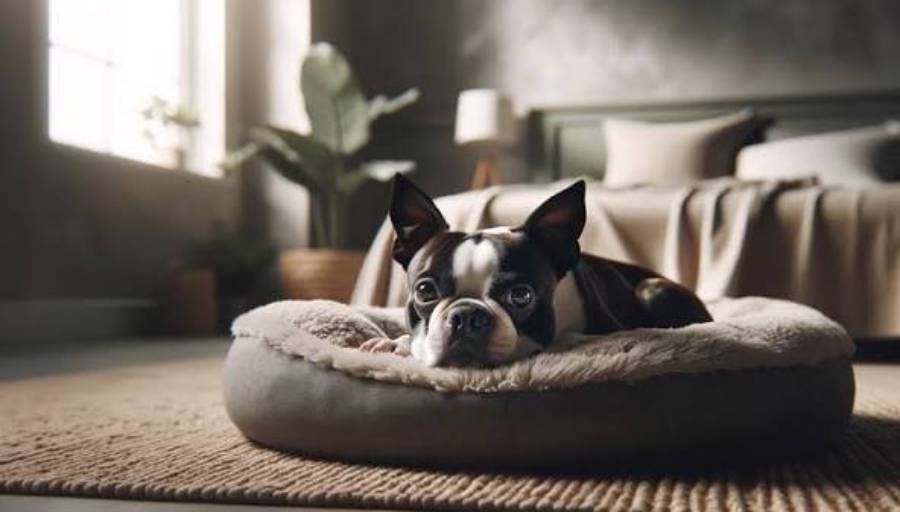
Boston Terriers can be left alone for limited periods, but they should not routinely spend an entire day without human interaction or a bathroom break. A healthy, well-trained adult Boston Terrier generally tolerates being alone better than a puppy because an adult has greater bladder control and is more likely to have an established daily routine. Puppies require shorter periods alone because they need more frequent bathroom breaks, feeding, supervision, and gradual training.
How well a Boston Terrier handles time alone also depends on temperament, previous training, exercise, and the home environment. Boston Terriers are companion dogs that tend to form close relationships with their owners, so some individuals become distressed when left alone for longer than they can comfortably tolerate. Persistent barking, pacing, destructive chewing, house-soiling, or attempts to escape can indicate that the dog is struggling rather than simply resting while its owner is away.
The appropriate amount of alone time therefore differs between puppies, adults, and senior dogs. Owners should consider both the length of the absence and how their individual dog responds to it. This guide explains how long Boston Terriers can be left alone, whether 8 hours is too long, signs of separation anxiety, and how to train and prepare a Boston Terrier for time home alone.
Can Boston Terriers Be Left Alone?
Boston Terriers can be left alone for several hours when they are healthy, comfortable at home, and gradually trained to tolerate their owner’s absence. Their ability to stay alone depends on age, temperament, previous training, daily routine, and whether their physical and social needs have been met before the owner leaves.
Boston Terriers were developed primarily as companion dogs, so human interaction is an important part of their daily life. A Boston Terrier that follows its owner from room to room or enjoys frequent physical contact is not necessarily unable to stay home alone. The important distinction is whether the dog can settle, sleep, play with an enrichment toy, and remain relaxed after the owner leaves. A dog that remains calm has learned that separation is temporary and predictable.
Previous experience also affects how a Boston Terrier responds to being alone. A dog that has gradually practiced short periods of separation is more prepared for a longer absence than one that suddenly goes from constant companionship to several hours alone. For example, an owner working from home every day should not assume that an adult Boston Terrier will immediately adjust to a five-hour absence simply because the dog is physically capable of waiting that long.
Physical preparation matters as well. A Boston Terrier that has exercised, had a bathroom break, eaten according to its normal schedule, and received mental stimulation is more likely to settle while alone. In contrast, an energetic dog left without exercise or an opportunity to eliminate may become restless, vocal, or destructive. These behaviors can result from unmet needs and should not automatically be classified as separation anxiety.
How Long Can Boston Terriers Be Left Alone?
A healthy adult Boston Terrier may tolerate several hours alone, while puppies need substantially shorter periods because their bladder control, training, and independence are still developing. There is no single safe number of hours that applies to every Boston Terrier. Age establishes an important starting point, but health, toilet habits, behavior, and previous alone-time training determine the practical limit for an individual dog.
Alone time should also be measured by the dog’s ability to remain comfortable, not only by how long it can physically avoid urinating. A Boston Terrier might physically make it through a long absence yet spend part of that period barking, pacing, or waiting anxiously near the door. Conversely, a well-adjusted adult may spend much of a shorter absence sleeping. Owners can use a pet camera to observe what actually happens after they leave rather than assuming that the absence is comfortable because no damage or toilet accident occurs.
How Long Can a Boston Terrier Puppy Be Left Alone?
Boston Terrier puppies should be left alone for shorter periods than adults and introduced to alone time gradually. Young puppies require frequent bathroom opportunities, meals, supervision, social interaction, and sleep. Their daily needs make a full workday without a caregiver inappropriate even when the puppy is confined in a crate or playpen.
The amount of time should increase as the puppy develops bladder control and becomes comfortable with separation. Training can begin with very short departures, such as leaving the puppy in a safe area while the owner moves to another room. The owner can then progress to briefly leaving the home and extend the duration as long as the puppy remains comfortable. This approach teaches independence without making a long absence the puppy’s first experience of being alone.
Bathroom needs create a separate limitation. A puppy that needs to eliminate cannot simply be expected to wait because its owner is working. If the required absence exceeds the puppy’s current toilet routine, the owner should arrange a bathroom break through a household member, pet sitter, or other appropriate caregiver.
How Long Can an Adult Boston Terrier Be Left Alone?
Adult Boston Terriers generally handle longer periods alone than puppies, but their comfortable limit depends on routine, training, health, and individual temperament. An adult with established house training and positive experience of owner departures has fewer practical limitations than a young puppy, but this does not mean it should regularly spend most of the day alone.
A suitable routine combines alone time with bathroom access, exercise, mental stimulation, and social interaction. For example, an adult Boston Terrier that receives a walk and bathroom break before its owner leaves may settle and sleep during part of the morning. A dog walker or caregiver can provide another bathroom opportunity and interaction when the owner must remain away for a longer workday.
Senior Boston Terriers need an individual assessment rather than automatically following an adult schedule. Aging can change mobility, bladder control, sleep patterns, and health needs. A senior that previously stayed comfortable for several hours may therefore require more frequent bathroom breaks or supervision as it gets older.
The practical limit is reached when the duration starts interfering with the individual Boston Terrier’s physical or behavioral needs. Repeated toilet accidents, persistent vocalization, destructive behavior, pacing, or distress associated with departures are reasons to shorten the absence and identify the underlying problem rather than simply expecting the dog to adapt.
Can Boston Terriers Be Left Alone for 8 Hours?
Boston Terriers should not routinely be left alone for 8 hours without a bathroom break, exercise, or human interaction. Some healthy, house-trained adult Boston Terriers may physically tolerate an occasional longer absence, but physical bladder control does not mean that 8 hours of isolation is appropriate for every dog. Puppies, senior dogs, and Boston Terriers with health or behavioral problems generally require more frequent attention.
An 8-hour work shift can also result in more than 8 hours alone. Commuting, errands, and unexpected delays may extend the owner’s absence to 9 or 10 hours. During that period, the Boston Terrier has limited opportunities to eliminate, exercise, interact with people, or receive new mental stimulation. Making this schedule a daily routine can therefore create both practical and behavioral problems.
There is also an important difference between an occasional long absence and a repeated schedule. A well-adjusted adult Boston Terrier that spends 8 hours alone on an unusual day may cope differently from a dog experiencing the same absence five days per week. Owners should evaluate the entire weekly routine, including how much exercise, companionship, training, and enrichment the dog receives when they are home.
A midday break is a practical solution when an owner regularly works a full day away from home. A dog walker, pet sitter, trusted family member, or other caregiver can provide a bathroom opportunity, movement, and social interaction. Dog daycare is another option for suitable dogs, although it is not necessary or appropriate for every Boston Terrier.
Owners should also observe their individual dog rather than treating 8 hours as a universal threshold. A pet camera can reveal whether the Boston Terrier settles after departure or spends extended periods barking, pacing, scratching doors, or showing other signs of distress. The dog’s behavior provides more useful information about its tolerance than the absence of household damage alone.
Do Boston Terriers Get Separation Anxiety When Left Alone?
Boston Terriers can develop separation anxiety or other forms of separation-related distress when left alone, but not every Boston Terrier experiences this problem. Being a companion-oriented breed does not automatically mean an individual dog has separation anxiety. The condition involves distress associated with separation from an attachment figure and should be distinguished from boredom, insufficient exercise, incomplete house training, and other behavioral or medical problems.
Signs associated with separation distress can include persistent barking or howling, pacing, destructive behavior, scratching or chewing around doors and windows, house-soiling, and attempts to escape. The timing of these behaviors matters. Destruction that repeatedly begins around an owner’s departure provides different information from chewing that occurs at unrelated times because a young dog is bored or has access to inappropriate objects.
House-soiling also requires context. A Boston Terrier that urinates indoors after being left beyond its normal bathroom schedule may simply have been unable to wait. A puppy may have an accident because house training is incomplete. Repeated elimination associated specifically with owner departures, especially when accompanied by vocalization, pacing, or escape behavior, deserves closer attention.
Boredom can produce behaviors that resemble separation problems. A Boston Terrier receiving insufficient physical exercise or mental stimulation may chew objects, investigate trash, or find other activities while alone. Increasing appropriate exercise and enrichment may improve boredom-related behavior, whereas a dog experiencing genuine separation distress may remain anxious despite having toys available.
Owners can gather useful information by recording the Boston Terrier during departures. The recording can show when a behavior starts, how long it continues, whether the dog settles, and which behaviors occur together. For example, a dog that begins pacing and vocalizing shortly after its owner leaves and repeatedly attempts to reach an exit presents a different pattern from a dog that sleeps for several hours and later chews an accessible household item.
Severe or persistent distress should not be addressed simply by extending the absence until the Boston Terrier “gets used to it.” Training should instead keep separation within a duration the dog can tolerate and increase that duration progressively. Cases involving intense panic, self-injury, repeated escape attempts, or persistent inability to remain alone require professional assessment rather than relying solely on home-management strategies.
What Happens If a Boston Terrier Is Left Alone Too Long?
Leaving a Boston Terrier alone longer than it can comfortably tolerate can lead to toilet accidents, excessive barking, destructive behavior, restlessness, and separation-related distress. The specific response depends on why the period is too long. Physical needs can cause one set of problems, while boredom or anxiety can produce different behaviors.
Toilet accidents are one of the most direct consequences of an excessive absence. A Boston Terrier has a limit to how long it can comfortably wait for a bathroom break, and that limit varies with age, health, routine, and individual bladder control. Puppies generally reach this limit sooner than healthy adults, while senior dogs may need increasingly frequent bathroom opportunities. An accident caused by an excessively long absence should not automatically be treated as a house-training failure.
Insufficient activity can also lead to restlessness and destructive behavior. Boston Terriers need opportunities for physical movement, interaction, and mental stimulation as part of their daily routine. A dog left with unused energy and little appropriate enrichment may redirect that energy toward chewing furniture, investigating household objects, or repeatedly seeking stimulation around the home. In this situation, the sequence is straightforward: insufficient activity increases restlessness, and restlessness increases the likelihood that the dog creates its own activity.
Persistent barking or whining can develop for several reasons. A Boston Terrier may vocalize in response to outside noises, frustration, boredom, or distress caused by separation. The duration and context help distinguish these possibilities. A few barks at a person passing a window are different from sustained vocalization that starts shortly after the owner leaves and continues alongside pacing or attempts to escape.
Repeated excessive absences can also make an unsuitable routine harder for the dog to manage. For example, leaving a Boston Terrier alone until it becomes highly distressed gives the dog repeated experiences in which owner departure predicts an uncomfortable period. Owners should respond to recurring signs of distress by reducing the difficulty of the absence and addressing its cause rather than waiting for the behavior to disappear on its own.
How Can You Train a Boston Terrier to Be Left Alone?
Train a Boston Terrier to stay alone by starting with short, manageable separations and gradually increasing their duration while the dog remains calm. The objective is to teach the Boston Terrier that owner departures are predictable, temporary, and safe rather than immediately testing how many hours the dog can tolerate.
Start by creating a secure area where the Boston Terrier already feels comfortable. Depending on the individual dog, this may be a dog-proof room, playpen, gated area, or crate for a dog that has already been positively crate-trained. Include an appropriate resting place and access to water where suitable. Remove electrical cords, unsafe foods, small objects, and other items the dog could chew or swallow.
Next, practice separation while remaining at home. Ask the Boston Terrier to settle in its safe area and briefly move out of sight. Return while the dog is still comfortable rather than deliberately waiting for intense barking or panic. Repeating calm, short separations establishes the basic behavior before the owner begins practicing actual departures from the house.
Progress to brief departures once the Boston Terrier can relax without constant visual contact. Leave the home for a short period and observe the dog when possible with a camera. The important measurement is not merely whether the dog avoided damaging anything. Look for relaxed behaviors such as lying down, sleeping, calmly interacting with an enrichment item, or changing resting positions without persistent attention to the exit.
Increase the duration progressively rather than jumping from minutes to several hours. A successful 15-minute absence does not establish that the Boston Terrier is ready for a four-hour absence. Longer sessions should follow repeated successful shorter sessions. Reduce the duration again if the dog consistently becomes distressed at a particular point.
Exercise and bathroom breaks should also form part of the training routine. Give the Boston Terrier an opportunity to eliminate before a planned absence and provide appropriate activity based on its age and health. This removes two common sources of restlessness and makes settling easier. Exercise should prepare the dog to relax, not exhaust it to the point that fatigue masks an unresolved separation problem.
Safe enrichment can create a positive activity during ordinary alone time. A food puzzle or suitable stuffed toy, for example, can occupy a Boston Terrier after the owner leaves. Enrichment is most useful for a dog that is already capable of eating and engaging with objects while alone. A severely distressed dog may ignore food entirely, so adding more toys is not a substitute for addressing the underlying separation problem.
Keep departures and returns predictable rather than turning them into highly stimulating events. The Boston Terrier should learn that people leaving and returning are normal parts of its routine. Consistency also allows owners to identify changes more easily because bathroom breaks, exercise, departure routines, and alone periods occur within a recognizable pattern.
The final training duration should reflect the individual dog rather than an arbitrary target. A Boston Terrier that remains relaxed for a given period can progress gradually, while one that repeatedly vocalizes, paces, attempts to escape, or becomes highly distressed needs a shorter training interval. Successful alone-time training is measured by the dog’s ability to remain comfortable, not simply by the number of hours the owner manages to stay away.
Should You Crate a Boston Terrier When Leaving It Alone?
You can crate a Boston Terrier while you are away if the dog is already comfortable and properly crate-trained, but a crate should not be used as an all-day confinement solution. Whether a crate is appropriate depends on the dog’s age, training history, length of absence, and behavior when confined.
A crate can provide a predictable resting area for a Boston Terrier that has developed a positive association with it. A crate-trained dog may voluntarily enter the space to sleep or relax because it recognizes the crate as part of its normal routine. This makes the crate useful for managing short absences, preventing access to household hazards, and maintaining a consistent resting environment.
Crating has a different effect when the Boston Terrier has not been conditioned to accept confinement. Placing an untrained dog in a crate immediately before leaving can combine two challenges: separation from the owner and restriction of movement. A dog that responds by continuously barking, biting the crate, attempting to force the door open, or injuring itself should not simply be left confined for longer in the expectation that it will eventually adjust.
A crate also does not solve separation anxiety. Confinement may prevent a Boston Terrier from damaging furniture, but preventing the visible consequence does not remove the emotional cause of the behavior. A dog experiencing severe separation distress may actually direct escape behavior toward the crate itself. Separation-related problems therefore need to be addressed through appropriate behavior management and training rather than confinement alone.
Alternatives include a playpen, gated section of the home, or dog-proof room. These options provide more space for movement and can accommodate separate areas for resting, water, and enrichment. Free roaming may be suitable for an adult Boston Terrier that is reliably house-trained, does not chew unsafe objects, and has already demonstrated calm behavior while alone.
The correct setup is the one in which the individual Boston Terrier can remain both safe and relaxed. Owners should introduce the chosen area while they are still home, build a positive association with it, and observe the dog’s behavior before relying on that space for longer absences.
How Should You Prepare a Boston Terrier Before Leaving It Home Alone?
Prepare a Boston Terrier for time alone by meeting its bathroom, exercise, hydration, environmental, and enrichment needs before leaving. A consistent pre-departure routine reduces avoidable sources of discomfort and gives the dog a better opportunity to settle after the owner leaves.
First, provide a bathroom break as close to departure as practical. This is especially important for puppies, senior dogs, and Boston Terriers that will be alone for several hours. Giving the dog an opportunity to eliminate before departure increases the amount of comfortable time available before another bathroom break is required.
Second, provide appropriate physical activity. A walk, supervised play session, or another suitable form of exercise allows the Boston Terrier to use energy before entering a quieter period. The amount and intensity should match the dog’s age, health, physical condition, and environmental temperature rather than following a single exercise target for every Boston Terrier.
Third, make fresh water available unless a veterinarian has given different instructions for an individual dog. Restricting water simply to reduce the likelihood of a toilet accident does not address the underlying problem of an absence that exceeds the dog’s bathroom routine.
Fourth, create a safe indoor environment. Remove accessible medications, cleaning products, electrical cords, unsafe foods, trash, small objects, and anything the Boston Terrier is likely to swallow or destroy. Close access to rooms that cannot be made safe and provide a comfortable resting location within the area the dog will use.
Temperature management deserves particular attention because Boston Terriers are brachycephalic dogs with short muzzles. Owners should maintain a comfortable indoor environment and avoid leaving the dog in an area that can become excessively hot. A parked vehicle, enclosed outdoor space, or room exposed to substantial heat is not an appropriate substitute for a temperature-controlled indoor environment.
Fifth, provide safe enrichment appropriate for unsupervised use. A familiar food-dispensing toy or other enrichment activity can give the Boston Terrier something constructive to do during the early part of the absence. Owners should choose items they already know the individual dog can use safely rather than testing an unfamiliar chew or toy for the first time immediately before leaving.
Finally, keep the routine consistent enough that departure becomes predictable. A sequence such as bathroom break, appropriate activity, water check, calm settling, and departure gives the Boston Terrier recognizable cues about what happens next. Predictability does not guarantee that a dog will tolerate a long absence, but it removes unnecessary uncertainty from an already established alone-time routine.
What Can Keep a Boston Terrier Busy While Home Alone?
Food puzzles, stuffed enrichment toys, safe chew items, scent-based activities, and rotating familiar toys can keep a Boston Terrier occupied while home alone. These activities provide mental stimulation and give the dog an appropriate behavior to perform after the owner leaves. However, enrichment is most effective for boredom and should not be treated as a solution for separation anxiety.
Food-based enrichment can extend the time a Boston Terrier spends eating and encourage problem-solving. Instead of placing an entire meal in a standard bowl, owners can put an appropriate portion into a food-dispensing toy or puzzle the dog already knows how to use. Searching, licking, and manipulating the toy creates an activity that can occupy the dog during the transition from interacting with its owner to settling alone.
Safe chew items can serve a similar purpose for Boston Terriers that naturally enjoy chewing. The item must be appropriate for the individual dog and suitable for unsupervised use. A toy that breaks into pieces, creates a choking risk, or is routinely destroyed should not be left with the dog simply because it provides entertainment. Owners should observe how their Boston Terrier uses an item while supervised before including it in an alone-time routine.
Scent-based activities provide another form of mental stimulation. For example, owners can create a simple search activity using an appropriate toy or food-based enrichment in a safe area. This encourages the Boston Terrier to use its nose and investigate its environment rather than depending entirely on high-energy physical play for stimulation.
Toy rotation can help maintain novelty without giving the dog access to every toy at once. A Boston Terrier that sees the same objects continuously may interact with them less frequently. Rotating several familiar and safe options allows individual toys to become more interesting when they return to the environment.
Physical exercise and mental enrichment should work together. A Boston Terrier that receives appropriate activity before the owner leaves may be more prepared to rest, while an enrichment activity provides something constructive to do before settling. Neither strategy means the dog needs to remain entertained for every minute of an absence. Sleeping and resting are normal parts of a comfortable alone-time routine.
Owners should pay attention when a Boston Terrier that normally enjoys food or toys refuses them specifically during departures. A dog experiencing significant separation distress may be too anxious to engage with enrichment. In that situation, adding additional toys does not address the cause of the behavior. The owner needs to reassess the duration of the absence and the dog’s response to separation.
Read more: Can Boston Terriers Handle Hot Weather?
What Should You Do With a Boston Terrier While You Are at Work?
Boston Terrier owners who work away from home should create a care schedule that combines manageable periods alone with bathroom breaks, exercise, enrichment, and human interaction. The appropriate arrangement depends on the length of the workday, commute time, the dog’s age, and its demonstrated ability to remain comfortable alone.
A short work absence may require little additional support for a healthy adult Boston Terrier that is house-trained and accustomed to being alone. The owner can provide exercise and a bathroom break before departure, leave the dog in a safe environment with water and suitable enrichment, and provide another bathroom opportunity after returning.
Longer workdays require more planning. An owner should count the total door-to-door absence rather than only scheduled working hours. An 8-hour shift combined with a 45-minute commute each way, for example, creates approximately 9.5 hours away from home. A Boston Terrier should not be expected to follow an 8-hour plan when its actual period alone is substantially longer.
A dog walker can divide a long absence into shorter periods. The visit can provide a bathroom opportunity, movement, and human interaction before the Boston Terrier returns home to rest. A pet sitter or trusted family member can provide similar support, particularly for puppies, senior dogs, or dogs requiring more individualized care.
Dog daycare can be considered for Boston Terriers that are comfortable in that environment and interact appropriately with other dogs and people. Daycare should be selected according to the individual dog rather than treated as a requirement for the breed. A Boston Terrier that finds group environments stressful may benefit more from a dog walker or pet sitter providing individual attention.
Puppies require a more intensive arrangement than healthy adults. A young Boston Terrier cannot simply be placed in a crate at the beginning of a full workday and released when the owner returns. Bathroom needs, feeding schedules, supervision, training, and social development require additional care during prolonged owner absences.
Owners who regularly work from home should also practice appropriate independence. Constant access to the owner does not automatically teach a Boston Terrier how to cope when circumstances change. Short, planned periods in another room or brief departures can preserve the dog’s familiarity with being alone without requiring unnecessary prolonged separation.
The schedule should ultimately be based on the Boston Terrier’s behavior. A workable routine is one in which the dog can eat, rest, use appropriate enrichment, and remain relaxed between scheduled interactions. Persistent barking, pacing, escape attempts, destructive behavior associated with departures, or other signs of distress indicate that the existing workday arrangement needs to be reassessed.
When Should You Get Professional Help for a Boston Terrier That Cannot Stay Alone?
Get professional help when a Boston Terrier shows persistent or severe distress during owner absences, especially when the behavior includes self-injury, repeated escape attempts, intense vocalization, destructive behavior, or an inability to tolerate even short periods alone. These behaviors indicate that ordinary enrichment or basic alone-time training may not be sufficient to address the problem.
Self-injury requires particular attention. A distressed Boston Terrier may bite or scratch at doors, gates, crates, or other barriers while attempting to reach its owner or escape confinement. This behavior can damage the teeth, nails, paws, or other parts of the body. Increasing the duration of confinement is not an appropriate response when the dog is physically harming itself.
Persistent escape behavior is another reason to seek assistance. A Boston Terrier that repeatedly pushes through barriers, damages doors, or tries to force its way out of a crate may be responding to confinement, separation distress, or another behavioral problem. The trigger needs to be identified before the owner decides how the dog should be managed during future absences.
Professional assessment is also appropriate when gradual training produces little progress. For example, a Boston Terrier that becomes distressed within minutes of every departure despite repeated short, controlled training sessions may need a more individualized behavior plan. Continuing to extend the absence while the dog is already distressed can make it difficult to establish calm alone-time behavior.
A veterinarian can help determine whether a medical problem contributes to a sudden change in the Boston Terrier’s ability to stay alone. Increased urination, gastrointestinal problems, pain, age-related changes, or other health issues can alter behavior and bathroom needs. This is particularly important when an adult or senior Boston Terrier that previously remained comfortable alone suddenly begins having accidents, vocalizing, or behaving differently during owner absences.
A qualified behavior professional can evaluate patterns surrounding departures and develop a structured training plan when the primary problem appears behavioral. Video recordings can provide useful information because they show when distress begins, what the Boston Terrier does while alone, whether the behavior escalates, and whether the dog eventually settles.
Owners should therefore evaluate more than the amount of time their Boston Terrier spends alone. The key measure is whether the dog can remain physically safe and behaviorally comfortable during that time. A Boston Terrier that consistently rests, sleeps, eats, or calmly uses enrichment during an appropriate absence is responding differently from one that spends the same period pacing, vocalizing, attempting to escape, or showing other persistent signs of distress.
1 thought on “Can Boston Terriers Be Left Alone? How Long Is Safe?”