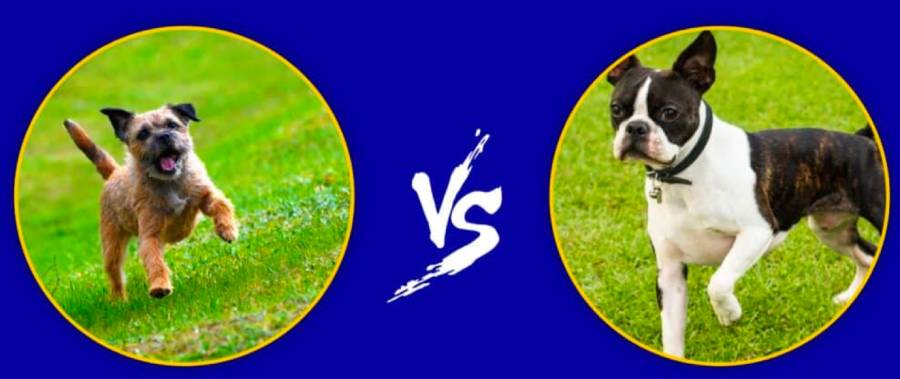
Boston Terriers and Border Terriers are small dog breeds, but they differ substantially in appearance, temperament, exercise needs, natural instincts, and daily care requirements. The Boston Terrier is a compact companion breed known for its short coat, flat muzzle, and people-oriented personality. The Border Terrier has a wiry coat, longer muzzle, and stronger working-terrier traits, including a greater tendency to chase and pursue small animals.
These differences affect the type of home and owner that suits each breed. Boston Terriers generally fit owners looking for a sociable companion with manageable exercise and grooming needs, although their brachycephalic anatomy requires attention to heat and breathing. Border Terriers generally require more physical activity, mental stimulation, and management of terrier behaviors such as chasing, digging, and independent decision-making.
This Boston Terrier vs Border Terrier comparison examines their size, appearance, temperament, exercise requirements, trainability, prey drive, compatibility with children and pets, grooming, health, lifespan, and living requirements. Understanding these differences helps prospective owners evaluate each breed based on daily lifestyle and long-term care requirements rather than appearance alone.
What Are the Main Differences Between a Boston Terrier and a Border Terrier?
Boston Terriers and Border Terriers differ most in their physical structure, coat, temperament, exercise requirements, and natural hunting instincts. Boston Terriers were developed primarily toward companionship, while Border Terriers retain stronger characteristics associated with working terriers. This difference in breed background affects how the two dogs behave, exercise, train, and interact with their environment.
Boston Terriers have compact, muscular bodies with short muzzles, large round eyes, erect ears, and smooth coats. Border Terriers have longer muzzles, narrower bodies, small V-shaped ears, and dense, wiry coats. Their physical differences also affect care requirements. Boston Terriers need relatively simple coat maintenance but require additional consideration during strenuous activity and hot weather because of their short muzzle. Border Terriers require more coat maintenance and generally have greater capacity for sustained physical activity.
Temperament creates another significant distinction. Boston Terriers tend to be companion-oriented and strongly interested in interaction with people. Border Terriers can also form close relationships with their owners, but their working background contributes to greater independence and stronger chasing instincts. Individual temperament varies according to genetics, socialization, training, and previous experiences, so breed tendencies should not be treated as guarantees for every dog.
The main differences can be summarized as follows:
| Attribute | Boston Terrier | Border Terrier |
|---|---|---|
| General build | Compact and muscular | Narrow and athletic |
| Muzzle | Short and flat | Longer |
| Coat | Short and smooth | Dense and wiry |
| Grooming | Relatively simple | Requires more coat maintenance |
| Temperament | Sociable and companion-oriented | Affectionate but more independent |
| Exercise | Moderate daily activity | Greater daily activity |
| Prey drive | Generally less pronounced | Stronger terrier chasing instinct |
| Training | Responsive to consistent reward-based training | Trainable but can be independent |
| Heat tolerance | Requires greater caution | Generally better suited to sustained outdoor activity |
| Typical ownership challenge | Brachycephalic health management | Exercise and prey-drive management |
These differences mean that size alone is not sufficient for comparing the two breeds. A prospective owner also needs to consider exercise capacity, training commitment, existing pets, grooming requirements, and the amount of behavioral management they can provide.
How Do Boston Terriers and Border Terriers Differ in Size and Appearance?
Boston Terriers are compact, short-coated dogs with distinctive flat faces, while Border Terriers have narrower bodies, longer muzzles, and wiry coats. Both are relatively small breeds, but their body structures reflect different breed development and functional backgrounds.
Boston Terriers have a square, balanced appearance with a short muzzle and broad head. Their large, round eyes and small erect ears create one of the breed’s most recognizable facial profiles. The body is compact rather than elongated, with a smooth coat that lies close to the skin. Their markings also contribute strongly to their appearance because Boston Terriers characteristically combine white markings with darker coat colors.
Border Terriers have a noticeably different structure. Their heads are commonly described as having an “otter-like” appearance, with relatively short, strong muzzles and small V-shaped ears that fall forward. The body is narrow and functional rather than square and heavily compact. This structure reflects the breed’s working background, where mobility and the ability to follow quarry were important physical characteristics.
Coat type provides another immediate way to distinguish the breeds. Boston Terriers have short, smooth coats, whereas Border Terriers have harsh, wiry outer coats with softer undercoats. The Border Terrier’s double coat provides greater protection from outdoor conditions but also creates different grooming requirements. Boston Terrier coats require routine brushing and basic maintenance, while Border Terrier coats need additional management to preserve their characteristic texture.
The two breeds therefore look different even before temperament or behavior is considered. A Boston Terrier is identified primarily by its compact body, short muzzle, erect ears, prominent eyes, and smooth coat. A Border Terrier is identified by its narrower working build, longer facial structure, folded ears, and wiry double coat. These structural differences also connect directly to later considerations such as exercise, grooming, and health.
How Are Boston Terrier and Border Terrier Temperaments Different?
Boston Terriers are generally more companion-oriented and socially focused, while Border Terriers tend to show greater independence and stronger working-terrier instincts. Both breeds can form close relationships with their families, but they often express their personalities differently. Boston Terriers typically seek frequent interaction with people, whereas Border Terriers combine affection with the alertness, persistence, and independence expected from a working terrier.
Boston Terriers are known for being lively, playful, and responsive to human attention. Their companion-oriented nature makes interaction with family members an important part of daily life. Many enjoy games, short training sessions, and spending time close to their owners. This social orientation can make them suitable for households that want a dog actively involved in everyday family activities.
Border Terriers are also affectionate with their families, but their historical working role influences their behavior. They were developed to work with enough independence to pursue quarry, so environmental smells, movement, and potential prey can compete strongly for their attention. This does not mean Border Terriers are distant from people. It means their behavior can be more strongly influenced by external stimuli than that of a dog bred primarily for companionship.
The distinction becomes particularly important outdoors. A Boston Terrier may become distracted by people, dogs, or interesting surroundings, while a Border Terrier may become intensely interested in scents or moving animals. Genetics, early socialization, training, and individual experience influence both breeds, but prospective owners should account for these different behavioral tendencies when planning exercise and training.
Which Breed Needs More Exercise, a Boston Terrier or a Border Terrier?
Border Terriers generally require more sustained physical activity and mental stimulation than Boston Terriers. Their working-terrier background produces an active dog that benefits from regular walks, exploration, play, training, and activities that provide opportunities to use both physical energy and problem-solving abilities.
Boston Terriers still require daily exercise. Walks, interactive games, training sessions, and indoor play help maintain healthy body weight and provide mental stimulation. However, exercise intensity needs to account for the Boston Terrier’s brachycephalic structure. A shortened muzzle can make efficient cooling through panting more difficult, so strenuous activity in hot or humid conditions requires particular caution.
Border Terriers are built for a different type of activity. Their narrower athletic bodies and working heritage support longer periods of movement and exploration. Walking alone may not satisfy every individual, particularly when the walk provides little opportunity for sniffing, training, or environmental engagement. Activities such as scent-based games, controlled exploration, interactive play, and structured training can provide additional mental stimulation.
Exercise requirements should therefore be considered in terms of both duration and type of activity. A household looking for a small dog does not automatically need a low-activity dog. Border Terriers demonstrate this distinction clearly because their relatively small size is combined with substantial working-terrier energy. Boston Terriers also need consistent exercise, but owners must balance activity with temperature, physical condition, age, and respiratory tolerance.
Is a Boston Terrier or Border Terrier Easier to Train?
Boston Terriers tend to be more focused on human interaction, while Border Terriers can require additional management when their independent instincts and interest in the environment compete with training. Both breeds can learn household rules, basic obedience, and practical behaviors through consistent reward-based training.
Boston Terriers often respond well when training is interactive and rewarding. Food, toys, praise, and short training games can maintain engagement. Their social orientation can support training because attention from the owner itself may have value. Repetition still needs to be structured carefully because an individual dog can lose interest when sessions become unnecessarily long or predictable.
Border Terriers are trainable, but training needs to account for their working instincts. A dog may understand a cue yet find a scent trail or moving animal more rewarding at that moment. Effective training therefore involves more than teaching the meaning of commands. Owners also need to build reliable responses gradually in environments containing increasingly difficult distractions.
Recall is a particularly important practical skill for a Border Terrier because chasing behavior can interfere with returning to the owner. Recall training should progress from controlled, low-distraction environments toward more challenging situations rather than assuming that a response learned indoors will remain equally reliable outdoors. A long line can provide additional control during appropriate stages of training.
Trainability should not be treated as the same thing as intelligence. A dog can learn quickly while still choosing to investigate another stimulus when motivation changes. For both Boston Terriers and Border Terriers, consistent reinforcement, early socialization, clear household rules, and training appropriate to the individual dog produce more useful results than relying on breed intelligence labels alone.
Which Breed Has a Higher Prey Drive, a Boston Terrier or Border Terrier?
Border Terriers generally have a stronger prey drive than Boston Terriers because they were developed as working terriers for pursuing quarry. This instinct can appear as chasing small animals, following scent trails, investigating holes, digging, or becoming intensely focused on fast-moving objects. Boston Terriers can also chase animals, but prey-related behavior is less central to their breed background.
A Border Terrier’s prey drive matters most during outdoor exercise. Rabbits, squirrels, rodents, and other small animals can trigger pursuit, and a dog focused on a moving animal may temporarily prioritize chasing over responding to a recall cue. Secure fencing, leash management, recall training, and controlled opportunities to explore therefore form important parts of responsible Border Terrier ownership.
The same instinct affects off-leash decisions. Reliable behavior in a house or enclosed training area does not guarantee reliable recall when wildlife appears. Owners should build recall progressively around distractions and use secure areas when environmental conditions make chasing possible. Digging also deserves consideration because terrier instincts can make access beneath or through inadequate fencing a practical management issue.
Boston Terriers generally require less prey-drive management, but they should not automatically be considered safe off-leash or around every small animal. Individual behavior varies according to genetics, socialization, previous experiences, and training. Owners should evaluate the individual dog rather than assuming breed tendencies predict every encounter.
Are Boston Terriers or Border Terriers Better With Children and Other Pets?
Both Boston Terriers and Border Terriers can live successfully in family households, but compatibility depends on the individual dog’s temperament, socialization, training, and the types of animals already in the home. The most significant difference concerns small pets because the Border Terrier’s stronger prey drive can require greater management.
How Do Boston Terriers and Border Terriers Behave Around Children?
Boston Terriers and Border Terriers can both develop positive relationships with children when interactions are supervised and the dog has been appropriately socialized. Boston Terriers tend to be playful and people-oriented, which can make them enthusiastic family companions. Their compact size, however, means rough handling by children can still cause injury or defensive behavior.
Border Terriers can also be affectionate and playful with family members. Their higher activity level may suit households where children participate in appropriate walks, games, and training. Excited play still needs supervision because an energetic dog can jump, chase, or become overstimulated even without aggressive intent.
Children should learn practical boundaries with either breed. They should not disturb a dog while it is sleeping or eating, pull its ears or tail, climb on it, or remove valued objects from its mouth. Adult supervision is especially important with young children because safe interaction depends on managing both the child’s behavior and the dog’s response.
Can Boston Terriers and Border Terriers Live With Other Dogs?
Both breeds can live with other dogs, particularly when introductions, socialization, and household management are handled appropriately. Breed alone cannot determine whether two individual dogs will be compatible because age, sex, temperament, previous social experience, resource guarding, and activity level also influence the relationship.
Boston Terriers are generally socially oriented and may enjoy canine companionship when matched with an appropriate dog. Their play style and physical limitations should still be considered. A much larger or highly physical dog, for example, may require closer supervision during play because differences in size and play intensity increase the possibility of accidental injury.
Border Terriers can also share a home with other dogs. Their working history included operating around other dogs, but individual terrier behavior still varies. Introductions should occur gradually, and owners should monitor resources such as food, toys, resting spaces, and attention if these trigger competition.
Can Boston Terriers and Border Terriers Live With Cats and Small Pets?
Boston Terriers generally present fewer breed-specific prey-drive concerns around small pets, while Border Terriers require more careful assessment and management. A Border Terrier’s instinct to pursue small moving animals can make households containing rodents, rabbits, or similar pets particularly challenging.
Living successfully with a cat is different from living with very small prey animals. A dog raised and socialized with cats may learn household boundaries, but previous success with one cat does not prove that the same dog will behave identically around unfamiliar cats outdoors. Movement can trigger chasing even when the dog does not show the same response toward a familiar household cat.
Small animals such as hamsters, guinea pigs, rabbits, and similar pets require stronger physical separation when a dog shows predatory interest. Training can improve impulse control, but management should not depend exclusively on obedience when natural chasing behavior is strong. Secure enclosures and controlled access provide a physical layer of protection that verbal commands alone cannot guarantee.
For both breeds, individual behavior should determine household management, while breed tendencies provide useful context for anticipating potential challenges. This distinction is particularly important for Border Terriers because their small body size does not indicate a weak hunting instinct.
Which Breed Requires More Grooming, a Boston Terrier or Border Terrier?
Border Terriers generally require more specialized coat maintenance than Boston Terriers because they have a wiry double coat, while Boston Terriers have a short, smooth coat. Both breeds still need routine care such as brushing, nail trimming, ear checks, dental care, and occasional bathing, but their coat-maintenance requirements differ substantially.
Boston Terriers have short coats that lie close to the body. Regular brushing removes loose hair and distributes natural skin oils, while occasional bathing helps keep the coat and skin clean. Their short coat does not require trimming or stripping, making routine coat maintenance relatively straightforward. Owners should still monitor the skin for irritation and check areas where moisture or debris can accumulate.
Border Terriers have a dense undercoat covered by a harsh, wiry outer coat. Maintaining this characteristic texture requires more attention than maintaining a Boston Terrier’s smooth coat. Hand stripping is commonly used to remove dead outer hairs while preserving the texture and function of the coat. Coat-care requirements can change with the individual dog’s coat condition, season, and whether the dog is maintained primarily as a companion or for activities where coat texture matters.
Shedding also differs because coat type affects how loose hair is released and managed. Boston Terriers shed despite their short coats, so owners should not interpret a smooth coat as a non-shedding coat. Border Terriers also shed, with the undercoat contributing to seasonal coat changes. Regular brushing helps remove loose hair from both breeds, although the Border Terrier’s double coat requires a different grooming approach.
Neither breed should be selected solely on the assumption that a small dog requires little grooming. Coat care is only one component of maintenance. Owners also need to trim nails before excessive length affects movement, keep ears clean and dry, maintain dental hygiene, and monitor the skin, eyes, paws, and coat for changes that may require veterinary attention.
What Health Problems Affect Boston Terriers and Border Terriers?
Boston Terriers and Border Terriers have different breed-associated health concerns, so prospective owners should evaluate health history and responsible breeding practices rather than assuming that two similarly sized breeds have similar medical risks. Genetics, body structure, age, body condition, preventive care, and breeding practices all influence an individual dog’s health.
Health comparisons also need to distinguish an increased breed predisposition from a guaranteed diagnosis. A condition associated with a breed does not mean every member of that breed will develop it. Health screening of breeding dogs, routine veterinary examinations, appropriate exercise, weight management, dental care, and early investigation of symptoms can reduce preventable risks or identify problems earlier.
What Health Problems Are Common in Boston Terriers?
Boston Terriers require particular attention to health problems associated with their brachycephalic head structure, eyes, and other inherited conditions. Their shortened muzzle changes the anatomy of the upper airway, which can contribute to breathing difficulty in affected individuals. Exercise tolerance and heat management therefore deserve particular attention, especially during strenuous activity or hot weather.
Their prominent eyes are another area owners need to monitor. The shape and position of the eyes can increase exposure to irritation or injury, making redness, excessive tearing, squinting, cloudiness, or sudden changes in appearance signs that should not be ignored. Eye problems can progress quickly, so abnormal symptoms warrant veterinary assessment rather than home diagnosis.
Boston Terrier owners should also discuss breed-relevant screening and inherited health concerns with breeders and veterinarians. A responsible breeder should be able to explain the health history of the breeding dogs, relevant screening procedures, and known conditions within their lines. This information is more useful than relying only on a puppy’s appearance or a general claim that the parents are healthy.
Maintaining an appropriate body condition is particularly important because excess weight increases physical workload and can make exercise more difficult. Owners should combine portion control, appropriate daily activity, preventive veterinary care, and observation of breathing and exercise tolerance throughout the dog’s life.
What Health Problems Are Common in Border Terriers?
Border Terriers can also develop inherited and acquired health conditions, although their health profile differs from the structural concerns associated with Boston Terriers. Prospective owners should investigate breed-specific screening, family health history, and the health records of breeding dogs before choosing a puppy.
Neurological, orthopedic, eye, and other inherited conditions may be relevant within Border Terrier populations, depending on the individual line. The practical implication is not that every Border Terrier will develop these disorders, but that buyers should ask breeders specific questions about testing and health history rather than accepting broad assurances of good health.
Activity levels also influence long-term care. Border Terriers benefit from regular exercise, but activity should remain appropriate for age and physical condition. Puppies, adults, senior dogs, and dogs recovering from injury have different exercise capacities. Changes such as persistent limping, unusual reluctance to exercise, loss of coordination, repeated episodes of discomfort, or major behavioral changes justify veterinary assessment.
For both breeds, responsible health management begins before ownership. Prospective owners should investigate the health of the puppy or adult dog, obtain available medical records, and understand which screening procedures are relevant to that breed. After adoption, maintaining healthy body weight and attending routine veterinary examinations provide a foundation for detecting health changes early.
Do Boston Terriers or Border Terriers Live Longer?
Both Boston Terriers and Border Terriers can live well into their senior years, but lifespan varies between individual dogs and should not be predicted from breed averages alone. Genetics, inherited disease, body weight, diet, exercise, veterinary care, dental health, accidents, and living conditions all influence longevity.
Published lifespan estimates can differ because organizations use different datasets and methods. For that reason, a lifespan range is more useful than treating one age as a guaranteed life expectancy. Breed averages describe populations; they cannot determine how long an individual Boston Terrier or Border Terrier will live.
Preventive care affects quality of life as well as longevity. Maintaining appropriate body condition reduces unnecessary stress on joints and other body systems. Regular veterinary examinations can identify changes before obvious symptoms become severe, while dental care, vaccination and parasite-control programs appropriate to the dog’s circumstances address additional preventable health risks.
Breed-specific management also remains important throughout life. Boston Terrier owners need to pay particular attention to breathing, heat exposure, exercise tolerance, and eye health. Border Terrier owners need to combine sufficient activity with monitoring for changes in movement, neurological function, or other signs associated with the individual dog’s health history.
Lifespan should therefore be considered alongside health profile rather than used as the only measure of longevity. A prospective owner needs to consider whether they can provide the preventive care, daily management, exercise, and veterinary support required by the individual dog throughout puppyhood, adulthood, and the senior years.
Is a Boston Terrier or Border Terrier Better for Apartment Living?
Both Boston Terriers and Border Terriers can live in apartments, but their daily management requirements are different. Boston Terriers generally have exercise needs that are easier to accommodate in smaller living spaces, while Border Terriers require owners who can consistently provide sufficient outdoor exercise, mental stimulation, and management of working-terrier behaviors.
Boston Terriers can adapt well to apartment routines because physical exercise can be divided between daily walks, interactive play, and short training sessions. Their small, compact bodies also require relatively little indoor space. Apartment suitability still depends on providing regular activity because living in a small home does not eliminate a dog’s need for exercise, social interaction, and mental stimulation.
Temperature management is particularly relevant for Boston Terriers. Their brachycephalic anatomy can reduce their ability to tolerate strenuous exercise and heat, so owners should adjust outdoor activities during hot or humid weather. This does not mean Boston Terriers should remain inactive. It means exercise intensity, duration, and environmental conditions need to match the individual dog’s respiratory tolerance and physical condition.
Border Terriers can also live in apartments when their exercise requirements are met outside the home. Their small size does not make them low-energy dogs. A Border Terrier that receives insufficient physical activity and mental stimulation may redirect its energy toward behaviors such as persistent exploration, digging, chewing, or attempts to pursue interesting scents and movement.
Access to a private yard is therefore not the deciding factor for either breed. A consistent exercise routine is more important than simply having a large property. A Border Terrier living in an apartment with an active owner may receive more appropriate exercise than one living in a house with a yard but receiving little structured activity.
Noise and neighbor proximity should also be considered in apartment environments. Individual dogs vary in how readily they vocalize in response to hallway noises, visitors, other dogs, or activity outside windows. Early training can teach calm responses to common environmental triggers, while sufficient exercise can reduce behavior associated with boredom.
What Type of Owner Is Best Suited to a Boston Terrier or Border Terrier?
Boston Terriers generally suit owners seeking an interactive companion with moderate exercise requirements, while Border Terriers are better matched to households prepared for greater physical activity, mental stimulation, and terrier-specific behavior management. Neither profile guarantees compatibility because the individual dog’s age, temperament, health, and previous experiences remain important.
A Boston Terrier can suit an owner who wants a dog involved in everyday household activities without requiring prolonged periods of strenuous exercise. Daily walks, play, training, and regular interaction remain necessary, but these activities can often fit into an urban or moderately active lifestyle. Owners must also be prepared to manage breed-specific considerations involving heat, breathing, and eye health.
Border Terrier ownership requires greater emphasis on activity and environmental management. An owner should be prepared to provide regular walks, opportunities to explore, training, and mentally engaging activities. Because prey drive can affect recall and reactions to small animals, leash use and secure exercise areas may remain important even after substantial training.
Training commitment also separates the two ownership experiences. Boston Terriers benefit from consistent reward-based training and socialization, while Border Terriers require the same foundation plus additional attention to recall, impulse control, and behavior around potential prey. Owners who enjoy structured training, outdoor activities, scent games, and interactive exercise may find these requirements easier to incorporate into daily routines.
Existing pets are another practical consideration. A household containing cats or small animals should evaluate the individual dog’s previous experience and behavior rather than relying solely on breed reputation. This assessment is especially important with Border Terriers because their working-terrier background contributes to stronger prey-related tendencies.
Grooming preferences also affect suitability. Boston Terriers have relatively straightforward coat maintenance because their coats are short and smooth. Border Terriers have wiry double coats that require a different maintenance routine, including appropriate removal of dead coat when necessary. Prospective owners should consider whether they are willing to perform this care themselves or use a groomer familiar with the breed’s coat.
The most suitable owner is therefore determined by compatibility between the dog’s requirements and the household’s daily routine. People choosing between these breeds should evaluate how much time they can consistently dedicate to exercise, training, grooming, veterinary care, social interaction, and behavioral management over the dog’s entire life.
What Do Boston Terriers and Border Terriers Have in Common?
Boston Terriers and Border Terriers are both small companionable dogs that require daily exercise, consistent training, social interaction, routine grooming, and preventive veterinary care. Their physical appearance and working backgrounds differ, but neither breed should be treated as a low-maintenance pet simply because of its relatively small body size.
Both breeds benefit from early socialization. Positive exposure to different people, dogs, environments, sounds, surfaces, and everyday situations helps a young dog develop appropriate responses to its surroundings. Socialization does not mean allowing uncontrolled interaction with every person or animal. It involves creating structured experiences that teach the dog how to remain comfortable and responsive in different situations.
Training is also necessary for both breeds. Boston Terriers and Border Terriers need practical behaviors such as recall, leash walking, waiting, settling, and responding to household boundaries. Reward-based training can reinforce these behaviors, although the challenges encountered during training differ. Boston Terriers may be more focused on interaction with their owners, while Border Terriers can become strongly distracted by scents, movement, and potential prey.
Both breeds also need daily physical and mental activity. The required intensity differs, but exercise remains necessary for maintaining healthy body condition and providing appropriate behavioral outlets. Interactive games, walks, training exercises, and opportunities to explore can contribute to daily enrichment.
Long-term ownership creates similar responsibilities as well. Both dogs need appropriate nutrition, dental care, nail maintenance, veterinary examinations, parasite control appropriate to their circumstances, and monitoring for changes in behavior or physical health. Prospective owners should therefore consider the complete lifetime commitment rather than focusing only on the differences between the breeds.
Read more: Boston Terrier vs Cavalier King Charles Spaniel
Why Were Boston Terriers and Border Terriers Originally Bred?
Boston Terriers developed into companion dogs, while Border Terriers were developed as working terriers capable of pursuing quarry. Their different historical purposes help explain several modern differences in body structure, exercise requirements, independence, and prey drive.
The Boston Terrier originated in the United States and developed away from its early bull-and-terrier ancestry into a smaller companion breed. Selective breeding emphasized the compact body, distinctive head, characteristic markings, and companion temperament associated with the modern Boston Terrier. This development helps explain why interaction with people occupies such an important role in the breed’s modern lifestyle.
The Border Terrier originated in the border country between England and Scotland. It was developed as a functional working terrier capable of accompanying hunts and pursuing foxes and other quarry. A working dog needed endurance, mobility, determination, and enough independence to continue a task away from constant human direction.
These historical functions remain relevant because selective breeding can preserve behavioral and physical tendencies across generations. The Border Terrier’s drive to investigate scents, chase small animals, dig, and remain physically active reflects traits that had practical value in working environments. The Boston Terrier’s stronger companion orientation reflects a different direction of breed development.
Breed history does not determine every individual’s behavior. It provides context for understanding why certain tendencies occur more frequently within a breed. Modern temperament is also influenced by genetics at the individual and family-line level, socialization, training, health, age, and life experience.
What Should You Consider Before Choosing Between a Boston Terrier and a Border Terrier?
Consider 7 factors before choosing between a Boston Terrier and a Border Terrier: exercise requirements, temperament, training commitment, prey drive, household composition, grooming, and health management. Comparing these requirements with your actual daily routine provides a more useful basis for selecting a dog than choosing according to appearance alone.
First, consider exercise. Boston Terriers need consistent daily activity but require careful management of strenuous exercise and heat because of their brachycephalic anatomy. Border Terriers generally require greater physical activity and mental stimulation. An owner who prefers longer outdoor activities may have different requirements from someone seeking a companion for shorter walks and household interaction.
Second, consider temperament. Boston Terriers generally have a stronger companion-oriented profile, while Border Terriers combine affection with greater working-terrier independence. Owners should decide whether they prefer a dog primarily focused on social interaction or are comfortable managing a dog whose attention may frequently shift toward environmental stimuli.
Third, evaluate training commitment. Both breeds require training, but Border Terrier ownership places particular importance on recall, impulse control, and management around wildlife. Training should continue beyond puppyhood because behavior changes as dogs mature and encounter new environments.
Fourth, consider prey drive. Households with cats and especially smaller pets need to assess this factor carefully. Border Terriers have stronger breed-related hunting instincts, so physical management may remain necessary even when a dog has received extensive training.
Fifth, evaluate the household itself. Children, existing dogs, cats, small pets, apartment neighbors, access to outdoor exercise, and the amount of time the dog will spend alone all influence suitability. A breed that works well in one household can create substantial management challenges in another.
Sixth, compare grooming requirements. Boston Terriers have short, smooth coats that require relatively straightforward maintenance. Border Terriers have wiry double coats and require a more specialized coat-care routine. Grooming commitment therefore differs even though both dogs are small.
Seventh, consider long-term health management. Boston Terrier owners need particular awareness of issues associated with brachycephalic anatomy and prominent eyes. Border Terrier owners should understand health concerns relevant to their chosen dog’s family line and obtain appropriate health information from breeders or rescue organizations. Both breeds require preventive veterinary care throughout life.
The central difference between a Boston Terrier and a Border Terrier is not simply appearance: it is the type of daily ownership each dog requires. Boston Terriers generally emphasize companionship and moderate activity with additional brachycephalic health considerations. Border Terriers retain stronger working-terrier traits that increase the importance of exercise, mental stimulation, prey-drive management, and consistent training. Matching these characteristics to the household’s actual routine provides a stronger basis for choosing between the two breeds.