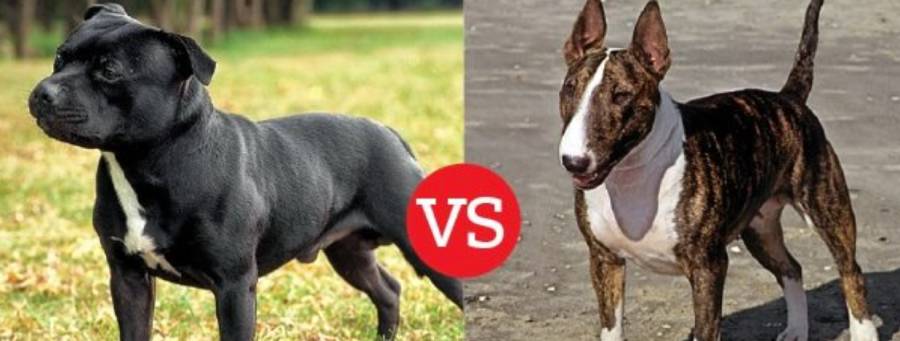
Boston Terriers and Staffordshire Bull Terriers differ most clearly in size, build, exercise needs, and several aspects of day-to-day ownership. Boston Terriers are smaller, lighter companion dogs with short muzzles, while Staffordshire Bull Terriers have heavier, more muscular bodies and generally require more physical activity. Both breeds can form strong bonds with people and live successfully as family companions when their exercise, training, socialization, and health needs are met.
Size is one of the easiest differences to recognize. An adult Boston Terrier typically weighs substantially less than a Staffordshire Bull Terrier, making the Boston easier to handle physically and potentially more practical in smaller homes. Staffordshire Bull Terriers have greater body mass and strength, so owners need to account for physical control alongside consistent training and daily activity.
The differences extend beyond appearance. Boston Terriers and Staffordshire Bull Terriers have distinct exercise requirements, health predispositions, and care considerations that affect their suitability for different households. Comparing their temperament, training needs, compatibility with children and other pets, grooming requirements, lifespan, and health provides a more useful basis for choosing between them than appearance alone.
What Is the Main Difference Between a Boston Terrier and a Staffordshire Bull Terrier?
The main difference between a Boston Terrier and a Staffordshire Bull Terrier is their physical build: Boston Terriers are smaller, lighter companion dogs, while Staffordshire Bull Terriers are heavier, stronger, and more muscular. This difference affects handling, exercise, and several aspects of everyday ownership.
Boston Terriers have a compact, square-proportioned body, short muzzle, large upright ears, and prominent round eyes. Their lighter frame makes them easier for most adults to physically manage. Staffordshire Bull Terriers are also compact, but their bodies are noticeably more muscular, with a broad head, powerful shoulders, and greater body mass relative to their height.
The two breeds also differ in their physical demands. Staffordshire Bull Terriers generally require more vigorous activity and need appropriate outlets for their strength and energy. Boston Terriers still need daily exercise and play, but their exercise routine must account for their short muzzle and reduced ability to tolerate strenuous activity in hot conditions.
These differences do not mean that one breed is universally easier to own. A Boston Terrier may fit an owner looking for a smaller companion, while a Staffordshire Bull Terrier requires an owner prepared to manage a physically stronger dog. Temperament, training, socialization, health, and the individual dog’s behavior remain important factors for both breeds.
How Do Boston Terriers and Staffordshire Bull Terriers Differ in Size?
Staffordshire Bull Terriers are substantially heavier than Boston Terriers, although the difference in height between the breeds is relatively small. Boston Terriers are generally 15–17 inches (38–43 cm) tall and weigh no more than 25 pounds (11.3 kg). Staffordshire Bull Terriers are generally 14–16 inches (36–41 cm) tall but weigh approximately 24–38 pounds (11–17 kg), depending partly on sex.
The weight difference comes primarily from body structure rather than height. Boston Terriers have compact bodies but a comparatively lighter frame. Staffordshire Bull Terriers carry considerably more muscle across the chest, shoulders, neck, and legs. As a result, two dogs of similar height can feel very different to handle.
This distinction matters in everyday situations. A 20-pound Boston Terrier is easier for most adults to lift into a vehicle, place on an examination table, or physically redirect when necessary. A Staffordshire Bull Terrier approaching 38 pounds remains a relatively compact dog but combines that weight with substantial muscular strength. Leash training and reliable responses to commands therefore become particularly important.
Neither breed should be selected based on size alone. Housing space, exercise opportunities, the owner’s physical ability, and the dog’s individual activity level determine whether its size is practical for a household.
How Do Boston Terriers and Staffordshire Bull Terriers Look Different?
Boston Terriers are distinguished by a short square muzzle, large upright ears, prominent round eyes, and tuxedo-like markings, while Staffordshire Bull Terriers have a broader head, stronger jaw structure, smaller ears, and a substantially more muscular body. Their silhouettes are therefore easy to distinguish despite both breeds having short coats and compact proportions.
The Boston Terrier has a square-looking head and short muzzle associated with its brachycephalic skull shape. Its ears stand erect and its eyes are large, round, and widely spaced. The body is compact and balanced rather than heavily muscular. Boston Terriers have smooth, short coats and are particularly recognizable for white markings combined with colors such as black, brindle, or seal.
The Staffordshire Bull Terrier has a broader skull, pronounced cheek muscles, a short foreface, and small rose or half-pricked ears. Its neck, shoulders, chest, and hindquarters display substantially more muscular development than those of a Boston Terrier. The breed also has a short, smooth coat, but its accepted coat colors and patterns extend beyond the characteristic tuxedo-style appearance associated with Boston Terriers.
Body structure is the clearest visual distinction when the breeds are viewed side by side. The Boston Terrier looks lighter and more square-proportioned, whereas the Staffordshire Bull Terrier looks broader, denser, and more powerful. These physical differences also provide context for later comparisons involving exercise, handling, and training.
How Does a Boston Terrier’s Temperament Compare With a Staffordshire Bull Terrier’s?
Boston Terriers and Staffordshire Bull Terriers are both people-oriented companion dogs, but they differ in physical intensity, energy, and the way owners need to manage their behavior. Boston Terriers tend to combine an affectionate temperament with a smaller, more manageable body, while Staffordshire Bull Terriers pair strong attachment to people with greater muscular strength and more energetic play.
Boston Terriers are typically social dogs that enjoy spending time with their household. Their playful behavior can continue well into adulthood, and interaction with people provides an important part of their daily stimulation. Their relatively small size also makes exuberant behavior easier to physically manage. Individual temperament still varies, so early exposure to different people, environments, sounds, and situations helps a Boston Terrier develop appropriate responses to everyday experiences.
Staffordshire Bull Terriers can also form strong bonds with their owners and are known for enthusiastic interaction with people. Their physical strength changes the practical consequences of excitement, pulling, jumping, or rough play, however. An owner should establish consistent boundaries and reinforce calm behavior from an early age rather than relying on physical restraint after unwanted habits develop.
Socialization and training influence the behavior of both breeds and should not be replaced by assumptions based solely on breed. Genetics can contribute to behavioral tendencies, but early experiences, reinforcement, environment, health, and the individual dog’s history also shape adult behavior. Two dogs of the same breed can therefore differ substantially in confidence, sociability, tolerance, and reactions to unfamiliar situations.
Which Breed Needs More Exercise, a Boston Terrier or Staffordshire Bull Terrier?
A Staffordshire Bull Terrier generally needs more vigorous daily exercise than a Boston Terrier because of its athletic, muscular build and higher capacity for sustained physical activity. Both breeds need daily movement and mental stimulation, but the intensity and type of exercise should match their physical characteristics.
Boston Terriers benefit from daily walks combined with play and mentally engaging activities such as short training sessions, food puzzles, and scent-based games. Exercise should be distributed across the day rather than concentrated into a single demanding session. Their brachycephalic facial structure can reduce the efficiency of breathing and cooling, making strenuous exercise particularly problematic in hot or humid weather.
Staffordshire Bull Terriers benefit from a more active routine that combines walks with structured play, training, and other appropriate physical outlets. Games such as retrieving and controlled tug can combine movement with owner interaction, while obedience exercises and scent activities add mental stimulation. Exercise alone is not a substitute for training; a physically fit dog still needs clear behavioral expectations and impulse control.
Weather and individual health should determine exercise intensity for both breeds. Boston Terriers require particular caution with strenuous activity in warm conditions, while Staffordshire Bull Terriers need sufficient structured activity to meet their physical and mental needs. Puppies, senior dogs, overweight dogs, and dogs with medical conditions require exercise plans adjusted to their developmental stage and veterinary needs rather than a routine based only on breed.
Which Is Easier to Train, a Boston Terrier or Staffordshire Bull Terrier?
Neither breed is automatically easier to train in every household, but Boston Terriers are physically easier to manage, while Staffordshire Bull Terriers require particularly consistent training because of their greater strength. Both breeds can learn household rules, basic obedience, leash manners, and practical commands through reward-based training that reinforces the behaviors owners want repeated.
Boston Terriers can respond well to short, engaging training sessions that use food, toys, praise, or play as rewards. Repetition without variety can reduce engagement, so owners should integrate commands into everyday situations. For example, practicing “sit” before meals, “wait” at doors, and recall during controlled play gives the dog a clear reason to perform each behavior. Their smaller size makes mistakes such as leash pulling physically easier to control, but size should not replace proper training.
Staffordshire Bull Terriers also benefit from reward-based methods, clear boundaries, and consistent reinforcement. Their muscular build makes early leash training, impulse control, recall, and calm greetings especially important. A dog that learns not to pull or jump while young is easier to manage when fully grown. Owners should therefore reinforce desirable behavior before physical strength turns an ordinary training problem into a difficult handling problem.
First-time ownership depends on more than trainability. A first-time owner needs enough time for daily training, socialization, exercise, and behavioral management regardless of which breed they choose. Boston Terriers may present fewer physical handling challenges, whereas Staffordshire Bull Terrier owners need to be comfortable managing a stronger dog. Individual temperament, previous experiences, age, and training history can make a specific dog easier or harder to train than breed-level tendencies suggest.
Are Boston Terriers or Staffordshire Bull Terriers Better Suited to Families With Children?
Both Boston Terriers and Staffordshire Bull Terriers can live successfully with children when the individual dog has an appropriate temperament and interactions are trained and supervised. The practical difference is that Boston Terriers are smaller and lighter, while Staffordshire Bull Terriers have substantially more strength and can create greater physical impact during energetic play.
Boston Terriers can suit households that want a compact dog involved in everyday family activities. Their playful and people-oriented nature can encourage interaction with children, but their smaller body does not eliminate the need for supervision. Children should learn not to pull a dog’s ears, disturb it while sleeping, take food or toys from it, or handle it roughly. The dog should also have a quiet area where it can move away from interaction.
Staffordshire Bull Terriers can be affectionate family companions, but their muscular bodies require additional attention during active play. Jumping, running, or enthusiastic physical contact can accidentally knock over a small child even when the dog is not displaying aggression. Training behaviors such as keeping four paws on the floor, waiting calmly, releasing objects on cue, and settling when requested can make everyday interactions easier to manage.
Breed alone cannot determine whether an individual dog is safe or suitable for a particular child. Temperament, socialization history, training, health, the child’s behavior, and adult supervision all affect dog-child interactions. Families should evaluate the individual dog rather than assuming that a reputation attached to either breed guarantees predictable behavior. Young children should not be left unsupervised with a dog, including a familiar family pet.
Can Boston Terriers and Staffordshire Bull Terriers Live With Other Pets?
Boston Terriers and Staffordshire Bull Terriers can live with other pets, but successful coexistence depends heavily on the individual dog, early socialization, previous experiences, and controlled introductions. Existing pets should therefore be considered separately rather than assuming that either breed will automatically accept every dog or cat in the household.
Compatibility is easier to evaluate when owners consider specific behaviors such as chasing, resource guarding, play intensity, response to unfamiliar animals, and ability to disengage when called. A dog that becomes highly aroused around another animal requires more management regardless of its breed. Introductions should take place gradually, with owners controlling access to food, toys, beds, and other resources that could create conflict.
Can They Live With Other Dogs?
Both breeds can live with other dogs when the individual dogs are compatible, although introductions and ongoing supervision remain important. Boston Terriers can be social with other dogs, especially when positive exposure begins early, but individual responses range from highly sociable to selective. Size differences also matter because rough play with a substantially larger dog can create an injury risk for the smaller Boston Terrier.
Staffordshire Bull Terriers require particularly careful assessment of dog-to-dog compatibility because their strength can increase the consequences of conflict. Owners should not treat breed identity alone as evidence that a particular dog will or will not tolerate another dog. Individual temperament, socialization, sex, age, previous experiences, and the behavior of the second dog all influence the relationship.
Initial meetings are easier to manage in a neutral environment with both dogs under control. Owners can begin with parallel walking at a comfortable distance before allowing closer interaction. Feeding dogs separately and supervising access to high-value toys can also reduce avoidable competition after they begin sharing a home.
Can They Live With Cats?
Boston Terriers and Staffordshire Bull Terriers can live with cats when the individual dog accepts cats and introductions are managed gradually. A dog raised around cats from an early age may respond differently from an adult dog with a history of chasing small animals, so previous behavior provides more useful information than breed assumptions alone.
Owners should initially separate the animals with a secure barrier and allow them to become familiar with each other’s presence without direct physical access. The dog should remain calm and responsive to the owner before closer interaction occurs. The cat also needs elevated areas and dog-free spaces where it can retreat voluntarily.
Chasing should not be encouraged as play. Repeated chasing can increase arousal and make coexistence more difficult even when the first interactions appear harmless. Households adopting an adult dog should ask the breeder, rescue organization, foster carer, or previous owner specifically about its documented behavior around cats and other small animals.
Which Breed Is Better Suited to Apartment Living?
Boston Terriers generally present fewer physical challenges in an apartment because they are smaller and lighter, but both breeds can live in apartments when their exercise, training, and behavioral needs are consistently met. Access to a large yard is not a substitute for these needs, and apartment suitability should not be determined by body size alone.
Boston Terriers fit easily into limited indoor space and do not require a large area simply to move around the home. Their daily routine should still include walks, play, mental stimulation, and opportunities to interact with their owners. Because Boston Terriers have short muzzles, indoor temperature control can also be important during hot weather, particularly in apartments that become warm or poorly ventilated.
Staffordshire Bull Terriers take up relatively little floor space for their muscular body size, but they require sufficient opportunities for structured activity outside the apartment. Daily walks, training, interactive play, and mental stimulation help prevent the home from becoming the dog’s only outlet for energy. Reliable leash manners are especially useful in shared hallways, elevators, entrances, and other confined spaces where encounters with neighbors and dogs are difficult to avoid.
The better apartment dog is ultimately the individual whose exercise requirements, behavior, and daily routine match the owner’s living situation. Owners should consider noise, separation tolerance, access to outdoor exercise areas, building rules, time spent away from home, and the dog’s response to close encounters with people or animals. A well-exercised and appropriately trained Staffordshire Bull Terrier can be easier to live with in an apartment than a Boston Terrier whose physical and behavioral needs are consistently unmet.
Which Breed Requires More Grooming?
Neither the Boston Terrier nor the Staffordshire Bull Terrier requires intensive coat grooming because both breeds have short, smooth coats. Their routine care is relatively straightforward compared with long-haired or double-coated breeds, although both still need regular brushing, nail trimming, dental care, ear checks, and skin monitoring.
Boston Terriers benefit from regular brushing to remove loose hair and distribute natural skin oils across the coat. Their short coat does not eliminate shedding, so hair can still accumulate on furniture and clothing. Bathing should be based on the dog’s activity level and skin condition rather than performed unnecessarily often. Particular attention should also be paid to the face because moisture and debris can collect around facial folds in dogs that have pronounced wrinkles.
Staffordshire Bull Terriers have similarly short, close-fitting coats that require limited maintenance. Regular brushing removes loose hair and provides an opportunity to inspect the skin for redness, irritation, lumps, or other changes. Their coat does not require clipping or elaborate professional grooming, making most routine coat maintenance possible at home.
Dental care, nails, ears, and skin are more important to the overall grooming routine than brushing alone. Owners should introduce tooth brushing and nail handling early so these procedures become familiar rather than stressful. Ears should also be checked for unusual odor, discharge, redness, or persistent scratching. Grooming therefore serves two functions for both breeds: maintaining cleanliness and providing regular opportunities to identify physical changes that may require veterinary attention.
What Health Problems Affect Boston Terriers and Staffordshire Bull Terriers?
Boston Terriers and Staffordshire Bull Terriers have different breed-associated health risks, so prospective owners should evaluate health screening as carefully as temperament, size, and appearance. A breed predisposition indicates an increased risk within a population; it does not mean that every individual dog will develop the condition.
The most useful approach is to consider the conditions associated with each breed alongside the health testing recommended for breeding dogs. Responsible breeding cannot eliminate every disease, but appropriate screening can identify certain inherited or structurally influenced risks before dogs are used for breeding.
What Health Problems Are Common in Boston Terriers?
Boston Terriers are particularly associated with health concerns involving their brachycephalic anatomy, eyes, kneecaps, and hearing. Their shortened skull and muzzle can contribute to brachycephalic obstructive airway problems, which may interfere with efficient breathing and temperature regulation. Signs such as excessive respiratory effort, exercise intolerance, or difficulty recovering in warm conditions require veterinary assessment rather than being dismissed as normal behavior for a short-muzzled dog.
Their prominent eyes are also more exposed than those of dogs with deeper-set eyes. Owners should monitor for squinting, redness, discharge, cloudiness, or sudden changes in the appearance of an eye. Eye injuries and disorders can progress rapidly, making prompt veterinary evaluation important when symptoms appear.
Patellar luxation is another orthopedic concern relevant to Boston Terriers. It occurs when the kneecap moves outside its normal position and can cause intermittent skipping, lameness, or abnormal movement. Congenital deafness is also recognized within the breed, which makes appropriate hearing evaluation relevant when assessing breeding dogs and puppies.
Health screening should therefore be part of the breeder-selection process. Prospective owners should ask for documented results rather than relying on statements that the puppy’s parents “look healthy.” Veterinary examinations and breed-appropriate screening provide more useful evidence of health status.
What Health Problems Are Common in Staffordshire Bull Terriers?
Staffordshire Bull Terriers have breed-associated risks that include hereditary eye disorders, certain inherited neurological or metabolic conditions, and skin problems. The specific risk profile differs from that of the Boston Terrier, making breed-specific testing important rather than applying the same screening process to every dog.
One inherited condition associated with Staffordshire Bull Terriers is L-2-hydroxyglutaric aciduria, commonly abbreviated as L-2-HGA. This metabolic disorder affects the nervous system and can produce neurological signs. DNA testing allows breeding dogs to be screened for the relevant genetic variant, helping breeders make informed mating decisions.
Hereditary cataracts are another condition for which genetic screening is relevant in Staffordshire Bull Terriers. Cataracts affect the transparency of the lens and can impair vision. Eye health should therefore be considered both when selecting a breeder and throughout the dog’s life, particularly when changes in vision or eye appearance become noticeable.
Skin problems can also occur in Staffordshire Bull Terriers, although a skin problem in an individual dog should not automatically be attributed to breed. Itching, recurrent infections, hair loss, redness, and persistent licking can have several causes, including allergies, parasites, and infections. Veterinary diagnosis is necessary to identify the cause rather than treating repeated symptoms without determining the underlying problem.
For both breeds, health documentation is more useful than general claims about having a healthy bloodline. Prospective owners should ask which tests were performed, which dogs were tested, and what the documented results show. Health screening reduces avoidable uncertainty, while routine veterinary care, appropriate body weight, dental care, exercise, and early investigation of symptoms remain important throughout the dog’s life.
How Long Do Boston Terriers and Staffordshire Bull Terriers Live?
Boston Terriers and Staffordshire Bull Terriers have broadly comparable lifespans, and both can live into their early teens with appropriate care. Boston Terriers commonly have an expected lifespan of about 11–13 years, while Staffordshire Bull Terriers commonly reach approximately 12–14 years. These ranges describe breed-level expectations rather than predicting how long an individual dog will live.
Genetics and inherited health conditions influence longevity in both breeds. Boston Terriers require particular attention to problems associated with their eyes, respiratory anatomy, kneecaps, and other breed-related conditions. Staffordshire Bull Terriers have a different health profile that includes inherited disorders for which responsible breeding and appropriate health testing can reduce avoidable risk.
Body condition also affects long-term health. Maintaining an appropriate weight reduces unnecessary stress on joints and avoids placing additional physical demands on the respiratory and cardiovascular systems. Owners can support healthy body condition by measuring food portions, limiting excessive treats, providing suitable daily exercise, and monitoring changes in weight over time.
Preventive veterinary care remains important throughout the dog’s life. Routine examinations can identify changes in body weight, teeth, skin, eyes, joints, heart, and other systems before obvious symptoms become severe. Dental care, parasite prevention, appropriate vaccination, exercise, nutrition, and prompt investigation of unusual symptoms all contribute to long-term health.
The lifespan difference between the breeds is less important than the health and care of the individual dog. Prospective owners should therefore consider breeder health screening, known family health history, preventive care, and their ability to manage breed-specific risks rather than selecting between the two breeds based on lifespan alone.
Read more: Boston Terrier vs Bull Terrier: Key Differences
How Much Daily Care Does Each Breed Require?
Both breeds require daily exercise, interaction, training, feeding, and basic health monitoring, but Staffordshire Bull Terriers generally demand more physical activity while Boston Terriers require greater attention to heat and breathing limitations. Grooming demands are relatively low for both because of their short coats.
A Boston Terrier’s daily routine should include moderate physical activity combined with mental stimulation and interaction with people. Walks, indoor play, short training sessions, and food puzzles can provide different forms of stimulation without relying on prolonged strenuous exercise. Owners should adjust outdoor activity during warm or humid conditions because the breed’s short muzzle can make effective cooling more difficult.
A Staffordshire Bull Terrier generally benefits from a more physically active routine. Walks should be combined with structured play, training, and mentally engaging activities rather than treating access to a yard as sufficient exercise. Because the breed is muscular and physically strong, daily reinforcement of leash manners, recall, impulse control, and calm behavior has practical value throughout adulthood.
Grooming takes comparatively little time for either breed. Regular brushing, nail care, dental hygiene, ear checks, and periodic bathing cover most routine grooming requirements. Owners should also use these sessions to inspect the dog’s skin, paws, eyes, ears, teeth, and body for changes such as lumps, irritation, injuries, or unusual sensitivity.
Human interaction is another daily requirement that should not be overlooked. Neither breed should be viewed as a low-maintenance pet simply because its coat is easy to groom. Dogs require time for exercise, behavioral reinforcement, enrichment, veterinary care, and social interaction throughout their lives. An owner’s available time therefore matters more than coat maintenance when estimating the practical workload of either breed.
| Daily care factor | Boston Terrier | Staffordshire Bull Terrier |
|---|---|---|
| Physical exercise | Moderate | Moderate to high |
| Mental stimulation | Daily | Daily |
| Training | Short, consistent sessions | Consistent training and impulse control |
| Coat grooming | Low | Low |
| Heat management | High priority | Important in hot conditions |
| Physical handling | Generally easier due to smaller size | Requires more control due to strength |
| Human interaction | High priority | High priority |
| Health monitoring | Brachycephalic, eye and orthopedic concerns | Genetic, eye, skin and other breed-related concerns |
The largest practical difference is therefore where owners spend their effort rather than whether either breed needs daily care. Boston Terrier owners need to balance activity with respiratory and temperature considerations, while Staffordshire Bull Terrier owners need to provide sufficient exercise alongside consistent behavioral training.
What Type of Owner Is Better Suited to Each Breed?
Boston Terriers generally suit owners who want a smaller companion with moderate exercise requirements, while Staffordshire Bull Terriers suit owners prepared for a stronger dog that benefits from more vigorous activity and consistent physical management. The appropriate match still depends on the individual dog’s temperament, age, health, training history, and behavior rather than breed characteristics alone.
A Boston Terrier can fit households where indoor space is limited and owners prefer a dog that is relatively easy to handle physically. Daily walks, play, training, and mental stimulation remain necessary, but the breed does not require the same level of vigorous exercise expected from many more athletic dogs. Owners must instead pay particular attention to heat, strenuous exercise, and signs of breathing difficulty because of the Boston Terrier’s brachycephalic anatomy.
A Staffordshire Bull Terrier is better matched with an owner who can provide regular physical activity and consistent behavioral training. Its compact dimensions can make the breed practical in different types of homes, but its muscular body means that leash pulling, jumping, or uncontrolled excitement can become difficult to manage. Owners should be prepared to reinforce leash manners, recall, impulse control, and calm interactions throughout the dog’s life.
Household composition also affects suitability. Families with children need to supervise interactions with either breed, while households with existing dogs or cats should evaluate the individual dog’s history and behavior around other animals. Prospective owners who already have pets should prioritize demonstrated compatibility over assumptions based on breed reputation.
Available time is equally important. Both breeds need daily interaction with people, and neither should be selected simply because its short coat appears low-maintenance. A suitable owner must have enough time for exercise, training, enrichment, preventive health care, and social interaction for the dog’s entire life.
What Should You Consider Before Choosing Between a Boston Terrier and a Staffordshire Bull Terrier?
Choose between a Boston Terrier and a Staffordshire Bull Terrier by comparing your household with the dog’s size, exercise needs, training requirements, health risks, and individual temperament. Appearance can influence personal preference, but it provides little information about whether an owner can meet the dog’s needs for the next decade or longer.
There are 8 practical factors to consider. First, assess living space and access to suitable exercise areas. Second, determine how much time you can consistently dedicate to walks, play, and mental stimulation. Third, consider your willingness and ability to provide ongoing training. Fourth, evaluate interactions with children. Fifth, account for existing dogs, cats, or other pets. Sixth, consider routine grooming and preventive care. Seventh, understand the health conditions associated with the breed. Eighth, calculate how much daily time you can provide for companionship and supervision.
Boston Terriers deserve particular consideration from owners concerned about brachycephalic health and heat tolerance. A prospective owner should be prepared to monitor breathing, control exercise intensity during warm weather, maintain an appropriate body condition, and seek veterinary assessment when respiratory symptoms occur. Choosing a breeder that performs appropriate health screening is also important when purchasing a puppy.
Staffordshire Bull Terriers require a different emphasis. Their muscular build increases the importance of early training, leash manners, impulse control, and appropriate physical activity. Prospective owners should also investigate breed-specific health screening and evaluate an individual dog’s behavior around other animals rather than relying on generalized descriptions of the breed.
Meeting adult dogs can provide information that photographs and breed descriptions cannot. When adopting, ask the rescue organization or foster carer about the dog’s behavior in a home, response to strangers, interactions with animals, activity level, training history, and known medical conditions. When purchasing a puppy, ask the breeder for documented health-test results for the parents and information about temperament, socialization, and living conditions.
The practical choice is the breed and individual dog whose needs your household can consistently meet. A Boston Terrier’s smaller body does not make it automatically easier in every respect, and a Staffordshire Bull Terrier’s greater strength does not make it unsuitable for every household. Evaluating the individual dog alongside exercise capacity, training commitment, household members, existing pets, health considerations, and available time provides a more reliable basis for choosing between them.