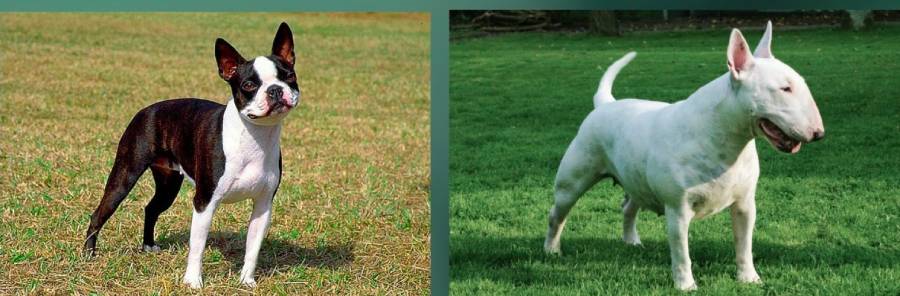
The Boston Terrier and Bull Terrier are two distinct dog breeds that differ substantially in size, physical structure, temperament, exercise needs, and training requirements. Boston Terriers are smaller companion dogs with compact bodies and short muzzles, while Bull Terriers are larger, more muscular dogs recognized by their distinctive egg-shaped heads. These physical differences also influence how owners handle, exercise, and care for each breed.
Temperament creates another important distinction. Boston Terriers are generally companion-oriented, playful dogs that adapt to a range of households. Bull Terriers are energetic, powerful, and persistent dogs that require consistent training, appropriate socialization, and sufficient physical and mental activity. Neither breed is suitable for every household, so choosing between them requires more than comparing appearance or size.
This Boston Terrier vs Bull Terrier comparison examines their size, appearance, temperament, exercise needs, trainability, shedding, grooming, health, lifespan, and compatibility with children and other pets. It also explains how these differences affect apartment living and first-time dog ownership, helping prospective owners determine which breed better matches their lifestyle and ability to provide appropriate care.
What Is the Difference Between a Boston Terrier and a Bull Terrier?
The main difference between a Boston Terrier and a Bull Terrier is that the Boston Terrier is a smaller, lighter companion breed, while the Bull Terrier is a larger, stronger, and more physically demanding breed. They also differ in head shape, temperament, exercise requirements, training needs, and suitability for different households. Despite sharing “Terrier” in their names, the two breeds have noticeably different physical and behavioral profiles.
Boston Terriers have compact bodies, short muzzles, large upright ears, and prominent round eyes. Adult Boston Terriers generally weigh no more than 25 pounds, making them considerably easier to physically handle than Bull Terriers. Bull Terriers have muscular, powerful bodies and are particularly recognizable by their long, egg-shaped heads and small triangular eyes. Standard Bull Terriers can weigh considerably more than Boston Terriers, so owners need to account for greater physical strength when exercising, training, and handling them.
Temperament and activity requirements create additional differences. Boston Terriers are playful, social companion dogs that tend to remain closely involved with their households. Bull Terriers are also affectionate and playful, but their greater strength, energy, and persistent nature make consistent training and appropriate socialization particularly important. A household choosing between these breeds therefore needs to consider more than physical appearance.
| Attribute | Boston Terrier | Bull Terrier |
|---|---|---|
| Overall size | Small | Medium-sized and substantially heavier |
| Maximum breed-standard weight | 25 lb | No specific weight limit in the breed standard |
| Body type | Compact and balanced | Strong and muscular |
| Head | Short, square muzzle | Long, egg-shaped head |
| Eyes | Large and round | Small and triangular |
| General temperament | Friendly, lively, companion-oriented | Playful, energetic, strong-willed |
| Exercise needs | Moderate daily activity | More substantial physical and mental activity |
| Training | Benefits from positive, consistent training | Requires consistent training and early socialization |
| Coat | Short and smooth | Short, flat, and harsh to the touch |
| Grooming | Relatively low maintenance | Relatively low maintenance |
| Physical handling | Easier due to smaller size | Requires greater control because of size and strength |
| Owner consideration | Lifestyle and health requirements | Exercise, training, strength, and socialization |
The practical difference is therefore the type of ownership commitment each dog requires. A Boston Terrier offers a smaller physical footprint and is generally easier to manage in limited living space, although its health, exercise, and companionship needs still require daily attention. A Bull Terrier requires an owner prepared to manage a more powerful dog and provide structured exercise, training, mental stimulation, and socialization. These distinctions become clearer when the two breeds are compared by individual attributes such as size, appearance, temperament, and exercise requirements.
How Do Boston Terriers and Bull Terriers Differ in Size?
Bull Terriers are substantially larger and heavier than Boston Terriers. The Boston Terrier breed standard divides dogs into weight classes of under 15 pounds, 15 to under 20 pounds, and 20 to no more than 25 pounds. This makes the Boston Terrier a relatively small dog with a compact body and manageable physical size.
The Bull Terrier has a considerably heavier and more muscular build. Unlike the Boston Terrier standard, the Bull Terrier standard does not establish a specific weight or height limit; instead, the dog should have maximum substance for its size while maintaining overall balance. This difference matters because comparing the breeds solely through height does not fully represent their physical contrast. Body mass, muscular development, and strength also determine how demanding a dog is to physically manage.
Size affects everyday ownership in at least 3 ways: handling, space, and physical control. A Boston Terrier’s lower body weight makes tasks such as lifting the dog, placing it in a vehicle, or physically managing it during veterinary visits easier for most adults. A Bull Terrier’s greater mass and muscular build require stronger leash control and more attention to training, particularly when the dog becomes excited or pulls during walks.
The difference does not mean that Boston Terriers require little exercise or that Bull Terriers automatically need a large house. Living-space suitability depends on both physical size and whether the owner can meet the dog’s behavioral and exercise requirements. A well-managed Bull Terrier can have its activity needs met through structured outdoor exercise, while a Boston Terrier still requires regular activity despite occupying less physical space.
How Do Boston Terriers and Bull Terriers Look Different?
Boston Terriers and Bull Terriers look distinctly different because the Boston Terrier has a compact, square-proportioned appearance with a short muzzle, while the Bull Terrier has a muscular body and a distinctive egg-shaped head. Head shape is the easiest physical characteristic to use when distinguishing the two breeds.
The Boston Terrier has a short, square head with a broad muzzle, large round eyes, and small erect ears. Its body is compact and balanced rather than heavily built. The short, smooth coat commonly creates a contrasting pattern that contributes to the breed’s recognizable appearance. The combination of a compact body, erect ears, short muzzle, and prominent eyes gives the Boston Terrier a markedly different profile from the Bull Terrier.
The Bull Terrier has a longer and more powerful physical structure. Its most distinctive feature is the head, which has an oval or egg-shaped appearance when viewed from the front and a curved profile when viewed from the side. Small triangular eyes and erect ears further distinguish the breed. The neck and shoulders connect to a muscular body with substantial bone and physical strength, creating a heavier appearance than the Boston Terrier.
Both breeds have short coats, but coat length alone does not make them physically similar. The Boston Terrier is distinguished by its compact proportions and short, square facial structure, whereas the Bull Terrier is distinguished by its muscular build and elongated head. These structural differences also affect ownership because body size, muzzle structure, and physical strength can influence exercise management, handling, and specific health considerations.
How Does the Temperament of a Boston Terrier Compare With a Bull Terrier?
Boston Terriers are generally lively, social companion dogs, while Bull Terriers combine affection and playfulness with greater physical intensity and a more persistent temperament. Both breeds can form strong relationships with their owners, but their behavioral traits create different training and management requirements.
Boston Terriers were developed primarily as companion dogs in their modern form, and close interaction with people is an important part of their daily life. They tend to be lively and playful without requiring the same degree of physical management as a much heavier dog. Their smaller size also makes energetic indoor behavior easier for many owners to control. Individual temperament still varies, so early socialization remains important when introducing a Boston Terrier to unfamiliar people, animals, places, and everyday situations.
Bull Terriers are also strongly people-oriented and can be affectionate and playful with their households. However, their combination of energy, muscular strength, and persistence means undesirable behaviors have greater practical consequences. Jumping, pulling on a leash, or becoming overexcited is easier to physically manage in a dog weighing 20 pounds than in a substantially heavier Bull Terrier. Training therefore needs to establish appropriate behavior before the dog’s physical strength becomes difficult for an owner to control.
The breeds also differ in the type of owner engagement they require. A Boston Terrier generally fits an owner seeking a smaller companion with a lively personality, while a Bull Terrier requires an owner prepared for more structured behavioral management, exercise, and consistent training. This does not make every Boston Terrier easy or every Bull Terrier difficult. Genetics, early experiences, socialization, training, age, and the individual dog’s personality all influence adult behavior.
Prospective owners should therefore evaluate temperament together with physical characteristics. A friendly dog can still be unsuitable for a household when its exercise or management requirements exceed what the owner can consistently provide. For Bull Terriers in particular, physical strength increases the importance of early socialization, leash manners, impulse control, and consistent household rules. For Boston Terriers, owners still need to provide social interaction, activity, and training rather than assuming their smaller size eliminates behavioral needs.
Which Needs More Exercise, a Boston Terrier or a Bull Terrier?
A Bull Terrier generally needs more intensive daily exercise than a Boston Terrier because it has a stronger, more athletic body and requires regular physical and mental activity. Both breeds need daily exercise, but the type and intensity of activity should reflect their different body structures, energy levels, ages, and health conditions.
Boston Terriers benefit from daily walks combined with interactive play and mental stimulation. Their smaller size makes indoor games easier to incorporate into an exercise routine, so activities such as playing with toys, short training sessions, and supervised games can supplement outdoor walks. Exercise should still be consistent because insufficient activity can leave a Boston Terrier without an appropriate outlet for its energy.
A Boston Terrier’s short muzzle also affects exercise management. As a brachycephalic breed, it can have greater difficulty cooling itself efficiently through panting, particularly during strenuous activity in hot or humid conditions. Owners should therefore adjust exercise intensity to the individual dog’s breathing ability and environmental conditions rather than assuming a fixed exercise routine is appropriate every day. Signs of breathing difficulty or heat stress require exercise to stop and may require veterinary attention.
Bull Terriers need regular opportunities to use both physical energy and mental focus. Walks, controlled play, training exercises, and other structured activities provide different forms of stimulation. Physical exercise alone does not address every behavioral need; training games and problem-solving activities can also give the dog a productive outlet for its attention and persistence.
Exercise requirements also have practical consequences for prospective owners. Boston Terriers can be easier to accommodate when an owner wants a smaller dog with manageable daily activity, while Bull Terriers are better matched with households prepared to provide more structured exercise and active engagement. Neither breed should be selected on the assumption that access to a yard replaces walks, training, social interaction, or other forms of daily activity.
Which Is Easier to Train, a Boston Terrier or a Bull Terrier?
Boston Terriers are generally easier for inexperienced owners to physically manage during training, while Bull Terriers require particularly consistent training because their strength, energy, and persistence make uncontrolled behavior harder to handle. Successful training for either breed depends on clear expectations, repetition, appropriate rewards, and early socialization rather than physical correction.
Boston Terriers can learn household rules, basic obedience behaviors, leash manners, and routines through short, engaging training sessions. Positive reinforcement using food, toys, praise, or play gives the dog a clear reason to repeat desired behavior. Consistency is important because allowing a behavior in one situation and correcting the same behavior in another makes household rules more difficult for the dog to understand.
Bull Terriers also respond to reward-based training, but owners need to account for their physical power and persistent personality. Basic behaviors such as walking without pulling, responding when called, waiting at doors, and remaining controlled around distractions have practical safety value in a strong dog. Teaching these behaviors early is easier than trying to correct established habits after the dog reaches full adult strength.
Socialization forms another part of training for both breeds. Early socialization should introduce a dog to different people, appropriate dogs, environments, sounds, surfaces, handling, and routine experiences in controlled situations. The objective is not simply to expose the puppy to as many stimuli as possible; experiences should help the dog develop appropriate responses without creating unnecessary fear or overexcitement.
Training difficulty should therefore not be reduced to intelligence alone. Motivation, attention, persistence, physical strength, previous learning, and owner consistency all affect training outcomes. A Boston Terrier’s smaller body can make mistakes easier to physically manage, whereas a Bull Terrier’s strength increases the importance of establishing reliable behavior early. Prospective Bull Terrier owners should be prepared to make structured training an ongoing part of everyday ownership rather than treating it as a short puppy-stage requirement.
Which Sheds More, a Boston Terrier or a Bull Terrier?
Boston Terriers and Bull Terriers are both short-coated breeds that shed, but neither requires the intensive coat maintenance associated with long-haired or continuously growing coats. The practical difference in grooming is relatively small compared with the larger differences between these breeds in size, exercise, training, and health.
Boston Terriers have short, smooth coats that require regular basic grooming. Brushing removes loose hair and distributes natural skin oils through the coat, while bathing is needed when the dog becomes dirty rather than according to an excessively frequent schedule. Routine care should also include nail trimming, ear checks, dental care, and monitoring the skin for irritation or abnormal changes.
Bull Terriers also have short coats that are relatively straightforward to maintain. Regular brushing helps remove loose hair and allows owners to inspect the skin at the same time. This inspection is useful because changes such as persistent redness, itching, hair loss, sores, or repeated irritation should not simply be treated as normal shedding. Veterinary assessment can identify whether an underlying skin or health problem is present.
Neither breed is non-shedding, so prospective owners should expect some loose hair in the home. Choosing between a Boston Terrier and Bull Terrier based only on grooming is unlikely to reveal a major advantage because both have relatively low-maintenance coats. Owners should instead consider whether they can consistently provide complete routine care, including brushing, nail trimming, dental hygiene, ear care, bathing, and veterinary attention when abnormalities appear.
What Health Problems Affect Boston Terriers and Bull Terriers?
Boston Terriers and Bull Terriers have different breed-associated health concerns, so health screening should be evaluated separately for each breed. Boston Terriers require particular attention to problems associated with their eyes, patellas, hearing, and brachycephalic structure, while Bull Terriers have recognized concerns involving areas such as hearing, kidneys, the heart, patellas, and skin. A breed’s predisposition does not mean every individual dog will develop these conditions.
Health should also influence how prospective owners evaluate breeders. Responsible breeding involves more than receiving a general statement that the parents are healthy. Buyers should ask what health tests were performed, which conditions those tests address, and whether the results can be independently verified. Veterinary records for an individual puppy are useful, but they do not replace appropriate health screening of breeding dogs for inherited conditions.
What Health Problems Are Common in Boston Terriers?
Important health concerns in Boston Terriers include brachycephalic airway problems, eye disorders, patellar problems, and hearing impairment. Their short facial structure is particularly relevant because brachycephalic anatomy can restrict airflow in affected dogs and reduce their tolerance for strenuous exercise or hot conditions.
The Boston Terrier’s prominent eyes also require attention. Their facial anatomy leaves the eyes relatively exposed, so owners should monitor for squinting, redness, discharge, cloudiness, or signs that the dog is rubbing an eye. Eye injuries and disorders can require prompt veterinary assessment because delaying treatment may allow a painful problem to worsen.
Patellar luxation is another orthopedic concern associated with the breed. It occurs when the kneecap moves out of its normal position and can cause signs ranging from intermittent skipping to persistent mobility problems, depending on severity. Hearing should also be considered because congenital deafness occurs within the breed and is one reason health testing matters when selecting breeding dogs.
These risks have direct implications for everyday care. Boston Terrier owners should pay particular attention to breathing, heat tolerance, eyes, mobility, and hearing rather than assuming that a smaller dog automatically has simpler health requirements. Maintaining an appropriate body condition is also important because excess weight places additional demands on breathing and movement.
What Health Problems Are Common in Bull Terriers?
Important health concerns in Bull Terriers include hereditary deafness, kidney disease, heart conditions, patellar problems, and skin disorders. The relevance of individual conditions varies between dogs and family lines, which makes appropriate screening and knowledge of the dog’s background important.
Deafness is one of the recognized concerns in Bull Terriers. Hearing impairment can occur in one ear or both ears, and a dog with unilateral deafness may not be as obviously affected in everyday situations as a dog unable to hear from either ear. Objective hearing testing provides more useful information than relying only on whether a puppy appears to respond to sounds.
Kidney and cardiac health also deserve consideration when evaluating the breed. These concerns illustrate why a visual inspection cannot establish that a breeding dog is free from inherited disease. Appropriate veterinary testing can detect or assess problems that may not produce obvious external signs in a young, active dog.
Bull Terriers can also experience skin problems, making routine observation useful. Persistent itching, redness, recurring inflammation, unusual hair loss, or repeated skin infections warrant veterinary investigation rather than repeated home treatment without identifying the cause. Patellar problems can additionally affect mobility and should be considered when evaluating orthopedic health.
For prospective owners, health history and documented screening are more useful than assuming a puppy is healthy because it looks energetic. Asking a breeder or rescue organization about known medical history, completed testing, ongoing treatment, and recommended follow-up care provides a clearer picture of the health commitment associated with an individual Bull Terrier.
Do Boston Terriers Live Longer Than Bull Terriers?
Boston Terriers and Bull Terriers have broadly comparable lifespans, although Boston Terriers can have a slightly longer expected lifespan depending on the individual dog and the reference used. Lifespan ranges should be treated as breed-level estimates rather than predictions for an individual dog because genetics, inherited disease, body condition, nutrition, preventive veterinary care, exercise, and accidents all affect longevity.
For prospective owners, lifespan is more useful when considered together with breed-specific health risks. A Boston Terrier may live well into its senior years, but brachycephalic airway problems, eye disorders, orthopedic conditions, and other health concerns can affect quality of life and veterinary requirements. Monitoring breathing, maintaining an appropriate body weight, providing suitable exercise, and obtaining routine veterinary care are therefore important throughout the dog’s life.
Bull Terriers can also remain active for many years when appropriately cared for, but hereditary and acquired conditions can influence longevity. Kidney disease, cardiac conditions, hearing impairment, orthopedic problems, and other health issues may require diagnostic testing or long-term management in affected dogs. Owners should therefore consider both expected lifespan and the potential veterinary commitment associated with the breed.
The lifespan difference alone is not substantial enough to make it the primary reason for choosing between a Boston Terrier and a Bull Terrier. Health history, documented health screening, lifestyle compatibility, and the owner’s ability to provide long-term care offer more practical information. A prospective owner should be prepared to care for either breed through puppyhood, adulthood, and the senior stage rather than making a decision based on a small difference in estimated lifespan.
Which Is Better With Children, a Boston Terrier or a Bull Terrier?
Both Boston Terriers and Bull Terriers can live successfully with children, but Boston Terriers are physically easier to manage because of their smaller size, while Bull Terriers require greater attention to training, supervision, and control because they are substantially stronger. Breed alone does not determine whether an individual dog is safe or appropriate around children.
Boston Terriers can suit family households because they are small, playful, and companion-oriented. Their lower body weight reduces the physical force involved when a dog jumps, runs into someone, or becomes excited during play. However, their smaller size also means children need to learn how to interact without grabbing, dropping, chasing, or handling the dog roughly. Supervision protects both the child and the dog.
Bull Terriers can be affectionate and playful family companions, but their muscular build changes the practical requirements of child-dog interaction. An excited Bull Terrier can unintentionally knock over a small child even without displaying aggressive behavior. Reliable household manners, impulse control, appropriate exercise, and adult supervision therefore have greater importance when a powerful dog shares a home with young children.
The child’s behavior is another part of compatibility. Children should learn not to disturb either breed while the dog is eating, sleeping, resting, or trying to move away from an interaction. They should also avoid pulling ears, climbing on the dog, taking objects directly from its mouth, or treating the dog as a toy. Adults remain responsible for managing interactions rather than expecting a child to recognize every sign that a dog wants space.
For households with children, individual temperament and management matter more than choosing a breed solely because it has a reputation for being family-friendly. Prospective owners should consider the dog’s history, socialization, behavior around children, physical strength, energy level, and ability to settle in the home. When adopting an adult Boston Terrier or Bull Terrier, information about that individual dog’s previous interactions with children can be more useful than breed-level assumptions alone.
Can Boston Terriers and Bull Terriers Live With Other Pets?
Both Boston Terriers and Bull Terriers can live with other pets, but successful multi-pet households depend on individual temperament, early socialization, introductions, and ongoing management. Boston Terriers are generally easier to physically manage during interactions because of their smaller size, while the Bull Terrier’s greater strength makes controlled introductions and reliable training especially important.
Boston Terriers can live with other dogs when introductions are gradual and interactions are appropriately supervised. Dogs raised around other animals from an early age have opportunities to learn appropriate social behavior, but early exposure does not guarantee compatibility with every animal. Age, previous experiences, resource guarding, fear, excitement levels, and individual temperament can all affect how a Boston Terrier responds to another pet.
Living with cats also requires individual assessment. A Boston Terrier that has learned to remain calm around cats may share a household successfully, while another dog may repeatedly chase a cat because movement triggers excitement. Owners should initially provide separate spaces and controlled interactions rather than allowing a new dog unrestricted access to an established cat. Food bowls, resting areas, toys, and other valued resources can also be managed separately when necessary.
Bull Terriers require the same individual assessment but present an additional management consideration because of their physical strength. Early socialization and controlled exposure to other animals can help establish appropriate behavior, while obedience skills such as recall, disengagement, and responding to the owner around distractions provide greater control. Owners should not assume that friendliness toward people automatically predicts compatibility with dogs, cats, or smaller animals.
Introductions should progress according to the animals’ behavior rather than a fixed timetable. Calm behavior, the ability to disengage, and the absence of persistent chasing or escalating conflict are more useful indicators than simply placing two pets together and waiting for them to adjust. Households with small pets should use particularly careful management because a substantial size difference can make even overly rough play dangerous.
For either breed, the safest decision is based on the individual dog. An adult dog with a documented history of living calmly with cats or other dogs provides more specific information than breed reputation alone. Prospective owners who already have pets should therefore discuss the individual dog’s behavior with the breeder, rescue, foster home, or shelter before introducing it into a multi-pet household.
Which Is Better for Apartment Living, a Boston Terrier or a Bull Terrier?
Boston Terriers are generally easier to accommodate in apartments because they are substantially smaller, but apartment suitability depends on exercise, behavior, training, and daily routine rather than size alone. Bull Terriers can also live in apartments when owners consistently meet their physical and mental needs and maintain appropriate household behavior.
A Boston Terrier’s compact body requires less physical space for sleeping, moving around, and playing indoors. This makes the breed practical for smaller homes where floor space is limited. Daily outdoor activity remains necessary, however. Apartment living does not eliminate the need for walks, play, training, social interaction, or opportunities to explore outside the home.
The Boston Terrier’s brachycephalic structure also means owners need to consider the environment surrounding an apartment. Long or strenuous walks in hot weather can be more challenging for an affected short-muzzled dog than moderate exercise under suitable conditions. Access to temperature-controlled indoor space and the ability to adjust outdoor exercise according to weather are therefore relevant ownership considerations.
Bull Terriers take up more physical space and require owners to provide sufficient outlets for energy despite the absence of a private yard. Structured walks, interactive activities, training, and mental stimulation become particularly important when the dog spends much of its time indoors. A Bull Terrier that receives appropriate activity can settle more successfully than one whose physical and behavioral needs remain unmet.
Behavior inside shared residential spaces matters as well. Leash manners, calm movement through hallways, appropriate elevator behavior, and controlled responses to neighboring people and dogs can determine whether apartment life works successfully. These skills are particularly important for a Bull Terrier because greater body weight and strength make pulling or overexcitement more difficult to manage in confined communal areas.
A yard should not be treated as the deciding factor for either breed. Having outdoor space does not automatically satisfy a dog’s exercise or social needs, while living in an apartment does not automatically prevent an owner from meeting them. The more useful question is whether the owner’s daily schedule provides sufficient exercise, training, interaction, and management.
For most apartment households comparing only these two breeds, the Boston Terrier has the practical advantage of smaller size and easier physical handling. A Bull Terrier requires a greater commitment to structured activity and behavioral control, but living space alone does not determine whether an individual dog can adapt successfully to an apartment.
Read more: Boston Terrier vs Border Terrier: Key Differences
Which Is Better for First-Time Owners, a Boston Terrier or a Bull Terrier?
A Boston Terrier is generally easier for a first-time owner to manage than a Bull Terrier because it is smaller, physically easier to control, and requires less intensive exercise and behavioral management. A Bull Terrier can still live successfully with a first-time owner, but that owner needs to be prepared for consistent training, structured exercise, early socialization, and the responsibility of handling a substantially stronger dog.
Physical management creates one of the clearest differences. Boston Terriers weigh no more than 25 pounds under the breed standard, making unwanted behaviors such as leash pulling, jumping, or overexcitement easier for an adult owner to physically manage. A Bull Terrier has substantially greater body mass and muscular strength. Training mistakes that appear minor in a small dog can therefore become more difficult to control in an adult Bull Terrier.
Exercise and training create another distinction. Boston Terriers need daily activity, play, social interaction, and basic training, but these requirements can generally be incorporated into a less physically demanding routine. Bull Terriers need owners who can consistently provide physical exercise and mental stimulation while reinforcing behaviors such as loose-leash walking, recall, impulse control, and calm responses around distractions.
Boston Terriers are not automatically low-effort dogs. Their brachycephalic anatomy and breed-associated health concerns mean owners need to monitor breathing, heat tolerance, eyes, mobility, and general health. A first-time owner should understand these requirements before choosing the breed based solely on its smaller size.
Bull Terrier ownership places greater emphasis on behavioral consistency. Rules concerning jumping, leash pulling, door manners, interactions with other animals, and responses to visitors should be established early and reinforced consistently. The dog’s strength makes reliable behavior particularly valuable in public spaces and shared environments.
For a first-time owner choosing only between these two breeds, the Boston Terrier generally presents fewer physical management challenges, while the Bull Terrier requires a greater commitment to training and structured activity. Individual dogs can differ substantially, so prospective owners should also consider temperament, health history, age, previous training, and their own daily schedule before making a decision.
Should You Get a Boston Terrier or a Bull Terrier?
Choose between a Boston Terrier and a Bull Terrier based on the dog’s size, exercise requirements, temperament, training needs, health considerations, and compatibility with your household rather than appearance alone. The Boston Terrier generally fits owners seeking a smaller companion dog, while the Bull Terrier better fits owners prepared to manage greater strength, energy, and training requirements.
A Boston Terrier may be the more suitable choice when you want a compact dog that is easier to handle physically, have limited living space, or prefer moderate daily activity rather than a more demanding exercise routine. The breed can also fit households that value close interaction with a companion dog. Owners must still be prepared for training, socialization, routine grooming, veterinary care, and health considerations associated with the breed’s brachycephalic structure.
A Bull Terrier may be the more suitable choice when you are comfortable handling a stronger dog and can consistently provide structured exercise, training, and mental stimulation. Owners should have enough time to establish household rules, practice leash manners, reinforce impulse control, and manage interactions with other animals and people. Selecting this breed primarily because of its distinctive appearance without considering these requirements can create a mismatch between the dog and household.
Families with children should consider physical strength and individual temperament in addition to breed characteristics. Boston Terriers are smaller and therefore easier to physically manage around children, although children must still interact with them appropriately. Bull Terriers require particularly careful supervision because enthusiastic play from a muscular dog can unintentionally knock over a young child.
Existing pets also affect the decision. Neither breed should be assumed to be universally compatible with every dog, cat, or smaller animal. An individual dog’s previous experiences, socialization, behavior, and demonstrated ability to remain calm around other animals provide more useful information than breed labels alone.
Housing should be evaluated in the same way. Boston Terriers have a clear size advantage in smaller apartments, but they still need daily activity outside the home. Bull Terriers require more space to move comfortably and sufficient structured exercise, although apartment living can work when owners reliably meet these requirements.
The Boston Terrier and Bull Terrier ultimately suit different ownership profiles. The Boston Terrier offers a smaller physical footprint and easier handling, while the Bull Terrier brings greater size, strength, and demands for structured management. The better match is the breed whose exercise, training, health, social, and long-term care requirements your household can consistently meet throughout the dog’s life.