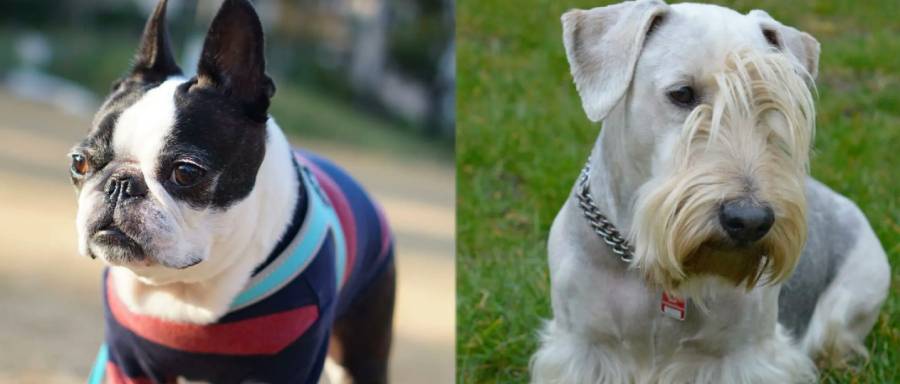
Boston Terriers and Miniature Pinschers are small dogs, but they differ significantly in size, temperament, exercise needs, trainability, and health concerns. The Boston Terrier is larger and generally more companion-oriented, while the Miniature Pinscher is smaller, more energetic, alert, and independent. These differences affect how well each breed fits a specific owner, household, and daily routine.
An adult Boston Terrier typically has a compact, muscular build and a short, flat muzzle, while the Miniature Pinscher has a lighter frame, longer muzzle, and distinctive high-stepping movement. Their behavioral characteristics also differ. Boston Terriers tend to seek close interaction with their families, whereas Miniature Pinschers combine affection with greater independence and an alert personality. Exercise, training, barking, and interactions with children or other pets can therefore require different approaches.
Health is another important distinction. Boston Terriers have a brachycephalic skull structure that influences breathing and heat tolerance, while Miniature Pinschers have a different set of breed-associated health concerns. Comparing these characteristics alongside lifespan, grooming, apartment suitability, and daily care requirements provides a clearer picture of what living with each breed involves.
What Is the Difference Between a Boston Terrier and a Miniature Pinscher?
The main differences between a Boston Terrier and a Miniature Pinscher are their size, body structure, temperament, exercise needs, training behavior, and health concerns. Boston Terriers are heavier, more compact dogs with short muzzles, while Miniature Pinschers are smaller, lighter dogs with longer muzzles and a more alert, independent temperament.
| Attribute | Boston Terrier | Miniature Pinscher |
|---|---|---|
| Height | 15–17 inches | 10–12.5 inches |
| Weight | 12–25 pounds | 8–10 pounds |
| Body type | Compact and muscular | Compact and well-balanced |
| Muzzle | Short and broad | Longer and tapered |
| Temperament | Friendly, social, lively | Alert, energetic, independent |
| Energy level | Moderate to high | High |
| Exercise needs | Regular daily exercise | Regular physical and mental activity |
| Training | Responsive but can be stubborn | Intelligent but independent |
| Barking tendency | Generally moderate | More alert and vocal |
| Coat | Short and smooth | Short, hard, smooth coat |
| Grooming needs | Low | Low |
| Key health consideration | Brachycephalic structure | Breed-specific orthopedic and neurological concerns |
The size difference is substantial despite both breeds being classified as small dogs. Boston Terriers weigh 12–25 pounds and stand 15–17 inches tall, whereas Miniature Pinschers weigh about 8–10 pounds and stand 10–12.5 inches tall. This makes the Miniature Pinscher easier to physically handle because of its lower body weight, although its smaller size does not mean it requires less activity or behavioral management.
Their personalities create another clear distinction. Boston Terriers were developed as companion dogs and are strongly associated with friendly, social interaction with people. Miniature Pinschers are also affectionate with their families, but their alertness, confidence, independence, and energetic behavior can make them more demanding to manage. A Miniature Pinscher may therefore require an owner who is prepared to provide consistent training, mental stimulation, and appropriate outlets for its energy.
Health considerations also differ because the two breeds have different physical structures. The Boston Terrier is a brachycephalic breed, meaning its shortened skull and muzzle can contribute to breathing and heat-related problems. Miniature Pinschers do not have the same brachycephalic anatomy, but they have their own breed-associated health risks. These differences make health, exercise tolerance, and veterinary care important factors when comparing the long-term requirements of the two breeds.
How Do Boston Terriers and Miniature Pinschers Differ in Size?
Miniature Pinschers are smaller than Boston Terriers in both height and weight. An adult Miniature Pinscher stands approximately 10–12.5 inches at the shoulder and weighs 8–10 pounds, while an adult Boston Terrier stands 15–17 inches and falls into a broader 12–25-pound weight range. A Boston Terrier can therefore weigh more than twice as much as a Miniature Pinscher at the upper end of the breed’s weight range.
Body structure further increases the physical difference between them. Boston Terriers have compact, muscular bodies with relatively substantial frames for small dogs. Miniature Pinschers are also compact, but their bodies are lighter and more streamlined. Their proportions, longer legs relative to overall size, and characteristic movement can make them appear more athletic despite their lower body weight.
Size affects practical aspects of ownership, including handling, transportation, feeding portions, and interactions with young children. An 8–10-pound Miniature Pinscher is physically easier for most adults to pick up and carry, but its small frame also requires careful handling to reduce accidental injuries. A Boston Terrier has a sturdier and heavier build, although its compact size still makes the breed manageable in smaller homes.
The size difference does not determine which breed needs more exercise. Miniature Pinschers are smaller but remain energetic dogs that require daily physical activity and mental stimulation. Boston Terriers are larger, yet their exercise must account for individual fitness and the limitations associated with their shortened muzzle. Size should therefore be considered alongside energy level, health, and temperament rather than used alone to determine which breed is easier to own.
How Do Boston Terriers and Miniature Pinschers Differ in Appearance?
Boston Terriers have a stockier body, shorter muzzle, and broader head, while Miniature Pinschers have a lighter frame, longer muzzle, and more streamlined appearance. Both breeds have short coats and compact bodies, but their proportions and facial structures make them easy to distinguish.
Boston Terriers have square, compact bodies with muscular proportions and relatively broad chests. Their heads are square and proportionate to their bodies, while their muzzles are short, wide, and deep. Large, round eyes and small, erect ears contribute to the breed’s distinctive facial appearance. The short muzzle is particularly important because the Boston Terrier is a brachycephalic breed, meaning its skull is shorter than that of dogs with conventional muzzle proportions.
Miniature Pinschers have compact but lighter bodies with well-defined proportions. Their heads narrow toward the muzzle rather than displaying the broad, flat facial structure seen in Boston Terriers. Erect ears, dark eyes, and a more elongated muzzle create a sharper facial profile. The breed is also known for its characteristic high-stepping movement, which produces a noticeably different outline and gait from the Boston Terrier.
Both breeds have short coats that require relatively little routine brushing, but their recognized coat colors differ. Boston Terriers are particularly associated with distinctive white markings combined with black, brindle, or seal coloring. Miniature Pinschers can have solid red, stag red, black with rust markings, or chocolate with rust markings under recognized breed standards. Coat color therefore provides another visible distinction, although body structure and head shape are more reliable ways to differentiate the breeds.
How Do Boston Terrier and Miniature Pinscher Temperaments Compare?
Boston Terriers are generally more sociable and companion-oriented, while Miniature Pinschers tend to be more independent, alert, and assertive. Both breeds can form strong relationships with their owners, but they express their personalities differently and require different approaches to daily interaction and behavioral management.
Boston Terriers are companion dogs that typically enjoy spending substantial time around people. Affection, playfulness, and social interaction are central characteristics of the breed. Their people-oriented temperament can make them suitable for owners who want a small dog that actively participates in household life. Individual Boston Terriers can still display stubborn behavior, so sociability should not be confused with automatic obedience.
Miniature Pinschers combine affection toward familiar people with greater independence and vigilance. They are energetic, curious dogs that tend to pay close attention to movement and changes in their surroundings. This alertness can contribute to watchdog behavior, including reacting to unfamiliar people, sounds, or activity. Their confidence can appear disproportionate to their 8–10-pound body size, making consistent boundaries important from an early age.
The two breeds also differ in how owners need to manage their behavioral traits. Boston Terriers generally benefit from frequent interaction, positive training, play, and opportunities to remain involved with their families. Miniature Pinschers require these elements as well, but their independence and high activity level increase the importance of consistent training and mental stimulation. Without sufficient outlets for activity and curiosity, an energetic Miniature Pinscher may redirect that energy toward unwanted behaviors.
Temperament is a breed tendency rather than a guarantee of an individual dog’s behavior. Genetics, early socialization, training, household environment, previous experiences, and the owner’s management all influence adult behavior. A well-socialized Miniature Pinscher can therefore be highly affectionate and sociable, while an individual Boston Terrier may be more independent than expected from general breed descriptions.
Which Breed Has More Energy, a Boston Terrier or a Miniature Pinscher?
Miniature Pinschers generally have higher energy levels than Boston Terriers and require consistent physical activity and mental stimulation. Boston Terriers are also playful and active, but their exercise intensity needs to account for individual fitness, weather conditions, and their brachycephalic facial structure.
Miniature Pinschers are energetic dogs that tend to remain active both indoors and outdoors. Walking alone may not satisfy their need for activity because physical exercise addresses only part of their stimulation requirements. Interactive play, short training sessions, scent-based activities, and food puzzles provide additional mental engagement. Their curiosity and alertness make structured activities particularly useful for preventing boredom and channeling energy into appropriate behaviors.
Boston Terriers benefit from daily walks and interactive play but generally do not require the same level of sustained activity as highly energetic small breeds. Activities such as neighborhood walks, retrieving toys, indoor games, and short training sessions can provide both physical and mental exercise. Their compact size also makes several forms of indoor activity practical when outdoor exercise is limited.
Exercise management is particularly important for Boston Terriers because their shortened muzzle can affect breathing and heat regulation. Owners should monitor breathing, fatigue, temperature, and exercise intensity rather than assuming that a Boston Terrier can safely maintain the same activity level under all conditions. Hot and humid environments can make strenuous exercise especially challenging for brachycephalic dogs.
The Miniature Pinscher’s smaller body does not translate into lower exercise requirements. Its combination of energy, curiosity, and alertness means that owners need to provide regular opportunities for movement and mental engagement. The Boston Terrier generally fits a more moderate exercise routine, while the Miniature Pinscher is better matched to an owner prepared for a consistently active small dog.
Which Is Easier to Train, a Boston Terrier or a Miniature Pinscher?
Boston Terriers are generally easier for inexperienced owners to manage during training, while Miniature Pinschers can require greater consistency because of their independent and confident temperament. Both breeds are capable of learning household rules and commands, but motivation, attention, socialization, and owner consistency influence training results.
Boston Terriers tend to respond well to positive, reward-based training that uses food, toys, praise, or play as reinforcement. Their interest in interacting with people can support training because the owner becomes part of the reward process. However, Boston Terriers can also be stubborn, so short and consistent sessions are more effective than repetitive training that causes the dog to lose interest.
Miniature Pinschers are intelligent and capable learners, but independence can make training more demanding. A Miniature Pinscher may understand a command without consistently choosing to follow it when something in the environment is more rewarding. Owners therefore need clear household rules, consistent reinforcement, and engaging training sessions that hold the dog’s attention. Rewarding the desired behavior is more productive than relying on harsh corrections.
Early socialization is important for both breeds. Controlled exposure to different people, dogs, sounds, surfaces, environments, and everyday situations helps puppies develop appropriate responses to unfamiliar experiences. This process is especially relevant for an alert Miniature Pinscher because unmanaged vigilance can contribute to excessive reactions toward environmental triggers.
First-time owners can successfully raise either breed, but the challenges differ. A Boston Terrier owner needs to balance training and exercise with the breed’s physical and respiratory considerations. A Miniature Pinscher owner needs to be prepared for higher activity, independence, alert behavior, and consistent behavioral boundaries. Training difficulty therefore depends not only on intelligence but also on how closely each breed’s behavioral characteristics match the owner’s experience, routine, and willingness to train consistently.
Which Barks More, a Boston Terrier or a Miniature Pinscher?
Miniature Pinschers generally have a stronger tendency to bark than Boston Terriers because they are highly alert and responsive to activity in their environment. Boston Terriers can bark at visitors, unfamiliar sounds, or during excitement, but barking is typically less central to their everyday behavior.
Miniature Pinschers tend to notice changes around the home quickly. People approaching the door, unfamiliar noises, animals outside, or movement near windows can trigger alert barking. This behavior can be useful for owners who want a small watchdog, but frequent environmental triggers can become difficult to manage in apartments or other homes where excessive noise creates problems.
Boston Terriers can also use barking to communicate excitement, seek attention, or respond to unfamiliar situations. However, their generally companion-oriented temperament means they are less defined by vigilant watchdog behavior than Miniature Pinschers. Individual Boston Terriers can still become frequent barkers when barking repeatedly produces a desired result, such as attention from an owner.
Training should address the reason for barking rather than attempting to eliminate vocalization completely. Owners can reduce unnecessary barking by rewarding calm behavior, providing sufficient physical and mental activity, controlling access to repeated visual triggers, and teaching consistent responses to visitors and household sounds. Early training is particularly valuable for Miniature Pinschers because their natural alertness can reinforce repeated barking when the behavior is left unmanaged.
Breed influences barking tendency, but it does not determine exactly how vocal an individual dog will become. Socialization, daily stimulation, learned behavior, household environment, and training can substantially change barking frequency. The Miniature Pinscher is therefore the more likely choice to require active barking management, while the Boston Terrier generally presents a lower alert-barking tendency.
Are Boston Terriers or Miniature Pinschers Better With Children?
Boston Terriers are generally more naturally suited to family interaction, while Miniature Pinschers can live successfully with children when handling, supervision, and socialization are appropriate. The most important differences involve physical size, interaction style, energy, and tolerance of handling rather than a simple distinction between a child-friendly and child-unfriendly breed.
Boston Terriers combine a sturdy small-dog build with a social and playful temperament. Their 12–25-pound weight range gives them a more substantial frame than the 8–10-pound Miniature Pinscher, which can reduce some of the physical vulnerability associated with very small dogs. Their interest in human interaction also allows play and family activities to become regular sources of stimulation.
Miniature Pinschers are playful and energetic, but their smaller frames require more careful handling. Rough play, dropping, squeezing, or accidentally stepping on an 8–10-pound dog can cause injury. Children therefore need to understand how to approach, touch, pick up, and play with a small dog appropriately. A Miniature Pinscher’s independence also means that children should respect signals that the dog wants space rather than continuing an unwanted interaction.
Supervision remains necessary with both breeds, particularly around young children. Adults should prevent children from disturbing a dog while it is eating or sleeping, taking toys or food directly from the dog, climbing on it, or forcing physical contact. These rules reduce preventable conflicts regardless of breed.
Early socialization further influences family compatibility. Puppies that have positive, controlled experiences with children can learn that their movement, voices, and play are normal parts of the household environment. Children must simultaneously learn appropriate behavior around dogs. Boston Terriers may provide a more straightforward fit for households seeking a social companion, while Miniature Pinschers can also thrive in families prepared to manage their smaller size, higher energy, and more independent temperament.
Do Boston Terriers or Miniature Pinschers Get Along Better With Other Pets?
Boston Terriers generally have a more social temperament around other household pets, while Miniature Pinschers can require more careful introductions and management because of their alert, independent nature. Both breeds can live successfully with other dogs and cats, but early socialization, individual temperament, previous experiences, and the behavior of the other animal influence compatibility.
Boston Terriers tend to enjoy social interaction and can adapt well to multi-dog households when properly introduced. Regular positive experiences with other dogs during puppyhood help establish appropriate communication and play behavior. Their playful personality can make another compatible dog a useful social companion, although differences in size, energy, and play style still need to be considered.
Miniature Pinschers can also live with other dogs, but their confidence means their behavior does not always correspond to their small size. An 8–10-pound Miniature Pinscher may approach a substantially larger dog without recognizing the physical disadvantage created by the size difference. Owners should therefore supervise early interactions and interrupt play that becomes excessively rough or intense.
Living with cats depends more heavily on the individual dog and its socialization history. A puppy raised around cats is generally easier to integrate than an adult dog with an established habit of chasing small animals. Introductions should be gradual, with the cat retaining access to elevated areas or separate spaces where the dog cannot follow. Owners should reward calm behavior instead of allowing repeated chasing to become established.
Neither breed should be assumed to be automatically safe with every animal based on breed characteristics alone. Compatibility develops through controlled introductions, socialization, supervision, and management of individual behavior. Boston Terriers generally provide the more naturally social starting point, while Miniature Pinschers may require additional attention to arousal, chasing, and confident interactions with larger animals.
Which Breed Is Easier to Groom, a Boston Terrier or a Miniature Pinscher?
Boston Terriers and Miniature Pinschers are both relatively low-maintenance grooming breeds because each has a short coat that requires limited brushing and no routine professional trimming. The differences in coat maintenance are small, so grooming is unlikely to be the deciding factor between the two breeds.
Boston Terriers have short, smooth coats that can be maintained with regular brushing to remove loose hair and distribute natural skin oils. Miniature Pinschers also have short, smooth coats, and routine brushing performs the same basic functions. Neither breed develops the mats or tangles associated with long-haired dogs, reducing the amount of time required for coat care.
Both breeds shed, despite their short coats. Loose hairs are simply shorter and less visually obvious than the longer hair produced by some breeds. Regular brushing can collect part of this loose hair before it reaches furniture and clothing, but neither a Boston Terrier nor a Miniature Pinscher should be considered a non-shedding dog.
Bathing should be based on coat condition, activity, and exposure to dirt rather than performed excessively. Frequent bathing without a specific need can remove protective oils from the skin. Owners should use products formulated for dogs and monitor for redness, itching, persistent odor, hair loss, or other changes that could indicate a skin problem rather than a grooming issue.
Routine grooming also extends beyond the coat. Both breeds require nail trimming, dental care, and ear checks. Nails need to remain short enough to avoid interfering with normal movement, while regular tooth brushing helps control plaque accumulation. Ears should be monitored for unusual odor, discharge, redness, or irritation.
Boston Terriers require one additional area of attention because of their facial structure. Facial folds and areas around the eyes should be monitored and kept clean and dry when necessary, particularly in dogs with more pronounced folds. Miniature Pinschers do not have the same facial-fold maintenance requirement. Overall, however, both breeds remain comparatively simple to groom, with coat care requiring considerably less work than training, exercise, and health management.
What Health Problems Affect Boston Terriers and Miniature Pinschers?
Boston Terriers and Miniature Pinschers have different breed-associated health concerns, with Boston Terriers requiring particular attention to brachycephalic, eye, and orthopedic problems, while Miniature Pinschers have notable orthopedic, neurological, and endocrine concerns. Breed predisposition increases the risk of specific conditions but does not mean every dog will develop them.
Health differences matter when choosing between these breeds because they affect veterinary monitoring, exercise management, and potential long-term care. A prospective owner should consider the health history of the puppy’s parents, health screening performed before breeding, and the individual dog’s veterinary records rather than relying only on average breed characteristics.
What Health Problems Are Common in Boston Terriers?
Boston Terriers are particularly associated with health concerns involving breathing, eyes, kneecaps, hearing, and the spine. Their shortened skull structure is one of the most important physical characteristics affecting health because it can restrict airflow in affected dogs.
Brachycephalic obstructive airway syndrome, or BOAS, describes breathing problems associated with anatomical abnormalities found in short-muzzled dogs. Affected Boston Terriers can show noisy breathing, reduced exercise tolerance, difficulty recovering after activity, or greater susceptibility to overheating. The severity differs between individual dogs, so exercise capacity should be assessed from the dog’s actual breathing and physical condition rather than breed appearance alone.
Eye problems also deserve attention because Boston Terriers have large, prominent eyes. Their eye structure can increase exposure to injury and irritation, making persistent redness, squinting, discharge, cloudiness, or obvious discomfort reasons for veterinary assessment. Patellar luxation, in which the kneecap moves out of its normal position, is another orthopedic condition associated with small breeds, including Boston Terriers.
Deafness and certain spinal abnormalities are additional concerns within the breed. Responsible breeding therefore involves more than producing puppies that visually meet breed characteristics. Appropriate health screening and knowledge of family medical history can help prospective owners evaluate health risks before choosing a puppy.
What Health Problems Are Common in Miniature Pinschers?
Miniature Pinschers can be affected by orthopedic conditions such as patellar luxation and Legg-Calvé-Perthes disease, as well as neurological and endocrine disorders found within the breed. Their longer muzzle means they do not face the same brachycephalic airway concerns as Boston Terriers, but this does not make them free from inherited health risks.
Patellar luxation affects the position and movement of the kneecap and can cause intermittent skipping, abnormal gait, discomfort, or more persistent mobility problems depending on severity. Legg-Calvé-Perthes disease affects the head of the femur at the hip joint and can lead to pain and lameness. Because the Miniature Pinscher weighs only about 8–10 pounds, owners should also prevent unnecessary physical trauma caused by falls or unsafe handling.
Neurological conditions, including epilepsy, can occur in Miniature Pinschers. Seizures require veterinary investigation because several underlying conditions can produce similar symptoms. Thyroid disorders are another health consideration, with hypothyroidism potentially affecting metabolism, body weight, skin, coat, and activity.
Health screening remains important even when a puppy appears healthy. Prospective owners should ask breeders which health tests have been performed on the parents and request documentation rather than relying on statements that a breeding line has no health problems. Veterinary examinations, appropriate nutrition, weight management, dental care, and preventive medicine remain necessary throughout the dog’s life regardless of breed.
Which Lives Longer, a Boston Terrier or a Miniature Pinscher?
Boston Terriers and Miniature Pinschers can both live well into their teens, and the difference between individual dogs can be greater than the difference between breed lifespan estimates. Lifespan ranges should therefore be treated as population-level guidance rather than a prediction of how long a specific dog will live.
Genetics is one of the major factors affecting longevity. Dogs produced from parents with documented health screening may have a lower risk of inheriting certain preventable or detectable disorders, although screening cannot eliminate every disease. Choosing a responsible breeder or obtaining detailed medical information for an adopted dog provides owners with a stronger basis for planning preventive care.
Body condition also affects long-term health. Maintaining an appropriate weight reduces unnecessary stress on joints and supports cardiovascular and metabolic health. This is relevant to both breeds but requires different exercise considerations: Miniature Pinschers need sufficient activity to satisfy their high energy levels, while Boston Terrier exercise must also account for breathing ability and heat tolerance.
Preventive veterinary care provides another major influence on lifespan. Routine examinations can identify dental disease, weight changes, heart abnormalities, mobility problems, eye conditions, or other health changes before they become more advanced. Vaccination, parasite prevention, appropriate nutrition, exercise, and prompt treatment of illness further influence long-term outcomes.
For prospective owners, lifespan should therefore be evaluated together with expected quality of life and breed-specific health risks. The more useful comparison is not simply which breed has the higher lifespan estimate, but which breed’s health requirements an owner is prepared to monitor and manage throughout the dog’s life.
Which Is Better for Apartment Living, a Boston Terrier or a Miniature Pinscher?
Boston Terriers generally have characteristics that are easier to accommodate in apartments, while Miniature Pinschers can also adapt well when their higher activity and alert-barking tendencies are properly managed. Both breeds are physically small enough for limited living spaces, but apartment suitability depends on more than body size.
Boston Terriers have compact bodies and generally moderate exercise requirements, allowing owners to meet much of their daily activity through walks, play, and short training sessions. They also tend to be less alert-driven than Miniature Pinschers, which can make environmental sounds in hallways, elevators, and neighboring apartments less likely to become persistent barking triggers. Their need for human interaction, however, means owners still need to provide companionship and daily engagement.
Miniature Pinschers occupy less physical space because adults are only about 10–12.5 inches tall and weigh approximately 8–10 pounds. Their small size makes them physically well suited to apartments, but their energy level can make them feel like much larger dogs in daily life. Indoor play, walks, training, and mental enrichment are necessary to prevent limited floor space from translating into insufficient stimulation.
Barking requires additional consideration for Miniature Pinschers in shared buildings. Their alert temperament means footsteps outside the door, people passing windows, elevator sounds, and other dogs can become repeated triggers. Training calm responses and limiting access to visual triggers can reduce this behavior. Exercise alone does not necessarily solve alert barking because the behavior is also influenced by environmental awareness and learned responses.
Apartment owners should also consider temperature when exercising a Boston Terrier. Its brachycephalic structure can make strenuous activity in hot conditions more difficult, so exercise may need to be scheduled for cooler periods and adjusted to the individual dog’s breathing ability. Miniature Pinschers have a different consideration: their small bodies and short coats provide limited insulation in cold weather.
Neither breed requires a large yard to maintain an appropriate activity routine. A Boston Terrier generally fits apartment life more easily when an owner wants a moderately active companion, while a Miniature Pinscher can thrive in an apartment when the owner consistently manages exercise, mental stimulation, and barking.
What Type of Owner Is Better Suited to a Boston Terrier?
A Boston Terrier is well suited to an owner who wants a social, playful small companion and can manage the health and exercise considerations associated with a brachycephalic breed. The breed is particularly compatible with people who prefer regular interaction with their dog rather than a highly independent companion.
Boston Terriers fit households where the dog can participate in everyday family activities. Their social temperament makes play, short walks, training sessions, and time with household members important parts of daily life. They do not require the exercise schedule of a high-endurance working breed, which can make them manageable for owners with moderately active lifestyles.
First-time dog owners may find Boston Terriers approachable because of their companion-oriented temperament and manageable body size. Training still requires consistency because individual dogs can be stubborn or easily distracted. Positive reinforcement and short sessions provide a practical training approach without turning every interaction into a prolonged obedience exercise.
Prospective owners must be prepared for breed-specific health management. Monitoring breathing, avoiding excessive heat exposure, maintaining a healthy body weight, and recognizing signs of respiratory or eye problems are important responsibilities. An owner who regularly participates in prolonged strenuous outdoor exercise may find these physical limitations less compatible with the activities expected from a dog.
Boston Terriers therefore fit owners who prioritize companionship, indoor family life, moderate daily activity, and relatively simple coat maintenance. The owner should simultaneously be willing to account for the breed’s brachycephalic anatomy throughout exercise, travel, weather exposure, and veterinary care.
Read more: Boston Terrier vs Staffordshire Bull Terrier: Differences
What Type of Owner Is Better Suited to a Miniature Pinscher?
A Miniature Pinscher is well suited to an owner who wants a small but energetic, confident, and alert dog and is prepared to provide consistent training and daily mental stimulation. Its 8–10-pound size makes the breed physically compact, but its behavioral needs are greater than its dimensions might suggest.
Active owners can provide appropriate outlets through daily walks, interactive games, training exercises, and opportunities to explore safely. Miniature Pinschers benefit from activities that engage both movement and problem-solving because their curiosity can otherwise lead them to create their own forms of entertainment. An owner looking specifically for a quiet, low-activity lap dog may therefore find the breed’s normal behavior demanding.
Consistency is especially important. Household rules should remain predictable, and desirable behaviors should be reinforced from puppyhood. Allowing unwanted behavior because a puppy is small can create management problems once those behaviors become established. Training should address practical skills such as recall, calm behavior, handling, and appropriate responses to environmental triggers.
Owners also need to manage the Miniature Pinscher’s physical vulnerability. Its small frame makes careful handling important, particularly in homes with young children or substantially larger dogs. Secure containment matters as well because an energetic, curious small dog can take advantage of openings that would not accommodate a larger breed.
The Miniature Pinscher therefore fits owners who value energy, alertness, personality, and active engagement in a compact dog. The strongest match is an owner who views training and enrichment as part of the daily routine rather than expecting small size to equal minimal care.
How Can You Choose Between a Boston Terrier and a Miniature Pinscher?
Choose between a Boston Terrier and a Miniature Pinscher by matching each breed’s temperament, energy level, training needs, physical characteristics, and health requirements with your household and daily routine. Boston Terriers generally fit owners seeking a social companion with moderate activity needs, while Miniature Pinschers fit owners who prefer a smaller, more energetic, alert, and independent dog.
A Boston Terrier is more closely aligned with households where companionship and frequent interaction are priorities. Its sturdy small-dog build can also be practical for families, while moderate exercise requirements make the breed manageable for owners who enjoy daily walks and play without wanting a highly active dog. Owners must, however, be prepared to manage the respiratory and heat-related considerations associated with the breed’s brachycephalic structure.
A Miniature Pinscher is more closely aligned with owners who want an active personality in a very small body. The breed’s energy, curiosity, alertness, and independence create a greater need for consistent training and mental stimulation. Its small size can work well in apartments, but size alone does not make the breed low-maintenance. Barking and indoor activity require active management, particularly in shared living environments.
Families with children should consider both temperament and physical size. Boston Terriers have a heavier, sturdier build, while the smaller Miniature Pinscher requires more careful handling. Households with other pets should evaluate individual behavior and previous socialization rather than selecting solely by breed. Controlled introductions remain important for both dogs.
Health requirements create another meaningful distinction. Boston Terrier owners need to account for brachycephalic anatomy, particularly during exercise and hot weather. Miniature Pinscher owners do not face the same shortened-airway concern but should remain aware of orthopedic, neurological, and other breed-associated conditions. Health screening and veterinary history should therefore be considered when choosing an individual puppy or adult dog.
The practical differences can be summarized by matching the owner’s circumstances with the characteristics that matter most:
| Owner consideration | Characteristics to prioritize |
|---|---|
| Apartment living | Boston Terrier for generally lower alert barking; Miniature Pinscher when exercise and barking can be consistently managed |
| Moderate activity | Boston Terrier |
| More active daily routine | Miniature Pinscher |
| Young children | Boston Terrier’s sturdier size can be easier to manage, with supervision still required |
| Very small dog preference | Miniature Pinscher |
| Lower alert-barking tendency | Boston Terrier |
| Alert watchdog behavior | Miniature Pinscher |
| First-time ownership | Boston Terrier may present fewer behavioral management demands |
| Simple coat maintenance | Both breeds |
| Hot-weather exercise | Miniature Pinscher avoids Boston Terrier’s brachycephalic airway limitation |
| Highly interactive companion | Boston Terrier |
| Independent, energetic personality | Miniature Pinscher |
Neither breed is universally more suitable because the strongest match depends on the owner’s lifestyle and expectations. A Boston Terrier emphasizes companionship, sociability, and moderate activity in a compact but relatively sturdy body. A Miniature Pinscher emphasizes energy, alertness, independence, and active engagement in a smaller frame. Comparing those characteristics against the household’s activity level, children, other pets, living space, training commitment, and ability to manage breed-specific health needs provides a more useful basis for choosing between them.