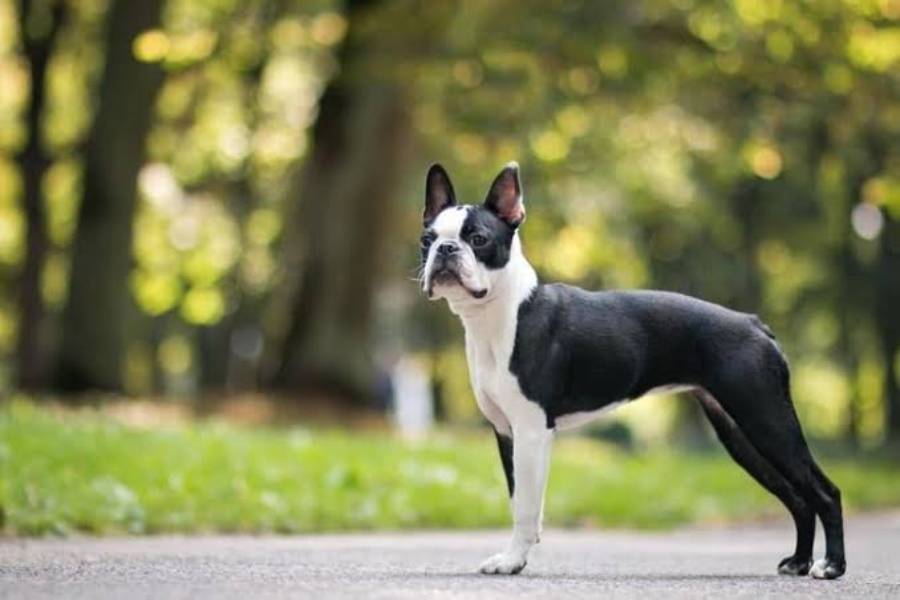
The Boston Terrier originated in Boston, Massachusetts, in the late 19th century, developing from bull-and-terrier-type dogs into a smaller companion breed with a distinct American identity. Its history is closely connected to Hooper’s Judge, a dog widely regarded as a foundation ancestor of the breed, and the generations of selective breeding that followed.
Early dogs in the Boston Terrier bloodline differed considerably from the compact, tuxedo-marked companions recognized today. Breeders gradually selected for more consistent size, appearance, markings, and temperament, helping establish the Boston Terrier as a distinct breed rather than another bull-and-terrier type. Organized breeding and the development of a formal breed identity eventually led to recognition by the American Kennel Club.
Understanding Boston Terrier history therefore involves more than identifying where the breed came from. Its ancestry, foundation dogs, original breeding context, changing physical characteristics, and transition toward companionship all help explain the modern Boston Terrier. This history also provides context for the breed’s strong association with Boston and its enduring nickname, the “American Gentleman.”
Where Did the Boston Terrier Originate?
The Boston Terrier originated in Boston, Massachusetts, during the late 19th century. Unlike many established dog breeds that trace their development to Europe, the Boston Terrier was developed in the United States. Its close connection with Boston became strong enough that the city eventually provided the breed with its permanent name.
The breed developed from bull-and-terrier-type dogs brought into the Boston area and subsequently bred by local dog enthusiasts. These early dogs were not identical to modern Boston Terriers. They tended to be larger and heavier, and their appearance was less standardized because breeders had not yet established the consistent physical characteristics associated with the breed today. Through successive generations, breeders selected dogs with specific traits and gradually created a more recognizable type.
Boston was therefore more than the location where individual ancestors happened to live. It was the center of the breeding activity that transformed those dogs into a distinct breed. Local breeders established bloodlines, selected desirable characteristics, and eventually organized efforts to define the breed. This connection between the dog and the city became a permanent part of Boston Terrier history and explains why the breed is strongly identified as American.
The late-19th-century origin also separates the Boston Terrier’s ancestry from the history of the standardized breed itself. Bull-and-terrier dogs existed before the Boston Terrier, but the Boston Terrier emerged only after breeders in the United States began developing those ancestral bloodlines toward a distinct and increasingly consistent type.
What Breeds Were Used to Create the Boston Terrier?
The Boston Terrier primarily developed from Bulldog and white English terrier ancestry associated with the bull-and-terrier dogs of the 19th century. These ancestral dogs combined characteristics from bulldog-type and terrier-type breeds, providing the foundation from which Boston breeders developed a separate breed.
The English Bulldog contributed to the bulldog side of the Boston Terrier’s ancestry, while the White English Terrier, an extinct breed also referred to in historical accounts as the English White Terrier, is commonly associated with its terrier ancestry. The resulting bull-and-terrier lineage existed before the Boston Terrier became standardized, so these ancestral dogs should not be treated as though they already possessed all the characteristics of a modern Boston Terrier.
This distinction explains why early dogs in the bloodline could look substantially different from Boston Terriers today. Early representatives were generally less uniform because features such as body size, head proportions, markings, and overall appearance had not yet been fixed through generations of selective breeding. Breeders subsequently emphasized particular characteristics, causing the developing Boston Terrier to become increasingly distinguishable from the broader bull-and-terrier population from which it descended.
The ancestry also provides historical context for the Boston Terrier’s sturdy body and distinctive head structure. However, the modern breed is the result of later selective breeding rather than a simple reproduction of its Bulldog and terrier ancestors. Understanding that distinction is important: the ancestral breeds supplied the original genetic foundation, while generations of breeding in Boston created the Boston Terrier as a recognizable breed.
Who Was Hooper’s Judge in Boston Terrier History?
Hooper’s Judge was one of the most important foundation dogs in Boston Terrier history and became a major ancestor of the developing breed. The dog was owned by Robert C. Hooper of Boston, and his bloodline became central to the breeding program that eventually produced the Boston Terrier.
Judge looked considerably different from the smaller Boston Terriers seen today. He was a bull-and-terrier-type dog with a heavier build and physical characteristics inherited from the Bulldog and terrier ancestry associated with early Boston Terrier development. His importance came primarily from his influence on subsequent generations rather than from representing the finished breed standard. For this reason, describing Judge as a foundation ancestor is more accurate than treating him as a modern Boston Terrier.
A crucial stage in the bloodline occurred when Judge was bred with Burnett’s Gyp, also known in historical accounts as Burnett’s Kate. Their offspring provided another generation from which breeders could continue selecting particular characteristics. Over successive breedings, descendants became more consistent in size, body structure, head shape, and other features that distinguished them from the larger bull-and-terrier dogs behind the original bloodline.
Judge therefore represents a starting point for tracing documented Boston Terrier development rather than the final form of the breed. His descendants gave Boston breeders a foundation they could selectively refine, eventually producing dogs substantially smaller and more standardized than Judge himself.
What Role Did Burnett’s Gyp Play in the Boston Terrier Bloodline?
Burnett’s Gyp contributed the maternal side of one of the foundational crosses in the developing Boston Terrier bloodline. Her breeding with Hooper’s Judge produced offspring that became important to subsequent generations, connecting two early lines from which breeders could continue developing a more consistent type.
This pairing is significant because dog breeds do not emerge from a single animal. Judge supplied an influential paternal line, while Gyp and subsequent females contributed equally necessary genetic material to later generations. Repeated selection among their descendants, rather than the Judge-Gyp pairing alone, ultimately shaped the Boston Terrier.
The role of Burnett’s Gyp also demonstrates why Boston Terrier history is best understood as a breeding process. Foundation dogs established the bloodline, but later breeders determined its direction by choosing which descendants to reproduce. Those choices gradually moved the dogs away from their larger bull-and-terrier ancestors and toward the recognizable Boston Terrier.
What Were Boston Terriers Originally Bred For?
The Boston Terrier developed from bull-and-terrier ancestry associated with the fighting and working dog culture of the 19th century, but the standardized Boston Terrier was subsequently developed toward companionship rather than fighting. This distinction is important because the historical purpose of ancestral dogs is frequently presented as though it automatically describes the purpose of the finished breed.
Bull-and-terrier dogs were historically produced by crossing bulldog-type dogs with terriers. Such dogs were associated with blood sports and were valued for combinations of strength, persistence, and agility. Hooper’s Judge came from this broader breeding background, which places the earliest Boston Terrier bloodline within that historical context.
The direction of Boston breeding changed as enthusiasts began selecting for a distinct type. Rather than maintaining large fighting dogs, breeders progressively emphasized smaller size, recognizable physical characteristics, and traits suited to life as a companion. The resulting dogs became increasingly different from the animals at the beginning of the bloodline.
This transition explains why the question “What were Boston Terriers originally bred for?” requires two levels of context. Their foundation came from bull-and-terrier dogs connected with fighting traditions, while the Boston Terrier that emerged as a standardized breed was developed into a companion dog. Treating these stages separately provides a more accurate explanation of how the breed moved from its 19th-century ancestry toward the temperament and role associated with Boston Terriers today.
How Did Early Boston Terriers Become a Distinct Breed?
Early Boston Terriers became a distinct breed through selective breeding for more consistent size, appearance, and temperament. The foundation dogs were not simply smaller versions of the Boston Terrier seen today. Breeders needed multiple generations to establish recognizable characteristics and separate the developing dogs from the broader bull-and-terrier types behind their ancestry.
Size was one of the characteristics that changed substantially during this process. Foundation dogs such as Hooper’s Judge had a heavier build than modern Boston Terriers. By selecting smaller descendants for breeding, breeders gradually produced a more compact dog. This reduction in size accompanied changes in body proportions and overall appearance, creating a type increasingly suited to companionship rather than the roles associated with earlier bull-and-terrier dogs.
Physical consistency also became more important as the breed developed. Early dogs could vary considerably because a formal standard had not yet fixed characteristics across the population. Selective breeding made features such as the compact body, distinctive head, short coat, and characteristic markings more predictable between generations. The process did not occur through a single cross. Each generation gave breeders another opportunity to reinforce desired traits and reduce characteristics that did not fit the emerging type.
Temperament developed alongside physical appearance. As the Boston Terrier moved toward the role of a companion dog, breeding priorities increasingly favored characteristics appropriate for living closely with people. The breed that emerged was therefore the product of deliberate selection rather than an unchanged continuation of its ancestral bull-and-terrier type.
Breed organization was another important step toward establishing a separate identity. Once enthusiasts could recognize a consistent type, they could define which dogs belonged to the developing breed and establish standards for future breeding. Selective breeding created greater consistency, while organized breeding turned that consistency into a defined Boston Terrier breed.
How Did the Boston Terrier Get Its Name?
The Boston Terrier received its name from Boston, Massachusetts, the city where the breed was developed. The name directly connects the breed with its American place of origin and distinguishes it from the broader Bulldog and terrier ancestry from which its foundation bloodline developed.
The name was not necessarily the first label associated with the developing dogs. During the early stages of breed formation, enthusiasts used other terminology for dogs belonging to this emerging type. As breeders worked toward establishing an independent breed identity, however, a name tied specifically to Boston provided a clearer distinction from existing bull-and-terrier dogs and other established breeds.
Adopting the Boston Terrier name also reflected a broader change in the dogs themselves. They were no longer defined only through their Bulldog and terrier ancestry. Generations of selective breeding in Boston had produced a population with increasingly consistent characteristics, allowing breeders to identify their dogs as members of a separate breed.
The geographic name consequently became part of the breed’s identity rather than simply describing where individual dogs lived. Boston identifies the place where the breed took shape, while Terrier preserves part of the terminology connected with its historical ancestry. The name remains one of the clearest reminders that the Boston Terrier was developed as a distinctly American breed.
When Was the Boston Terrier Recognized by the American Kennel Club?
The American Kennel Club recognized the Boston Terrier in 1893, marking a major step in establishing it as a distinct American dog breed. Formal recognition followed years of selective breeding and organization among Boston Terrier enthusiasts who wanted the developing dogs to be treated as a separate breed rather than as another variation of existing bull-and-terrier types.
Breed organization played an important role in reaching this stage. Boston Terrier enthusiasts formed a dedicated breed club and worked toward a clearer identity for their dogs. The Boston Terrier Club of America became the national organization associated with the breed, helping support the development and preservation of a defined breed standard.
AKC recognition mattered because a distinct breed requires more than a shared ancestry. Breeders also need a consistent definition of the physical characteristics that identify members of the breed. A formal standard provided a reference for characteristics such as size, proportions, head structure, coat, color, and markings. This gave breeders a more consistent target when selecting dogs for future generations.
Recognition also created a clearer separation between the Boston Terrier and the bull-and-terrier dogs from which its foundation bloodline developed. Hooper’s Judge and other early dogs represented the ancestry behind the breed, while the recognized Boston Terrier represented the result of generations of selective breeding and increasing standardization.
The 1893 recognition therefore represents a transition from a developing local type to an officially recognized breed. It did not end Boston Terrier development, because breed standards and breeding priorities continued to evolve, but it established a formal identity that breeders could preserve and refine.
How Has the Boston Terrier Changed Since the 19th Century?
The Boston Terrier has changed substantially in size, physical consistency, appearance, and companion-oriented temperament since its foundation bloodline emerged in the 19th century. Modern Boston Terriers are more standardized than the early dogs behind the breed and reflect generations of selection for characteristics defined through organized breeding.
One of the clearest changes involved size and build. Early foundation dogs could be larger and heavier than modern Boston Terriers. Hooper’s Judge, for example, belonged to a more substantial bull-and-terrier type. Breeders progressively selected smaller dogs, helping transform the developing breed into the compact companion recognized today. The modern Boston Terrier consequently should not be used as a direct physical model for what every early dog in its bloodline looked like.
Appearance also became more consistent. The early breeding population contained greater variation, while subsequent standards established clearer expectations for body proportions, head shape, coat, colors, and markings. Selective breeding reinforced these characteristics across generations. The recognizable contrast between dark coat colors and white markings eventually became one of the most visually distinctive features associated with the breed.
The breed’s role changed at the same time. Its foundation ancestry belonged to the broader bull-and-terrier tradition, but Boston Terrier breeding increasingly focused on producing a manageable companion dog. Selection for companionship helped move breeding priorities away from the functions historically associated with ancestral bull-and-terrier dogs and toward characteristics suitable for close interaction with people.
These changes demonstrate why Boston Terrier history cannot be understood from ancestry alone. Ancestry supplied the foundation, but selective breeding determined what the Boston Terrier became. The compact size, standardized appearance, recognizable markings, and companion role associated with the modern breed are products of the generations that followed its earliest foundation dogs.
Why Is the Boston Terrier Called the American Gentleman?
The Boston Terrier is called the “American Gentleman” because of its distinctly American development and the formal, tuxedo-like appearance created by its dark coat and white markings. The nickname connects two recognizable parts of the breed’s identity: its origin in the United States and its characteristic appearance.
The “American” portion has a direct connection to Boston Terrier history. The breed was developed in Boston, Massachusetts, rather than imported as a fully established breed from another country. Although its foundation bloodline included dogs with English Bulldog and terrier ancestry, the breeding process that created the recognizable Boston Terrier occurred in the United States. Its name, breed organization, and formal recognition consequently became closely associated with its American identity.
The “Gentleman” portion is commonly associated with the breed’s markings and polished appearance. A Boston Terrier typically has white markings contrasting with a darker coat, creating an appearance frequently compared with formal clothing. Selective breeding and breed standards helped make recognizable markings part of the Boston Terrier’s established appearance rather than a characteristic shared consistently by all of its early ancestors.
The nickname also fits the historical transition of the breed from its bull-and-terrier foundation toward companionship. Modern Boston Terriers are identified primarily as companion dogs rather than by the functions associated with their ancestral dogs. The “American Gentleman” therefore summarizes the modern identity that emerged after generations of breed development: an American companion dog with a distinctive, formal-looking appearance.
What Does Boston Terrier History Explain About the Breed Today?
Boston Terrier history explains why the modern breed combines bull-and-terrier ancestry with a compact body, standardized appearance, companion role, and distinctly American identity. These characteristics did not appear simultaneously. Each reflects a different stage in the breed’s development from its 19th-century foundation to the Boston Terrier recognized today.
Its ancestry explains the starting point. Hooper’s Judge and other early dogs connected the developing breed with older Bulldog and terrier bloodlines. These foundation dogs provided physical and genetic characteristics that breeders could work with, but they did not yet represent the standardized Boston Terrier. This distinction explains why historical descriptions of early dogs can differ considerably from the appearance expected under modern breed standards.
Selective breeding explains the transformation that followed. Boston breeders chose descendants according to characteristics they wanted to preserve, gradually producing smaller and more consistent dogs. Repeated selection helped establish recognizable proportions, head characteristics, coat patterns, and other physical traits. The modern Boston Terrier is therefore the result of generations of selection rather than a direct copy of any single foundation dog.
The breed’s companion role also reflects this development. As breeding priorities changed, the Boston Terrier moved away from the historical context surrounding its bull-and-terrier ancestors. Breeders increasingly developed a dog suited to companionship, while organized breed standards created greater consistency in appearance and identity.
Finally, the breed’s geographic history explains why Boston remains central to its identity. The city was not simply the home of a famous ancestor; it was the environment in which breeders transformed an early bloodline into a distinct breed. The Boston Terrier name, its recognition in the late 19th century, and the “American Gentleman” nickname all preserve that connection.
The Boston Terrier seen today is the product of ancestry, selective breeding, standardization, and a transition toward companionship. Understanding those stages provides the historical context behind the breed’s size, appearance, temperament, name, and enduring association with Boston.
1 thought on “Boston Terrier History: Origin, Ancestry & Development”