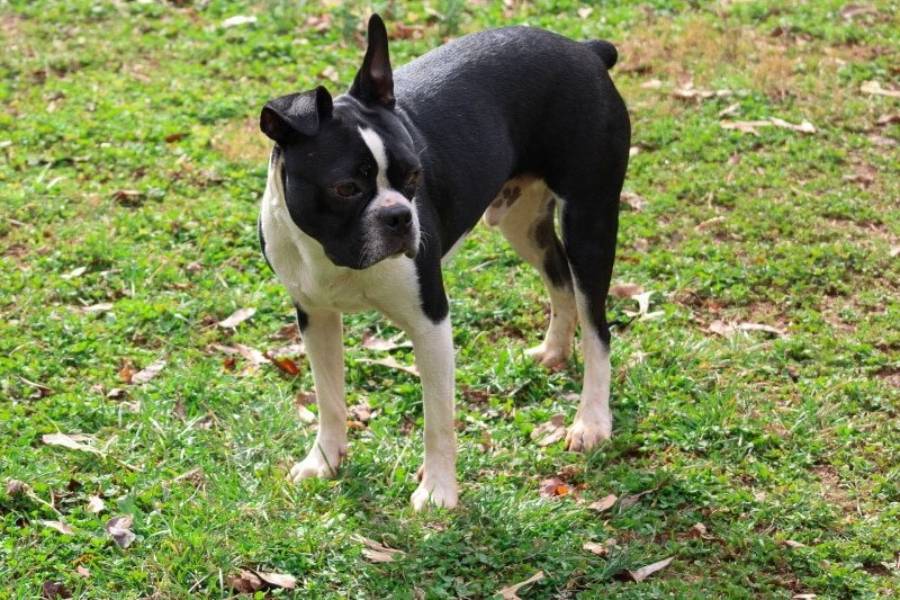
Boston Terriers can have several natural tail types, including straight, screw or corkscrew, crooked, and longer tails. Although the breed is known for its naturally short tail, tail shape and length vary between individual dogs. A Boston Terrier can therefore have a noticeably different tail from another Boston Terrier without the difference automatically indicating a health problem or determining whether the dog is purebred.
The appearance of a Boston Terrier’s tail depends on its length, shape, position, and underlying structure. Some tails are short and straight, while others curve or twist into a screw-like shape close to the body. Longer tails also occur, making it important to distinguish tail length from tail shape when identifying a Boston Terrier’s tail type.
These differences also matter beyond appearance. A tightly curled or screw-shaped tail can create skin folds around the tail area, which may require closer attention if moisture, debris, or irritation develops. The breed’s naturally short tail can also be mistaken for a docked tail. Understanding the main Boston Terrier tail types therefore helps owners identify normal physical variations, interpret breed characteristics, and recognize tail features that may require additional care.
What Types of Tails Do Boston Terriers Have?
Boston Terriers can have 4 recognizable tail variations: straight, screw or corkscrew, crooked, and longer tails. These categories describe either the shape or length of the tail, so they are not completely separate anatomical classifications. For example, a Boston Terrier may have a relatively long tail that is also straight, while another may have a very short tail with a screw shape.
Tail appearance varies because the vertebrae forming the tail can differ in length, alignment, and curvature between individual dogs. As a result, two Boston Terriers can have visibly different tails even when both are naturally born with them. Tail type should therefore be identified by examining several characteristics together, particularly shape, length, direction, and how closely the tail sits against the body.
What Does a Straight Boston Terrier Tail Look Like?
A straight Boston Terrier tail extends backward without forming the tight twists associated with a screw or corkscrew tail. It can be very short or extend farther from the body, depending on the individual dog. This means “straight” describes the shape of the tail rather than a specific tail length.
A short straight tail may look like a small projection from the hindquarters, while a longer straight tail is considerably easier to see. The distinction matters because owners sometimes assume that every Boston Terrier should have the same extremely short tail. In reality, natural variation means tail length and tail shape need to be considered separately.
The position of the tail also contributes to its overall appearance. A naturally straight tail does not need to point perfectly horizontally to qualify as straight. Its defining characteristic is the absence of pronounced twisting or corkscrew-like curvature along its structure.
What Does a Screw or Corkscrew Boston Terrier Tail Look Like?
A screw or corkscrew Boston Terrier tail has a tightly twisted or curled shape that keeps much of the tail close to the hindquarters. The curvature can make the tail appear shorter than it would if the vertebrae were arranged in a straight line.
The screw shape results from the underlying structure of the tail rather than the dog deliberately holding its tail in a curled position. This distinction separates a structurally twisted tail from a flexible tail that simply curves upward during movement or excitement. In a pronounced screw tail, the compact shape remains visible when the dog is relaxed.
A tightly positioned screw tail can also create folds where the tail meets or presses against surrounding skin. These folds are relevant to Boston Terrier care because areas with limited airflow can retain moisture and debris. The tail shape itself does not mean that a dog has a skin problem, but owners should be able to see the difference between normal tail anatomy and redness, odor, discharge, or persistent irritation around the area.
What Does a Crooked Boston Terrier Tail Look Like?
A crooked Boston Terrier tail bends or changes direction instead of extending in a consistently straight line or forming a complete screw-like shape. The bend can give the tail a kinked, angled, or irregular appearance.
The easiest way to distinguish a crooked tail from a screw tail is to examine the overall pattern. A screw tail has a more pronounced twisting or coiled structure, whereas a crooked tail may contain one or more visible changes in direction without forming a tight coil. The degree of crookedness can vary considerably between individual Boston Terriers.
A crooked appearance alone does not establish that the tail has been injured. A dog that has had the same tail shape since birth may simply have a natural structural variation. A sudden change in tail position, swelling, pain, or reluctance to move the tail is different because those signs can indicate an acquired problem rather than the dog’s normal anatomy.
Can a Boston Terrier Have a Long Tail?
Yes, a Boston Terrier can naturally have a longer tail. Boston Terriers are strongly associated with short tails, but individual dogs do not all inherit exactly the same tail length. A longer tail therefore needs to be evaluated as a variation in length rather than automatically being treated as a separate tail shape.
A longer Boston Terrier tail may be straight or have some degree of curvature. For this reason, describing a dog as having a “long tail” provides information about length but does not fully identify its morphology. Shape and length should be recorded separately: a dog could have a long straight tail, for example, while another could have a shorter crooked tail.
A long tail by itself also does not prove that a Boston Terrier is mixed rather than purebred. Physical appearance is only one source of information about a dog’s ancestry, and a single characteristic cannot establish pedigree status. For owners trying to identify their dog’s tail type, the more useful approach is to describe the visible characteristics first and consider pedigree questions separately.
Are Boston Terriers Born With Short Tails?
Boston Terriers can be born with naturally short tails, so a short tail does not mean that it has been surgically shortened. Tail length is a physical characteristic present from birth, and individual Boston Terriers can differ in both the length and shape of their tails. Some have extremely short tails that remain close to the hindquarters, while others have enough length for the tail to be clearly visible.
The length of a Boston Terrier’s tail is related to the structure of the vertebrae that form it. Differences in the number, size, and arrangement of these vertebrae affect how far the tail extends from the body and whether it appears straight, crooked, or tightly twisted. This is why tail length and tail shape should be treated as related but separate characteristics. A naturally short tail can be straight, while another short tail can have a screw or corkscrew appearance.
Natural variation also explains why Boston Terrier puppies from the same breed do not necessarily have identical-looking tails. Breed characteristics describe a recognizable pattern, but they do not mean every individual dog has exactly the same anatomy. Owners should therefore avoid using tail length alone to determine whether a Boston Terrier is typical of the breed.
A naturally short tail can sometimes be so small that it looks as though part of it has been removed. Examining the tail’s history is more reliable than judging from appearance alone. A dog that was born with a short tail has a natural tail characteristic, whereas a dog whose tail was surgically shortened has undergone tail docking.
Are Boston Terrier Tails Docked?
Boston Terriers do not need to have their tails docked to produce the short-tailed appearance commonly associated with the breed. Many Boston Terriers are naturally born with short tails, including straight, crooked, and screw-shaped variations. The compact appearance of these natural tails is one reason people can mistakenly assume that they have been cut.
Tail docking and a naturally short tail describe two different conditions. A naturally short tail develops as part of the dog’s anatomy before birth. Tail docking is a procedure that removes part of an existing tail after birth. Looking only at the final length can therefore be misleading because both may produce a visibly short tail even though their origins are different.
The distinction becomes particularly important when identifying a Boston Terrier’s tail type. A short screw tail, for example, should not automatically be described as a docked tail simply because little of the tail extends from the body. Its compact appearance can result from both its natural length and the way its vertebrae curve or twist.
Owners who are uncertain whether an individual dog’s tail is natural should use documented history when available rather than relying on appearance. Veterinary records, breeder information, or records from the dog’s early life can provide more useful evidence. Tail appearance can describe what the tail looks like, but it cannot by itself establish whether a surgical procedure occurred in the past.
What Does the Boston Terrier Breed Standard Say About the Tail?
The Boston Terrier breed standard describes the ideal tail as short, set low, and carried low rather than held above the horizontal. The tail can be straight or screw-shaped, which means both forms can occur within the characteristic appearance associated with the breed. Tail evaluation therefore involves more than determining whether the tail looks short.
Length, shape, set, and carriage describe different characteristics of a Boston Terrier’s tail. Length refers to how far the tail extends from the body, while shape describes whether it is straight, crooked, or screw-like. The set refers to where the tail joins the body, and carriage describes how the dog naturally holds it. Considering these characteristics separately gives a more accurate description than using tail length alone.
The breed standard should also be distinguished from the full range of physical variation that owners may see in individual Boston Terriers. A breed standard describes characteristics used to evaluate the breed against an established ideal; it does not mean that every Boston Terrier will have an identical tail. An individual dog can therefore differ in tail length or appearance without that single characteristic providing a complete assessment of the dog.
This distinction is especially useful when comparing a pet Boston Terrier with photographs of show dogs. A pet may have a more noticeable tail than dogs selected to closely match the breed standard. The visible difference identifies a variation in that physical characteristic, but pedigree and ancestry require evidence beyond the appearance of the tail.
Why Do Some Boston Terriers Have Longer Tails Than Others?
Boston Terriers can have different tail lengths because the physical structure of the tail varies between individual dogs. A longer-tailed Boston Terrier has a tail that extends farther from the hindquarters than the very short tail commonly associated with the breed. The difference can occur alongside variations in shape, so length does not determine whether a tail will be straight, crooked, or curved.
Inherited physical traits contribute to differences in appearance within a dog breed. Tail characteristics develop as part of the dog’s skeletal anatomy, and variation in the tail vertebrae can affect both its length and shape. This produces a range of visible outcomes rather than one tail configuration shared by every Boston Terrier.
A longer tail is especially noticeable because the popular image of the Boston Terrier emphasizes its compact body and short tail. When an individual has more visible tail length, owners may question whether the dog is a Boston Terrier at all. However, a long tail alone does not establish that a Boston Terrier is mixed-breed. Breed identity cannot be reliably determined from one anatomical characteristic.
Pedigree documentation provides stronger evidence of ancestry than tail appearance. When pedigree information is unavailable, physical characteristics can contribute to an overall assessment, but the tail should be considered together with other traits rather than treated as a standalone test. A Boston Terrier with a longer tail may simply represent variation in tail length, while its other characteristics remain consistent with the breed.
Read more: Boston Terrier Ear Types: Erect, Floppy & More
Can Boston Terrier Tail Shape Cause Health Problems?
Boston Terrier tail shape can contribute to health problems when a tightly curled or screw-shaped tail creates deep skin folds around the tail area. These folds can reduce airflow and trap moisture, natural skin oils, dirt, and other debris. The resulting environment can irritate the skin and make the area more difficult for owners to inspect and keep clean.
A tail pocket is a fold or indentation that can form beneath or around a short, tightly positioned tail. Not every Boston Terrier has a tail pocket, and its depth varies between individual dogs. Dogs with a pronounced screw or corkscrew tail may have less exposed skin around the base of the tail, making regular observation more important than it is for a dog with an easily accessible straight tail.
Skin irritation around the tail can produce visible or behavioral changes. Redness, swelling, persistent odor, discharge, tenderness, and repeated licking or rubbing of the area indicate that the skin should be examined more closely. These signs should not be treated as normal characteristics of a screw tail simply because the tail naturally creates folds.
Tail shape and spinal structure can also be relevant because the tail consists of vertebrae extending from the spine. An unusual tail shape alone does not establish that a Boston Terrier has a spinal disorder, however. Owners should distinguish between a stable tail shape that has existed since birth and symptoms such as pain, weakness, abnormal movement, or changes in mobility. A veterinarian should assess these signs rather than using the visible shape of the tail as a diagnosis.
How Should You Care for a Boston Terrier’s Tail?
Care for a Boston Terrier’s tail by regularly checking the tail, its base, and any surrounding skin folds for moisture, debris, redness, odor, or irritation. The exact routine should match the dog’s anatomy because a Boston Terrier with an exposed straight tail has different care needs from one with a tightly curled tail and a deep skin fold.
Owners should first identify whether the tail creates a pocket or covered area that is difficult to see. Gently inspecting this area makes it easier to notice changes before irritation becomes more severe. Skin that remains clean, dry, and free from inflammation generally requires less intervention than skin that repeatedly traps moisture or debris.
Cleaning should focus on the affected folds rather than aggressively scrubbing the entire tail area. After the area becomes wet from bathing, swimming, or cleaning, drying accessible skin folds is important because persistent moisture can contribute to irritation. Owners should also avoid forcing, pulling, or attempting to straighten a naturally crooked or screw-shaped tail, since its shape reflects the underlying anatomical structure.
Regular observation provides a useful baseline for each dog. Owners who know how their Boston Terrier’s tail normally looks, feels, and sits against the body are better positioned to notice a new change. Persistent redness, unpleasant odor, discharge, swelling, obvious pain, or repeated licking warrants veterinary attention, particularly when routine cleaning does not resolve the problem.
Tail care therefore depends more on the individual Boston Terrier’s structure than on the breed name alone. Straight and accessible tails generally require simple routine observation, while tightly positioned screw tails and tail pockets may require closer monitoring of the surrounding skin. Matching care to the actual tail type helps owners maintain the area without treating normal anatomical variation as a medical problem.
1 thought on “Boston Terrier Tail Types: Shapes, Lengths & Care”