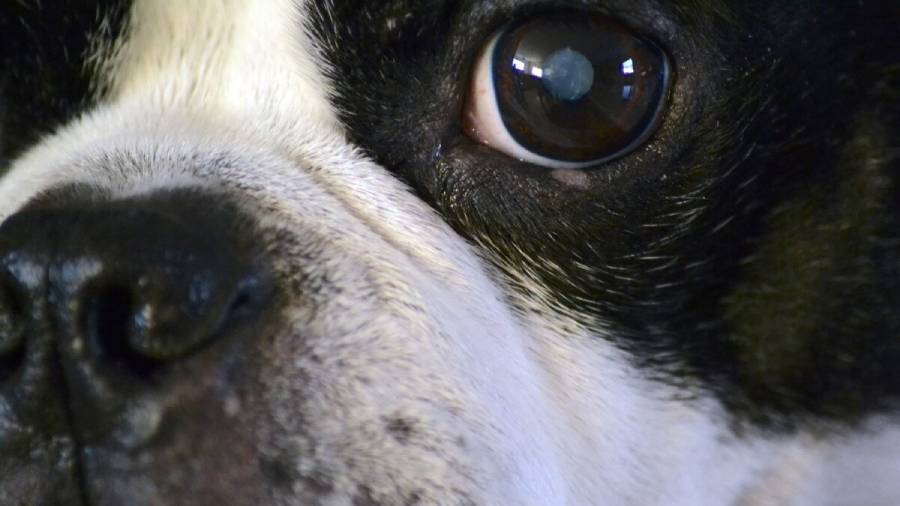
Boston Terrier cataracts occur when the normally clear lens of the eye becomes cloudy, reducing the amount of light that reaches the retina and interfering with vision. Cataracts can affect one or both eyes, and their impact ranges from minor visual impairment to significant vision loss depending on the location, size, and progression of the lens opacity. Boston Terriers can develop cataracts at different stages of life, including inherited forms that appear earlier in life and cataracts associated with other health or eye conditions.
Owners may first notice a cloudy or opaque appearance inside the eye, but changes in behavior can also indicate declining vision. A Boston Terrier with impaired vision may hesitate around stairs, bump into furniture, struggle to locate familiar objects, or become less confident in unfamiliar surroundings. Cloudy eyes do not always indicate cataracts because other lens changes, including nuclear sclerosis, can produce a similar appearance.
Veterinary examination is necessary to determine whether a Boston Terrier has cataracts and to assess their severity and underlying cause. This guide explains the signs, causes, hereditary factors, diagnosis, treatment options, cataract surgery, potential complications, and daily care considerations for Boston Terriers affected by cataracts.
What Are Cataracts in Boston Terriers?
Cataracts in Boston Terriers are areas of opacity that develop within the normally transparent lens of the eye and interfere with vision. The lens sits behind the iris and pupil and focuses incoming light onto the retina. A healthy lens must remain transparent for light to pass through efficiently. When lens fibers lose their transparency, the affected area becomes cloudy and prevents part of that light from reaching the retina clearly.
Cataracts can vary substantially in size and severity. A small opacity affecting a limited portion of the lens may have little effect on functional vision, while a cataract involving most or all of the lens can substantially reduce the dog’s ability to see. Cataracts may occur in one eye or both eyes, and they can remain relatively limited or progress over time. For this reason, the presence of a cataract does not automatically mean that a Boston Terrier is blind.
The visible appearance also depends on how much of the lens is affected. Owners may notice a white, gray, or cloudy area behind the pupil as the opacity becomes more noticeable. However, appearance alone cannot confirm a cataract. Age-related lens changes such as nuclear sclerosis can also make a Boston Terrier’s eyes look cloudy without producing the same type of lens opacity or degree of vision loss.
A veterinarian must examine the eye to determine whether the cloudiness is caused by a cataract and evaluate how much of the lens is affected. This distinction matters because cataracts and other causes of cloudy eyes can have different effects on vision and require different approaches to monitoring and treatment.
Are Boston Terriers Prone to Cataracts?
Boston Terriers can develop hereditary cataracts, making cataracts an important eye condition for owners and breeders to monitor. Hereditary cataracts result from inherited genetic factors that affect the lens rather than solely from aging, injury, or another disease. This means cataracts can occur in Boston Terriers before they reach their senior years.
Breed predisposition does not mean that every Boston Terrier will develop cataracts. An individual dog’s risk depends on factors such as genetics and the presence of other conditions capable of damaging the lens. Cataracts can also develop independently of inherited disease, so determining that a Boston Terrier has a cataract does not establish its cause.
Monitoring the eyes throughout a Boston Terrier’s life helps owners identify changes before severe vision impairment develops. Visible cloudiness, difficulty navigating familiar surroundings, hesitation around obstacles, or other changes in visual behavior warrant veterinary assessment. Detecting a lens change early also gives the veterinarian an opportunity to determine whether it is a cataract or another eye condition and monitor its progression.
Hereditary risk is particularly relevant to breeding decisions. Eye examinations and appropriate health screening can help identify inherited eye disorders in breeding dogs and reduce the likelihood of passing known problems to future generations. For pet owners, the practical priority is recognizing changes in the eyes or vision and obtaining a veterinary diagnosis rather than assuming that cloudiness is a normal characteristic of the breed.
What Are the Signs of Cataracts in Boston Terriers?
The main signs of cataracts in Boston Terriers are visible lens cloudiness and changes in behavior caused by declining vision. The signs become easier to notice as a cataract covers more of the lens or interferes with a larger portion of the dog’s visual field. An affected Boston Terrier may initially behave normally when the cataract is small but develop increasingly obvious navigation problems as vision deteriorates.
Cloudiness inside the eye is one of the most recognizable physical signs. Owners may see a white, gray, or opaque area behind the pupil rather than the normal dark appearance of the eye. The change can affect one eye or both eyes and may become more noticeable as the cataract progresses. However, a cloudy appearance alone does not confirm cataracts because other lens changes can produce a similar appearance.
Vision-related behavioral changes provide additional clues. A Boston Terrier with reduced vision may bump into furniture, misjudge distances, hesitate before using stairs, or have difficulty finding toys, food, or water. The dog may also move more cautiously in unfamiliar places because it cannot rely on a memorized layout to navigate obstacles. These behaviors result from reduced visual information rather than from the visible cloudiness itself.
Changes can be subtle when only one eye is severely affected because the other eye may compensate for the loss of vision. Owners may therefore notice problems only after both eyes become affected or when the dog enters an unfamiliar environment. Monitoring both eye appearance and behavior provides more useful information than relying on cloudiness alone.
Cloudy eyes should be evaluated by a veterinarian, particularly when they appear alongside noticeable changes in vision. Cataracts cannot be reliably diagnosed from appearance at home, and similar-looking eye changes can have different effects on vision and require different management.
What Causes Cataracts in Boston Terriers?
Cataracts in Boston Terriers can result from hereditary factors, metabolic disease, eye injury, inflammation, and other processes that damage the lens. These causes differ in how they affect the eye, but they ultimately disrupt the normal structure and transparency of the lens fibers. Once enough of the lens becomes opaque, light transmission decreases and vision can become impaired.
Hereditary cataracts develop because genetic factors predispose the lens to abnormal changes. This cause is particularly important in Boston Terriers because inherited cataracts can develop earlier than cataracts associated primarily with later-life changes. A young or middle-aged Boston Terrier can therefore develop cataracts, and owners should not assume that cataracts occur only in senior dogs.
Diabetes mellitus is another cause of cataracts in dogs. Persistently elevated blood glucose alters glucose metabolism within the lens. This process can cause substances and water to accumulate within lens fibers, disrupting their normal structure and transparency. Cataracts associated with diabetes can progress rapidly, making veterinary management of the underlying metabolic disease important alongside evaluation of the eyes.
Eye trauma can cause cataracts when an injury damages the lens or its protective capsule. Penetrating injuries are an obvious risk, but any significant eye injury requires veterinary assessment because damage to structures inside the eye may not be visible to the owner. Trauma-related cataracts can affect a single eye when only that eye has been injured.
Inflammation inside the eye can also damage the lens and contribute to cataract formation. The relationship can work in the opposite direction as well: cataracts can contribute to inflammatory complications as lens proteins trigger reactions within the eye. This connection is one reason a cataract should be considered an eye-health condition rather than only a cosmetic change in the color of the pupil.
Identifying the cause helps determine the next steps for an affected Boston Terrier. A hereditary cataract has different implications from a cataract associated with diabetes or trauma, even when the lenses look similar to an owner. Veterinary examination is therefore needed to confirm the cataract, investigate relevant underlying conditions, and determine whether monitoring or additional treatment is appropriate.
Are Cataracts in Boston Terriers Hereditary?
Cataracts in Boston Terriers can be hereditary, meaning genetic factors can increase a dog’s risk of developing lens opacity and subsequent vision impairment. Hereditary cataracts are different from cataracts caused by diabetes, eye trauma, inflammation, or other acquired conditions. Identifying this distinction is important because an inherited cataract has implications not only for the affected dog but also for breeding decisions.
Hereditary cataracts develop when inherited genetic changes interfere with the normal structure or function of the lens. Lens fibers must remain precisely organized and transparent for light to pass through them. When inherited abnormalities disrupt this structure, portions of the lens can lose transparency and form cataracts. The resulting opacity may initially affect a limited area before becoming more extensive.
A family history of cataracts can therefore be relevant when evaluating a Boston Terrier’s eye health. However, the presence of cataracts does not prove that they are inherited. A veterinarian must consider the dog’s age, medical history, eye examination findings, and possible secondary causes before determining the most likely explanation. For example, cataracts in a Boston Terrier with diabetes require a different clinical context from cataracts suspected to have a hereditary origin.
Hereditary eye disease is also relevant when selecting Boston Terriers for breeding. Appropriate eye examinations and breed-specific health screening can identify ocular abnormalities that may affect breeding decisions. Screening does not prevent an existing cataract from progressing, but it can provide information about the eye health of potential breeding dogs and help reduce the risk of knowingly breeding dogs affected by inherited eye disorders.
For pet owners, hereditary risk makes regular observation useful even when a Boston Terrier appears to see normally. Owners should watch for changes in lens clarity and visual behavior rather than waiting for obvious blindness. Early veterinary evaluation can establish whether an observed change is a cataract and determine whether continued monitoring or treatment is required.
At What Age Do Boston Terriers Develop Cataracts?
Boston Terriers can develop cataracts at different ages because the age of onset depends largely on the underlying cause. Cataracts should therefore not be considered exclusively a disease of senior Boston Terriers. Inherited forms can appear earlier in life, while cataracts associated with acquired diseases or other eye problems can develop at different stages of adulthood.
Early-onset cataracts are particularly important when hereditary disease is involved. A Boston Terrier can develop lens opacity while still relatively young if genetic factors affect lens development or stability. This differs from the common assumption that a cloudy lens must be a normal consequence of aging. A young dog’s cloudy eye warrants veterinary examination just as it would in an older dog.
Adult Boston Terriers can also develop cataracts after previously having clear lenses. The cause may be hereditary disease that becomes apparent later or an acquired condition such as diabetes, trauma, or ocular inflammation. Because these causes have different implications, the dog’s age alone cannot determine why the cataract developed.
Cloudiness in a senior Boston Terrier creates an additional diagnostic issue because age-related nuclear sclerosis can change the appearance of the lens. Nuclear sclerosis and cataracts are not the same condition, even though an owner may describe both as cloudy eyes. Their effects on the lens and vision differ, so visual inspection at home is not sufficient to distinguish between them reliably.
The practical approach is therefore to evaluate a Boston Terrier based on the eye changes present rather than assuming a specific diagnosis from age. Cloudiness in a young dog may indicate an early lens disorder, while cloudiness in a senior dog should not automatically be labeled a cataract. A veterinary eye examination can identify the type of lens change, determine its effect on vision, and establish whether further monitoring or treatment is necessary.
How Are Cataracts in Boston Terriers Diagnosed?
Cataracts in Boston Terriers are diagnosed through a veterinary eye examination that confirms lens opacity and evaluates how much of the eye and vision are affected. Cloudiness noticed at home is an important reason to schedule an examination, but it is not sufficient to diagnose a cataract because several eye changes can alter the appearance of the pupil or lens.
The examination starts with an assessment of the Boston Terrier’s eyes and visual function. The veterinarian evaluates the location and extent of lens opacity and looks for abnormalities in other structures of the eye. The goal is not only to confirm that a cataract exists but also to determine whether the change is limited or advanced and whether another ocular condition is present.
Medical history provides additional information about the possible cause. The dog’s age, timing of the eye changes, previous eye injuries, existing diseases, and progression of visual problems can help distinguish hereditary cataracts from cataracts associated with acquired conditions. Diabetes is particularly relevant because metabolic changes associated with the disease can affect the lens and lead to cataract formation.
A more detailed ophthalmic assessment may be required when cataracts significantly impair vision or surgery is being considered. A veterinary ophthalmologist can evaluate whether other structures needed for useful vision remain healthy. This assessment matters because removing an opaque lens cannot restore normal sight when another serious eye disorder has already compromised visual function.
Diagnosis therefore answers more than whether a Boston Terrier has a cataract. It establishes the cataract’s extent, investigates potential causes, identifies related eye problems, and provides the information needed to determine whether monitoring, medical management, or surgical treatment should be considered.
How Are Cataracts in Boston Terriers Treated?
Treatment for Boston Terrier cataracts depends on the severity of the cataract, its underlying cause, the health of the rest of the eye, and the degree of vision impairment. Management may include monitoring and treating associated medical or ocular conditions, while surgery is the treatment used to physically remove cataractous lens material when an affected dog is an appropriate candidate.
Can Cataracts in Boston Terriers Be Treated Without Surgery?
Non-surgical care can manage underlying diseases and cataract-related eye problems, but it does not perform the same function as surgical removal of an opaque lens. This distinction is important because owners may encounter products marketed as treatments for cloudy eyes even though managing an associated condition is different from removing an established cataract.
Monitoring is appropriate in cases where the veterinarian needs to track changes in the lens and visual function. Follow-up examinations allow the progression of the cataract and the health of surrounding eye structures to be assessed over time. The frequency of these examinations depends on the individual dog’s condition rather than on a single schedule for every Boston Terrier.
Underlying diseases also require appropriate treatment. A Boston Terrier with diabetes, for example, needs veterinary management of the metabolic disease regardless of how the cataract itself is ultimately addressed. If inflammation or another ocular complication develops, the veterinarian may prescribe treatment directed at that specific problem. These measures protect eye health but should not be confused with physically removing cataractous lens material.
Owners should therefore avoid assuming that an eye drop, supplement, or home treatment can reverse an established cataract unless the claim is supported by appropriate veterinary evidence. A veterinarian can determine what treatment is addressing the cataract itself and what treatment is managing an associated disease or complication.
When Is Cataract Surgery Recommended for a Boston Terrier?
Cataract surgery may be considered when cataracts significantly interfere with a Boston Terrier’s useful vision and examination shows that the dog is an appropriate surgical candidate. The decision is based on more than the visible size of the cloudy area because successful visual recovery also depends on the condition of other structures within the eye.
A veterinary ophthalmologist evaluates the cataract together with the dog’s overall ocular health. The assessment determines whether the eye has sufficient potential for useful vision after the cloudy lens material is removed. Existing retinal disease, severe inflammation, glaucoma, or other significant abnormalities can influence whether surgery is appropriate and what outcome can reasonably be expected.
The dog’s general health also matters because cataract surgery requires anesthesia and postoperative care. Medical conditions need to be identified and appropriately managed before surgery. The owner must also be able to follow postoperative instructions, which can include administering prescribed medications, restricting certain activities, protecting the operated eye, and attending follow-up examinations.
Surgery is therefore an individualized treatment decision rather than an automatic next step after a cataract diagnosis. The veterinarian or veterinary ophthalmologist considers visual impairment, cataract progression, ocular health, general health, and the feasibility of postoperative care before recommending the procedure for a Boston Terrier.
How Does Cataract Surgery Work for Boston Terriers?
Cataract surgery in Boston Terriers removes the cloudy lens material that blocks light from passing normally through the eye. The procedure is performed by a veterinary ophthalmologist after evaluating whether the affected eye has sufficient potential for useful vision. Surgery involves several stages, including preoperative testing, removal of the cataract, possible placement of an artificial lens, and postoperative monitoring.
Before surgery, the veterinary ophthalmologist evaluates the structures of the affected eye and looks for conditions that could interfere with visual recovery. The retina and other internal structures are particularly important because removing a cataract cannot restore useful vision if another serious eye disease prevents the visual system from functioning normally. The Boston Terrier’s general health is also assessed because the procedure requires anesthesia.
The cataract itself is commonly removed using a surgical technique called phacoemulsification. During this procedure, specialized equipment breaks the cloudy lens material into small fragments so that it can be removed from the eye. Removing this opaque material clears the visual pathway that had been obstructed by the cataract.
An intraocular lens may be placed in the eye after the cataractous lens material has been removed. The natural lens normally helps focus incoming light, so removing it changes the eye’s focusing ability. An artificial intraocular lens is designed to compensate for this loss when its placement is appropriate for the individual dog.
Postoperative care is an important part of the treatment process. Owners may need to administer prescribed eye medications, prevent the Boston Terrier from rubbing or injuring the operated eye, restrict activities according to the veterinary ophthalmologist’s instructions, and return for scheduled examinations. Follow-up allows the veterinary team to monitor healing and identify complications that require treatment.
Cataract surgery therefore involves more than removing visible cloudiness. The complete process includes determining whether the eye is suitable for surgery, removing the opaque lens material, supporting the eye during recovery, and monitoring whether the structures required for useful vision remain healthy.
Can a Boston Terrier See Again After Cataract Surgery?
A Boston Terrier can regain useful vision after successful cataract surgery when the retina and other structures involved in vision are healthy enough to function after the cloudy lens material is removed. The purpose of surgery is to restore a clearer pathway for light to enter the eye, but the final visual outcome depends on more than cataract removal alone.
The condition of the retina is one major factor in visual recovery. The retina receives light and converts it into signals that can be processed by the nervous system. Removing an opaque lens allows more light to reach the retina, but surgery cannot correct vision loss caused by serious retinal dysfunction. This is why evaluation of the eye before surgery is necessary.
Other ocular diseases can also affect the outcome. Inflammation, glaucoma, retinal abnormalities, and other significant eye problems may limit visual function or increase the complexity of treatment. The veterinary ophthalmologist evaluates these factors when determining whether surgery is appropriate and discussing expected outcomes with the owner.
Postoperative healing also influences the result. Prescribed medications, eye protection, activity restrictions, and follow-up examinations are intended to support healing and allow complications to be detected promptly. Owners therefore play an important role in the recovery period by following the postoperative plan provided for their Boston Terrier.
Visual improvement should not be interpreted as a guarantee that every Boston Terrier will regain completely normal vision. The realistic goal depends on the health of the individual eye before surgery and how it responds afterward. A veterinary ophthalmologist can provide a more specific prognosis after examining the cataract, retina, and other ocular structures of the affected dog.
What Is the Difference Between Cataracts and Nuclear Sclerosis in Boston Terriers?
Cataracts and nuclear sclerosis can both make a Boston Terrier’s eyes appear cloudy, but they are different lens changes and do not affect vision in the same way. Cataracts involve areas of lens opacity that block the normal passage of light and can cause substantial vision impairment. Nuclear sclerosis is an age-related change in the lens that can create a cloudy appearance without producing the same degree of visual obstruction associated with a significant cataract.
Nuclear sclerosis develops as new lens fibers continue to form throughout a dog’s life and older fibers become compressed toward the center of the lens. This process changes the density and appearance of the lens. Owners may notice a bluish-gray or hazy appearance in both eyes of an older Boston Terrier even when the dog continues to navigate its environment effectively.
A cataract results from loss of transparency within the lens. Depending on its location and extent, the opacity can interfere directly with light transmission and reduce vision. An affected Boston Terrier may show both visible lens changes and functional signs such as bumping into objects, hesitating around stairs, or having difficulty navigating unfamiliar environments.
Age and appearance alone cannot reliably distinguish the two conditions. Nuclear sclerosis is associated with aging, but senior Boston Terriers can also develop cataracts. A dog can therefore have cloudy-looking eyes without having a vision-limiting cataract, while another dog of a similar age may have lens opacity that significantly affects sight.
A veterinary eye examination provides the appropriate distinction between cataracts and nuclear sclerosis. This diagnosis matters because the two findings have different implications for vision, monitoring, and treatment. Owners should therefore have newly noticed cloudiness evaluated instead of assuming that it is either a cataract or a harmless consequence of aging.
What Complications Can Cataracts Cause in Boston Terriers?
Cataracts in Boston Terriers can cause progressive vision impairment and may be associated with secondary eye complications, including lens-induced inflammation and glaucoma. The risk and severity of complications vary between individual dogs, so a diagnosed cataract should be monitored even when the Boston Terrier still has useful vision.
Vision loss is the most direct consequence of cataract progression. As a larger portion of the lens becomes opaque, less light can pass through the affected area to reach the retina. A Boston Terrier may initially compensate for limited visual impairment, particularly when one eye remains functional, but navigation can become increasingly difficult when cataracts substantially affect both eyes.
Lens-induced uveitis is an important potential complication associated with cataracts. Changes within a cataractous lens can allow lens proteins to contribute to an inflammatory response inside the eye. Inflammation can produce additional ocular problems beyond the original loss of lens transparency and requires veterinary assessment and management.
Glaucoma can also become a serious concern when changes within the eye interfere with normal regulation of intraocular pressure. Elevated pressure can damage structures required for vision and can be painful. Cataract-related inflammation and other changes inside the eye can contribute to circumstances in which secondary glaucoma develops.
These complications explain why monitoring cataracts involves more than measuring how cloudy the lens appears. A Boston Terrier may require veterinary follow-up to evaluate both visual function and the health of other ocular structures. Changes such as increasing redness, apparent eye discomfort, sudden deterioration in vision, or other new abnormalities warrant veterinary attention because they may indicate that the condition of the eye has changed.
Can Cataracts Be Prevented in Boston Terriers?
Hereditary cataracts in Boston Terriers cannot always be prevented in an individual dog, but responsible breeding, regular eye examinations, management of associated diseases, and protection from eye injuries can reduce avoidable risks or help detect cataracts earlier. Prevention should therefore be separated into two goals: reducing preventable causes and identifying lens changes before they produce severe vision impairment or complications.
Responsible breeding is particularly relevant to hereditary cataracts. Dogs affected by or at risk for inherited eye disorders can pass genetic susceptibility to subsequent generations. Appropriate eye screening of breeding Boston Terriers provides information that can be considered when making breeding decisions. Screening does not remove cataracts from an affected dog, but it can help reduce the propagation of known hereditary eye problems within a breeding population.
Managing diseases associated with cataract formation is another important part of eye care. Diabetes mellitus can produce changes within the lens that lead to cataracts, so a Boston Terrier diagnosed with diabetes requires ongoing veterinary management. Disease management does not guarantee that cataracts will be prevented, especially after significant lens changes have begun, but controlling the underlying condition remains necessary for the dog’s overall health.
Preventing eye trauma can also reduce one acquired pathway to cataract formation. Boston Terriers have prominent eyes that can be exposed to environmental hazards, so owners should limit situations in which branches, sharp objects, rough play, or other sources of trauma could injure the eye. Any significant eye injury should receive veterinary attention because internal damage may be more extensive than the visible surface injury suggests.
Routine observation provides an additional opportunity for early detection. Owners can monitor lens clarity, navigation, confidence around stairs, and other aspects of visual behavior. Newly developed cloudiness or an unexplained change in vision should prompt veterinary assessment rather than waiting for the eye to become completely opaque.
Read more: Boston Terrier Deafness: Causes, Signs & Care
How Should You Care for a Boston Terrier With Cataracts?
Caring for a Boston Terrier with cataracts involves making its environment predictable, reducing physical hazards, monitoring changes in the eyes and vision, and following the veterinary treatment plan. Dogs can adapt to reduced vision by relying more heavily on smell, hearing, memory, and familiar environmental cues, so practical changes at home can help them navigate more safely.
Keep furniture, food bowls, water bowls, beds, and other frequently used objects in consistent locations. A Boston Terrier with impaired vision can memorize the layout of a familiar home and use that spatial memory to move between important areas. Frequently rearranging furniture removes those predictable reference points and can make navigation more difficult.
Reduce hazards in areas where the dog regularly moves. Stairs, balconies, swimming pools, sharp furniture edges, and unfamiliar obstacles can become more difficult to detect when vision declines. Barriers or supervised access may be appropriate around higher-risk areas, particularly when the Boston Terrier is still adjusting to visual impairment.
Use consistent auditory and tactile cues to help the dog anticipate what is happening. Speaking before approaching or touching a visually impaired Boston Terrier can prevent surprise, while consistent verbal cues can help with navigation and daily routines. Familiar sounds and scents can also provide useful environmental information when visual input becomes less reliable.
Maintain normal physical and mental activity at a level appropriate for the individual dog. Vision loss does not eliminate a Boston Terrier’s need for exercise, interaction, play, and environmental enrichment. Activities can be adapted by emphasizing scent, sound, texture, and predictable spaces rather than relying exclusively on visual tracking.
Continue veterinary monitoring after a cataract diagnosis even when the dog appears to adapt well to reduced vision. Cataracts can be associated with changes elsewhere in the eye, so functional adaptation does not confirm that the eye itself is stable. Owners should also watch for new redness, apparent pain, discharge, increased cloudiness, or sudden changes in navigation and report these changes to a veterinarian.
When Should a Boston Terrier With Cloudy Eyes See a Veterinarian?
A Boston Terrier with newly developed cloudy eyes should see a veterinarian, especially when the change occurs with vision loss, redness, discomfort, discharge, or other abnormalities of the eye. Cloudiness can result from cataracts, nuclear sclerosis, or other ocular conditions, and appearance alone cannot reliably identify the cause. A veterinary eye examination can determine which structure is affected and whether treatment or continued monitoring is necessary.
Schedule a veterinary examination when cloudiness develops gradually even if the Boston Terrier continues to navigate normally. Small or developing cataracts may not immediately produce obvious behavioral signs because the unaffected portions of the lens can still transmit light. A dog with one more severely affected eye may also compensate with the other eye, making early vision impairment difficult to recognize at home.
More prompt evaluation is appropriate when cloudiness occurs with noticeable changes in visual behavior. Examples include repeatedly bumping into furniture, hesitating at stairs, misjudging distances, struggling to find familiar objects, or becoming unusually cautious in unfamiliar environments. These behaviors can indicate that an eye condition is beginning to interfere with functional vision.
Eye cloudiness accompanied by redness, apparent pain, squinting, excessive tearing, discharge, or persistent rubbing of the eye also requires veterinary attention. These findings indicate that the problem may involve more than a stable change in lens transparency. Cataracts can be associated with inflammatory complications, and other painful eye disorders can produce symptoms that an owner may initially mistake for cataracts.
Sudden vision loss or a rapid and significant change in the appearance or comfort of the eye warrants urgent veterinary assessment. Rapid changes can indicate an acute ocular problem that should not be monitored at home while waiting to see whether it resolves. Early examination gives the veterinarian an opportunity to identify the cause and address conditions that could threaten vision or cause continuing discomfort.
Owners should not wait for a Boston Terrier to become blind before having cloudy eyes examined. Veterinary assessment is most useful when changes are first detected because it can distinguish cataracts from other causes of cloudiness, establish a baseline for monitoring progression, identify complications, and determine whether referral to a veterinary ophthalmologist is appropriate.
1 thought on “Boston Terrier Cataracts: Symptoms, Causes & Treatment”