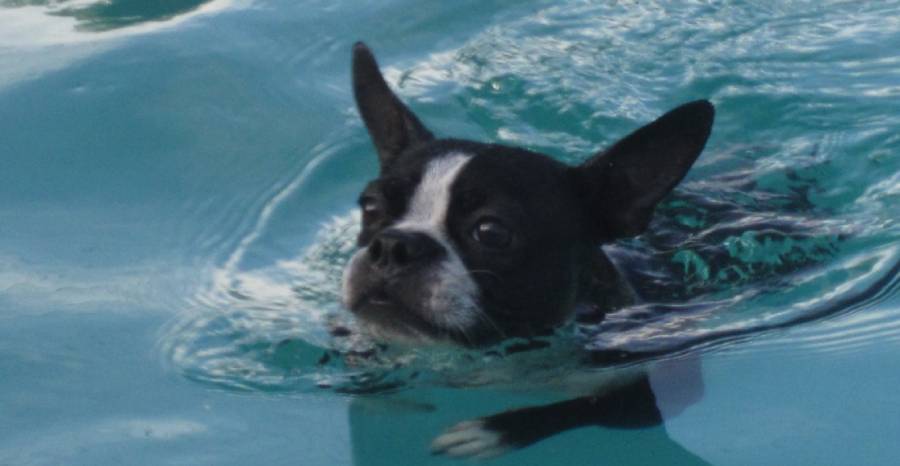
Boston Terriers can swim, but they are generally not strong swimmers and should always be closely supervised around water. Their short muzzle, compact body, and brachycephalic facial structure can make breathing and maintaining a stable position in the water more difficult, especially as they become tired. Being physically capable of paddling therefore does not mean a Boston Terrier can safely swim for long periods or handle deep water without assistance.
Swimming ability also varies between individual Boston Terriers. A healthy adult that has gradually learned to enter and move through shallow water may swim more confidently than a puppy, senior dog, inexperienced swimmer, or dog with breathing difficulties. Water conditions matter as well. A calm, shallow pool presents different challenges from a lake with changing depths or an ocean with waves and currents.
Owners should treat swimming as a supervised activity rather than assume their Boston Terrier will instinctively stay safe in water. A properly fitted dog life jacket, easy access to an exit, gradual water introduction, and close observation can reduce the main risks. This guide explains why Boston Terriers can struggle with swimming, how to recognize distress, when to use a life jacket, and how to keep them safer in pools, lakes, and the ocean.
Can Boston Terriers Swim?
Boston Terriers can swim, but most should not be treated as strong or endurance swimmers. They can paddle their legs and move through water, particularly in calm and shallow conditions, but swimming ability varies considerably between individual dogs. A Boston Terrier that can cross a small pool successfully may still struggle when swimming for longer periods or dealing with waves, currents, or deep water.
The important distinction is between being able to swim and being able to swim safely for an extended period. Dogs generally use coordinated movements of their front and rear legs to propel themselves through water while keeping their nose and mouth above the surface. For a Boston Terrier, maintaining this position can require substantial effort because swimming combines continuous physical activity with the need to control breathing and body position. As fatigue increases, the dog may have more difficulty keeping its airway comfortably above the water.
Individual characteristics also affect swimming ability. Age, fitness, body condition, previous exposure to water, confidence, and respiratory health can influence how well a Boston Terrier handles swimming. A healthy adult accustomed to shallow water may move confidently, while a puppy, senior dog, overweight dog, or inexperienced swimmer may tire or panic sooner. Owners should therefore assess the individual dog rather than assume that swimming ability is identical across the breed.
Swimming conditions create another major difference. Moving through calm, shallow water with an owner nearby is substantially different from falling unexpectedly into a deep pool or swimming in a lake or ocean. Depth, water temperature, waves, currents, and the availability of an easy exit all influence the amount of effort required. For this reason, a Boston Terrier that appears comfortable in one water environment should not automatically be considered safe in another.
Why Do Boston Terriers Have Difficulty Swimming?
Boston Terriers can have difficulty swimming because their brachycephalic facial structure, short muzzle, compact body, and limited endurance can make breathing and maintaining an efficient swimming position more demanding. These characteristics do not prevent every Boston Terrier from swimming, but they can reduce the margin for error when the dog becomes tired or encounters difficult water conditions.
Boston Terriers are a brachycephalic breed, meaning they have a relatively short skull and flattened facial profile compared with longer-muzzled breeds. This anatomy is particularly relevant in water because a swimming dog must keep its nose and mouth clear of the surface while continuing to breathe during physical activity. A Boston Terrier may need to hold its head higher to keep its short muzzle comfortably above water, which can make its swimming posture less efficient and increase physical effort.
Breathing and endurance are closely connected during swimming. Swimming requires continuous movement rather than the short bursts of activity a dog can stop whenever it chooses on land. A Boston Terrier that begins breathing heavily cannot simply stand still in deep water to recover. It must continue paddling or reach an exit. As fatigue develops, maintaining the head and airway above the surface can become progressively harder, which is why close supervision is necessary even when the dog initially appears comfortable.
Body structure also affects how an individual Boston Terrier moves through water. A compact body and differences in body composition influence buoyancy, balance, and swimming posture. However, body shape alone does not determine whether a Boston Terrier can swim. Fitness, weight, experience, respiratory function, and water conditions work together to determine how much effort an individual dog needs to remain afloat and move forward.
The practical limitation is therefore endurance rather than a simple inability to paddle. A Boston Terrier may swim successfully for a short distance but become vulnerable once physical effort exceeds its ability to maintain breathing and body position. Owners should never use successful swimming on one occasion as evidence that the dog can safely remain in deep water without supervision.
Is Swimming Dangerous for Boston Terriers?
Swimming can be dangerous for Boston Terriers when they become exhausted, have difficulty breathing, enter deep water without support, or cannot easily get out of the water. The primary concern is not that every Boston Terrier is unable to swim. The risk comes from a relatively small margin between swimming successfully and becoming too tired to maintain a safe position in the water.
Exhaustion is particularly important because a dog in deep water cannot stop paddling to rest. A Boston Terrier that becomes fatigued must either continue moving or reach an accessible exit. As its energy decreases, the dog may struggle to keep its nose and mouth above the surface. This problem can develop faster when the dog is already working harder to breathe because of its short muzzle and brachycephalic anatomy.
Unexpected entry into water creates another risk. A Boston Terrier that deliberately walks into shallow water has time to adjust its movement and position, while a dog that falls into a pool or off a dock may immediately panic. Panic can produce rapid, inefficient paddling and make it harder for the dog to locate an exit. Pools with steep sides are especially problematic when a dog cannot climb out without assistance, even if it can initially stay afloat.
Environmental conditions can increase the physical demands of swimming. Waves and currents require a dog to work harder than calm water, while cold water can make prolonged swimming more physically demanding. Distance from shore also matters because the dog must retain enough energy for the return journey. Owners should therefore evaluate the water environment as well as the Boston Terrier’s apparent swimming ability.
What Are the Signs That a Boston Terrier Is Struggling in Water?
A Boston Terrier struggling in water may show frantic paddling, difficulty keeping its face above the surface, abnormal breathing, declining coordination, repeated attempts to escape, or a sudden reduction in swimming strength. These signs indicate that the dog needs assistance rather than additional time to continue swimming.
A change in body position can provide an early warning. A comfortable dog may paddle with relatively controlled movements and keep its face consistently above the surface. A struggling dog may become increasingly vertical, splash excessively, or repeatedly allow its mouth and nose to approach the water. The movements may become faster without producing effective forward motion.
Breathing should also be monitored closely. Boston Terriers already have a short muzzle, so unusually labored breathing during or immediately after swimming deserves attention. Owners should end the swimming session when breathing becomes noticeably difficult rather than waiting for the dog to reach complete exhaustion. A dog that continues to show respiratory distress, weakness, coughing, unusual behavior, or other concerning symptoms after leaving the water should receive veterinary attention.
The safest response to visible fatigue is to remove the dog from the water promptly. Owners should not test whether a tired Boston Terrier can continue for another lap or reach the opposite side of a pool. Swimming ability can deteriorate as exhaustion progresses, and intervention is easier while the dog still has enough strength to cooperate.
Do Boston Terriers Need a Life Jacket for Swimming?
Boston Terriers should wear a properly fitted dog life jacket when swimming in deep, unfamiliar, or unpredictable water, and a life jacket is also useful for inexperienced swimmers. Added buoyancy reduces the amount of effort required to remain at the surface and provides an additional layer of protection if the dog becomes tired.
A life jacket is especially valuable around lakes, boats, docks, beaches, deep pools, and other environments where a Boston Terrier cannot immediately stand on the bottom or leave the water. Even a dog that swims confidently can encounter an unexpected wave, current, fall, or period of fatigue. The jacket provides additional flotation while the owner helps the dog return to safety.
A suitable life jacket should fit securely without restricting normal breathing or leg movement. Important features include sufficient buoyancy for the dog’s size, adjustable and secure straps, a visible color, and a strong rescue handle on the back. The handle allows an owner to assist or lift the dog when necessary, although the jacket should be used according to its design and fit instructions.
Correct fit is as important as the presence of the jacket itself. A loose jacket can shift while the dog is swimming, while an excessively tight jacket can interfere with comfortable movement. Owners should fit and adjust the jacket on land first, allow the Boston Terrier to become comfortable wearing it, and then test it in controlled shallow water before relying on it in deeper conditions.
A life jacket does not make unsupervised swimming safe. It can improve buoyancy, but it cannot prevent every problem involving breathing difficulty, panic, entanglement, waves, currents, or an inaccessible exit. The safest combination is a properly fitted life jacket, continuous supervision, controlled swimming conditions, and an exit the Boston Terrier can reach easily.
How Can You Teach a Boston Terrier to Swim Safely?
Teach a Boston Terrier to swim by introducing water gradually, starting in shallow water, supporting the dog when necessary, and allowing it to progress at its own pace. The goal is not to make the dog swim as far as possible. The goal is to teach it to remain calm, move effectively in water, and find a safe exit without becoming exhausted.
Start in calm water shallow enough for the Boston Terrier to stand comfortably. Allow the dog to approach and enter voluntarily instead of pulling it into the water. Toys, treats, or praise can create a positive association with the water, but the dog should always have the option to move back onto dry ground. A Boston Terrier that hesitates, repeatedly retreats, or shows signs of stress needs more time at the current depth rather than being moved into deeper water.
Progress from standing to short periods of paddling only after the dog is comfortable in shallow water. Support the Boston Terrier around the torso when moving into a depth where its feet no longer touch the bottom. The support should help the dog maintain a stable position while allowing all four legs to move naturally. A properly fitted life jacket can provide additional buoyancy during this stage, particularly for an inexperienced swimmer.
Teach the exit route as part of every swimming session. In a pool, repeatedly guide the Boston Terrier toward the steps, ramp, or another designated exit until it learns where to leave the water. Entering a pool is often easier than climbing out, so knowing how to locate an exit is a separate safety skill. The same principle applies near docks, shorelines, and other controlled swimming areas.
Never teach a Boston Terrier to swim by throwing it into deep water. Forced entry can cause panic, and frantic paddling uses energy without necessarily producing effective movement. Deep-water exposure also removes the dog’s ability to stand and recover when it becomes tired. A safer progression is shallow water → voluntary entry → supported paddling → short independent swimming → gradual increases in distance.
Swimming sessions should remain controlled even after the Boston Terrier becomes more confident. Stay within immediate reach, maintain a clear path to the exit, and stop the activity before visible exhaustion develops. Confidence in water should not be interpreted as unlimited endurance.
How Long Should a Boston Terrier Swim?
There is no single safe swimming duration that applies to every Boston Terrier because endurance depends on the individual dog’s breathing, fitness, age, experience, and water conditions. A short session that is easy for one Boston Terrier may be demanding for another, so observable physical condition is more useful than applying one fixed time limit to the entire breed.
Begin with brief swimming attempts separated by periods of rest on land. This allows the owner to evaluate how the Boston Terrier responds to swimming before increasing the duration or distance. An inexperienced dog should not progress from a few successful paddles directly to continuous swimming simply because it appears enthusiastic.
End the session when the Boston Terrier shows increasing respiratory effort, slower or less coordinated paddling, difficulty maintaining its head position, repeated attempts to leave the water, or declining energy. Waiting until the dog is completely exhausted removes the safety margin needed for it to reach an exit. The owner should make the decision to stop before the Boston Terrier loses the ability to swim comfortably.
Water conditions also affect how quickly fatigue develops. Swimming against waves or currents requires more effort than moving through calm water, while colder conditions can create additional physical demands. A distance that is manageable in a controlled pool should therefore not be used as a benchmark for swimming in a lake or ocean.
The safest duration is the period during which the individual Boston Terrier can swim comfortably while maintaining controlled movement and normal breathing, with enough energy remaining to exit the water easily. Owners who have concerns about a Boston Terrier’s breathing, exercise tolerance, or suitability for swimming should discuss those concerns with a veterinarian before introducing more demanding water activities.
Can Boston Terriers Swim in a Pool?
Boston Terriers can swim in a pool when the water is calm, the dog has an accessible exit, and an owner provides continuous supervision. A controlled pool can offer more predictable swimming conditions than natural bodies of water, but steep sides, deep water, slippery surfaces, and accidental falls still create significant risks.
An easy-to-find exit is one of the most important pool safety measures. A Boston Terrier may be able to paddle after falling into a pool but still be unable to climb over the edge. Pool steps or a suitable ramp give the dog a defined escape route. Owners should repeatedly guide the dog from different parts of the pool toward this exit so it learns where to go rather than expecting it to locate the steps automatically during an emergency.
Accidental entry requires particular attention. A Boston Terrier that chooses to walk into shallow water is prepared for the transition, while a dog that unexpectedly falls into a pool may panic and paddle inefficiently. Fencing or another secure pool barrier can prevent unsupervised access when the pool is not being used. Pool covers should not automatically be considered a safe substitute because their design and ability to support an animal vary.
Pool water also introduces chemical exposure. Chlorine and other properly maintained pool chemicals are different from drinking water, so owners should discourage Boston Terriers from repeatedly drinking from the pool. Fresh drinking water should be available nearby to reduce the temptation to consume pool water. After swimming, rinsing the dog’s coat with fresh water can remove residual pool chemicals.
A life jacket provides additional protection for inexperienced Boston Terriers and dogs swimming where they cannot stand on the bottom. However, the jacket does not replace an accessible exit or active supervision. A Boston Terrier should never be left alone around a swimming pool simply because it can swim or is wearing a life jacket.
Can Boston Terriers Swim in Lakes?
Boston Terriers can swim in lakes, but lake swimming requires additional precautions because depth, currents, water quality, underwater obstacles, and exit conditions are less predictable than in a controlled pool. A Boston Terrier that swims comfortably in a backyard pool should not automatically be expected to handle a lake with the same level of confidence or endurance.
Start at a calm shoreline where the Boston Terrier can enter gradually and remain in shallow water. Avoid immediately encouraging the dog to follow a person, toy, or another dog far from shore. Swimming outward consumes only part of the dog’s available energy; it still needs enough stamina to return safely. Keeping the swimming area close to shore reduces the distance required to reach solid ground if fatigue develops.
Underwater conditions can create hazards that are difficult to see from the surface. Rocks, branches, vegetation, sudden changes in depth, fishing equipment, and other objects can interfere with movement or injure a dog. Owners should choose a known swimming area and inspect the immediate shoreline before allowing a Boston Terrier to enter. Fast-moving water and areas with noticeable currents should be avoided because they increase the effort required to maintain position and return to shore.
Water quality also matters. Natural freshwater can contain harmful microorganisms or algal growth, and visible scum, unusual discoloration, unpleasant odors, or posted water-quality warnings are reasons to keep a dog out of the water. Owners should not assume that water is safe for a pet simply because people can physically access the lake.
A properly fitted life jacket is particularly useful at a lake because the dog may encounter unexpected depth before the owner realizes it. The rescue handle can also help an owner assist the Boston Terrier back to a dock, boat, or shoreline. The dog should remain within close reach rather than being allowed to swim long distances into open water.
After lake swimming, offer fresh drinking water and rinse the Boston Terrier when appropriate to remove dirt, plant material, and contaminants from the coat. Check the paws and body for cuts, debris, or other visible problems. Lake swimming is safest when the Boston Terrier remains close to shore, wears appropriate flotation in deeper water, and has an owner actively monitoring its breathing, movement, and energy level.
Can Boston Terriers Swim in the Ocean?
Boston Terriers can swim in the ocean, but waves, currents, changing water depth, and salt water make ocean swimming more demanding than swimming in calm, controlled water. A Boston Terrier should stay close to shore, remain under continuous supervision, and wear a properly fitted life jacket when entering water deep enough that it cannot stand.
Waves create a particular challenge because a Boston Terrier must maintain its swimming position while repeatedly adjusting to moving water. A wave can temporarily cover the dog’s face, disrupt its breathing rhythm, or turn its body away from shore. These conditions can be more difficult for a short-muzzled dog that already needs to keep its nose and mouth clear of the surface while swimming.
Currents add another physical demand. A Boston Terrier swimming against moving water must expend more energy to cover the same distance, which can accelerate fatigue. Owners should avoid areas with strong currents, rough surf, or posted warnings and should not allow the dog to swim far from shore. Calm water near the shoreline provides a more controlled environment for a Boston Terrier that enjoys entering the ocean.
A life jacket adds buoyancy but does not eliminate these environmental risks. Keep the Boston Terrier within immediate reach and provide frequent opportunities to return to dry land. Swimming should stop when the dog develops labored breathing, loses coordination, struggles to maintain its head position, repeatedly tries to leave the water, or shows declining energy.
Is Salt Water Dangerous for Boston Terriers to Drink?
Boston Terriers should not be allowed to drink seawater because consuming excessive salt water can make a dog ill. Swimming in the ocean and drinking ocean water are separate issues: a Boston Terrier may enter suitable seawater under supervision, but owners should minimize the amount it swallows.
Dogs may ingest seawater while retrieving toys, biting at waves, or attempting to drink when thirsty. Providing fresh water before and during a beach visit gives the Boston Terrier a safer drinking source. Owners should interrupt repeated seawater drinking rather than waiting until the dog has consumed a substantial amount.
After an ocean swim, monitor the Boston Terrier for unusual behavior or signs of illness. Vomiting, diarrhea, marked weakness, abnormal coordination, or other significant changes after seawater ingestion warrant veterinary attention. The amount swallowed and the dog’s individual condition influence the level of concern, so suspected substantial seawater consumption should not be treated as a normal consequence of swimming.
Read more: Do Boston Terriers Smell? 7 Common Causes
What Should You Do After Your Boston Terrier Goes Swimming?
After swimming, give your Boston Terrier fresh drinking water, rinse its coat when necessary, dry it thoroughly, check its body and paws, and monitor its breathing and behavior during recovery. Post-swim care helps identify problems that may not be obvious while the dog is still excited or active in the water.
Start by allowing the Boston Terrier to rest and drink fresh water. Swimming is physical exercise, and the dog may need time to recover even when the session was short. Observe whether its breathing gradually returns toward its normal resting pattern. Persistent breathing difficulty, pronounced weakness, coughing, or other concerning changes should not be dismissed simply because the dog has finished swimming.
Rinse the coat with fresh water after exposure to salt water or chlorinated pool water. Rinsing removes salt, pool chemicals, sand, and other material that can remain on the skin and coat. Dry the dog afterward, paying attention to areas that remain damp rather than allowing it to stay wet for an extended period.
Check the paws and visible skin for cuts, abrasions, plant material, or debris, particularly after swimming in lakes or at beaches. Natural swimming areas can contain rocks, sticks, shells, and other surfaces that are not present in a controlled pool. Finding a minor injury after the session is easier when the dog is calm and its body can be examined systematically.
The ears should also be checked and gently dried externally after water activities. Do not insert objects deep into the ear canal to remove water. A Boston Terrier that develops persistent ear irritation, head shaking, discharge, odor, or discomfort after swimming may need veterinary evaluation.
Post-swim observation completes the safety process. A swimming session is not finished from a care perspective until the Boston Terrier has recovered comfortably, is breathing normally for that individual, and shows no concerning change in movement or behavior. This is especially important after strenuous swimming, accidental immersion, rough water, or suspected ingestion of a substantial amount of seawater.
What Should You Do if Your Boston Terrier Does Not Like Swimming?
Do not force a Boston Terrier to swim if it consistently avoids the water or becomes stressed when entering it. Swimming is an optional activity rather than a requirement for the breed, and a Boston Terrier can exercise, play, and cool down without entering water deep enough to require swimming.
Start by determining whether the Boston Terrier dislikes swimming specifically or is uncomfortable around water in general. A dog may willingly walk through shallow water but become hesitant when its feet can no longer touch the bottom. Another may avoid pools while enjoying a sprinkler or shallow paddling area. These differences matter because reluctance to swim does not necessarily mean the dog must avoid every form of water activity.
Owners who want to build water confidence should use gradual exposure rather than forced immersion. Allow the Boston Terrier to explore shallow water voluntarily and reward calm behavior with praise, treats, or a favorite toy. Keep each interaction short and provide an unrestricted route back to dry ground. Progress should depend on the dog’s behavior rather than a predetermined training schedule.
Never throw a reluctant Boston Terrier into a pool or carry it into deep water to trigger an instinctive swimming response. Although the dog may begin paddling, paddling under stress does not demonstrate that it has become comfortable with swimming. Forced exposure can create panic while placing the dog in a situation where it must continue moving to keep its airway above the surface.
Several water-based activities do not require sustained swimming. A Boston Terrier may enjoy walking through shallow water, playing near a sprinkler, interacting with floating toys from the edge, or using a shallow dog pool where all four feet can remain on the bottom. These activities provide water exposure while allowing the dog to control how deeply it enters.
Individual preference should ultimately determine whether recreational swimming becomes part of a Boston Terrier’s routine. A Boston Terrier does not need to enjoy swimming to be healthy or active. If the dog remains uncomfortable despite gradual and positive exposure, owners can choose land-based exercise and shallow-water activities instead of continuing swimming training.
Owners should also distinguish behavioral reluctance from a physical problem. A Boston Terrier that previously entered water comfortably but suddenly refuses to swim, becomes unusually tired, develops breathing difficulty, or shows signs of pain may need veterinary evaluation. A sudden change in exercise tolerance should not automatically be interpreted as a training problem.
1 thought on “Can Boston Terriers Swim? Safety & Swimming Guide”