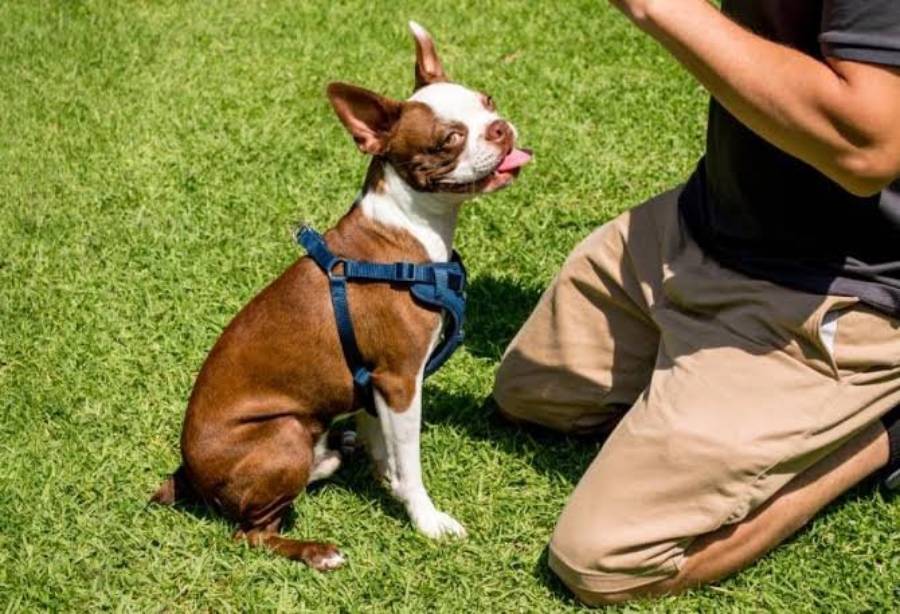
Boston Terriers are generally easy to train because they are intelligent, people-oriented dogs that respond well to consistent, reward-based training. They can learn basic commands, household routines, and appropriate social behaviors effectively when owners use clear cues and reward correct behavior immediately. This trainability also makes the breed manageable for many first-time dog owners who are prepared to train consistently.
However, training a Boston Terrier is not always effortless. Some Boston Terriers show an independent or stubborn streak, especially when a training session becomes repetitive or the reward is not motivating enough. The breed can also be sensitive to harsh corrections, so punishment-based methods may interfere with learning rather than improve obedience. Short sessions, positive reinforcement, and consistent rules are better suited to their temperament.
Training difficulty also depends on the skill being taught. Basic obedience commands may be easier to establish than reliable recall around distractions, while potty training, crate training, leash manners, and socialization each require different routines and levels of repetition. Understanding these differences helps owners set realistic expectations and choose training methods that match a Boston Terrier’s temperament, age, and motivation.
Are Boston Terriers easy to train?
Boston Terriers are generally easy to train because they are intelligent, attentive to their owners, and responsive to positive reinforcement. They can learn basic obedience commands, household rules, and daily routines when training is consistent. Their interest in interacting with people also gives owners several practical ways to reinforce behavior, including food rewards, praise, toys, and play.
Training success depends on more than intelligence. A Boston Terrier needs to understand which behavior produces a reward, and that connection becomes stronger when the same cue and response are practiced consistently. For example, when an owner says “sit,” rewards the dog immediately after it sits, and repeats the process across short sessions, the dog learns an association between the verbal cue, the behavior, and the positive outcome. Changing commands or rewarding the behavior inconsistently makes that association less predictable.
Boston Terriers can also be suitable for first-time owners who are willing to follow a consistent training routine. Their relatively manageable size makes physical handling easier than with a large, powerful breed, while reward-based methods allow owners to teach many behaviors without relying on physical corrections. However, inexperienced owners still need to establish clear household rules. Allowing a behavior one day and correcting the same behavior the next can make training less consistent and slow progress.
Individual Boston Terriers do not learn at exactly the same rate. Age, previous training, motivation, distractions, and the complexity of a behavior all affect how quickly a dog responds reliably. A Boston Terrier may learn “sit” in a controlled room relatively quickly but require substantially more practice before responding to “come” outdoors around other dogs, people, smells, and moving objects. For this reason, trainability should be judged by consistent progress rather than by how quickly a dog performs a command for the first time.
Why are Boston Terriers relatively easy to train?
Boston Terriers are relatively easy to train because three characteristics support the learning process: intelligence, a people-oriented temperament, and responsiveness to rewards. These characteristics make it easier for owners to establish clear associations between commands, desired behaviors, and positive outcomes.
Intelligence helps a Boston Terrier recognize patterns and learn repeated routines. A dog does not need to understand language in the human sense to respond to a command; it learns that a particular cue predicts an opportunity to perform a behavior and receive an outcome. This allows owners to build increasingly complex behaviors from simple ones. A Boston Terrier that reliably responds to its name, for example, has already developed a useful foundation for teaching attention, recall, and other obedience behaviors.
A people-oriented temperament can also support training because interaction with the owner becomes part of the reward system. Food is not the only reinforcement available. Praise, attention, a favorite toy, or permission to resume an enjoyable activity can reinforce a desired behavior when the individual dog values that reward. An owner can therefore use different rewards depending on the situation rather than relying on treats for every command.
Responsiveness to rewards is especially useful because it allows training to communicate clearly which behavior should be repeated. The timing of the reward matters. Giving a reward immediately after the desired behavior creates a clearer association than delaying it until the dog has performed several additional actions. For example, rewarding a Boston Terrier as soon as all four paws remain on the floor when greeting someone helps reinforce calm greeting behavior. Rewarding several moments later may unintentionally reinforce whatever the dog is doing at that later moment.
These characteristics make Boston Terriers trainable, but they do not eliminate the need for repetition and consistency. Intelligence can help a dog learn a behavior, while reliable obedience requires the dog to perform that behavior under different conditions. Owners therefore need to practice learned commands in progressively more distracting environments rather than assuming that a command learned inside the home will automatically transfer to every situation.
What makes a Boston Terrier difficult to train?
Boston Terriers can be difficult to train when independence, distractions, boredom, sensitivity, or inconsistent rules interfere with the learning process. These challenges do not make the breed untrainable. Instead, they affect how owners should structure training sessions and reinforce desired behaviors.
Independent behavior is one of the main reasons a Boston Terrier may appear stubborn. A dog that understands a command does not necessarily have the same motivation to perform it in every situation. A Boston Terrier may sit immediately in the kitchen when a food reward is available but ignore the same cue outdoors when another dog is more interesting. In this situation, increasing the value of the reward and reducing environmental distractions can be more effective than repeatedly giving the command.
Boredom can also reduce engagement when training becomes too repetitive. Repeating the same exercise for an extended period gives the dog fewer reasons to remain focused, particularly after it has already performed the behavior successfully several times. Owners can maintain engagement by keeping sessions focused, alternating between learned and new behaviors, and ending a session while the dog is still participating willingly. A short productive session provides clearer learning opportunities than a long session in which the dog repeatedly loses attention.
Boston Terriers can also be sensitive to harsh corrections. Shouting, intimidating the dog, or using physical punishment does not clearly teach the alternative behavior the owner wants. Rewarding the correct response provides more specific information. For example, when teaching a Boston Terrier not to jump on visitors, rewarding the dog for keeping all four paws on the floor communicates the desired behavior more clearly than punishment after jumping occurs.
Inconsistent rules create another training obstacle. Every person in the household should reinforce the same expectations and use the same cues for important behaviors. A Boston Terrier that is allowed on the sofa by one person but repeatedly removed by another receives conflicting information. Consistency makes the consequences of behavior predictable and gives the dog a clearer pattern to learn.
What is the best way to train a Boston Terrier?
The best way to train a Boston Terrier is to use positive reinforcement, consistent cues, immediate rewards, and gradually increasing levels of difficulty. Training should show the dog exactly which behavior produces a desirable outcome instead of relying primarily on corrections after unwanted behavior occurs.
Start with one clearly defined behavior and one consistent cue. When teaching “down,” for example, use the same verbal cue rather than alternating between “down,” “lie down,” and other phrases. Reward the correct behavior as soon as it occurs. Once the Boston Terrier responds reliably in a quiet environment, practice the same behavior in locations with gradually increasing distractions.
Positive reinforcement should use rewards that the individual Boston Terrier values. Food treats are practical for teaching new behaviors because they can be delivered quickly, but praise, toys, play, and access to desired activities can also reinforce behavior. For example, asking a Boston Terrier to sit before opening the door makes access to the outdoors the reward. This approach integrates obedience into everyday routines rather than limiting training to formal sessions.
Training difficulty should increase gradually. A dog that can perform a command inside the home should not immediately be expected to perform it reliably in a crowded park. Owners can first practice in another room, then in the yard, followed by a quiet outdoor area and eventually environments with stronger distractions. This progression teaches the Boston Terrier that the same command applies across different locations and situations.
Owners should also avoid repeating a cue continuously when the dog does not respond. Saying “come” five or six times can teach the dog that responding to the first cue is unnecessary. Instead, reduce the difficulty, regain the dog’s attention, and create a situation in which the correct response can be reinforced. Reliable obedience develops through successful repetitions rather than through increasing the number of times a command is spoken.
How long should Boston Terrier training sessions be?
Boston Terrier training sessions should generally be short enough to maintain the dog’s attention and end before engagement declines. There is no single session length that applies to every Boston Terrier because age, experience, environment, and the difficulty of the exercise affect concentration.
Puppies usually benefit from particularly brief training periods because they are simultaneously processing new sounds, smells, people, objects, and environments. Adult dogs with established training experience may remain engaged for longer. Owners should therefore monitor training quality rather than treating a fixed number of minutes as a requirement.
Several short sessions distributed throughout the day also create repeated opportunities for learning. Training can be incorporated into normal activities by asking for a sit before meals, practicing wait before going through a doorway, or reinforcing recall during controlled play. This approach allows a Boston Terrier to practice useful behaviors repeatedly without turning every learning opportunity into a long formal training session.
What commands should you teach a Boston Terrier first?
The first commands to teach a Boston Terrier are name response, sit, come, stay, down, and leave it because these behaviors create a foundation for everyday control and safety. Owners should teach these commands individually in a low-distraction environment before expecting reliable responses around people, dogs, traffic, food, or other distractions.
Name response is a useful starting point because attention supports almost every other training exercise. Say the Boston Terrier’s name once and reward the dog when it looks toward you. Repeated successful responses teach the dog that hearing its name means directing attention toward the owner. Once this response is reliable, it becomes easier to give another cue because the dog is already focused on the person giving it.
“Sit” is another practical early command because it can replace unwanted behaviors in everyday situations. Owners can ask a Boston Terrier to sit before receiving food, going through a doorway, greeting a person, or having its leash attached. This gives the dog a specific behavior to perform instead of simply correcting jumping, rushing through doors, or other unwanted actions.
“Come” is particularly important for safety. Begin recall training at a short distance in a controlled environment and reward the Boston Terrier immediately for reaching you. Distance and distractions should increase only after the dog responds consistently at the easier level. Calling the dog for unpleasant experiences every time, such as immediately ending play, can weaken the positive association with returning to the owner.
“Stay” and “down” add impulse control and make a Boston Terrier easier to manage during daily activities. Stay should initially involve a very short duration before the owner gradually adds more time, distance, and distraction. Changing all three variables at once makes the exercise unnecessarily difficult and increases the likelihood of failure.
“Leave it” teaches the Boston Terrier to disengage from an object or potential reward. This command can be useful when the dog approaches dropped food, household objects, or something inappropriate during a walk. Training should begin with low-value items before progressing to objects the dog finds more tempting.
Owners should prioritize reliability over the total number of commands their Boston Terrier knows. A dog that consistently responds to 5 or 6 useful commands in different environments has more practical training than a dog that has been introduced to dozens of cues but responds only when no distractions are present.
Are Boston Terriers easy to potty train?
Boston Terriers can be successfully potty trained when owners follow a predictable bathroom schedule, supervise the dog closely, and reward outdoor elimination immediately. Puppies require more frequent opportunities to eliminate because bladder and bowel control develops as they mature, while adult dogs may progress differently depending on their previous routines and training history.
A consistent schedule reduces the number of opportunities for indoor accidents. Take a Boston Terrier puppy to the designated potty area after waking, after eating or drinking, after active play, and at other predictable points in the daily routine. Regular trips help the owner anticipate elimination instead of waiting for the puppy to signal after the need has already become urgent.
Reward timing is especially important during potty training. Praise or reward the Boston Terrier immediately after it finishes eliminating in the correct location. Waiting until the dog returns inside creates a weaker connection between the reward and the outdoor elimination. The goal is to make the correct location consistently predict a positive outcome.
Supervision prevents a puppy from repeatedly practicing the wrong behavior. When direct supervision is not possible, owners can use an appropriately introduced crate, pen, or other controlled area as part of a structured routine. This does not replace regular bathroom opportunities. Instead, environmental management reduces unsupervised accidents while the dog is still learning where elimination should occur.
Indoor accidents should be cleaned thoroughly rather than treated as evidence that the Boston Terrier is deliberately disobedient. Punishing a dog after discovering an accident does not clearly communicate where it should have eliminated. It may instead teach the dog to avoid eliminating when the owner is nearby. The more useful response is to improve supervision, adjust the bathroom schedule, and reinforce the next correct elimination.
Why does a Boston Terrier keep having accidents indoors?
A Boston Terrier may continue having accidents indoors because of an inconsistent potty schedule, insufficient supervision, incomplete house training, changes in routine, or a physical problem affecting elimination. Identifying the cause is more effective than treating every accident as the same training failure.
Training-related accidents often follow a recognizable pattern. A puppy may be given too much freedom before developing reliable habits, miss a scheduled bathroom trip, or become distracted outdoors and eliminate after returning inside. Owners can address these situations by temporarily increasing supervision and bathroom frequency while rewarding successful outdoor elimination consistently.
Regression can also occur after environmental or routine changes. Moving to a new home, changing the daily schedule, or introducing unfamiliar circumstances may disrupt an established routine. Returning temporarily to a more structured potty schedule can help re-establish the expected behavior.
Repeated accidents can also require veterinary attention when they appear suddenly in a previously house-trained Boston Terrier or occur alongside signs such as unusually frequent urination, straining, increased thirst, diarrhea, or apparent discomfort. Training cannot correct an underlying medical cause, so unexpected changes in elimination should not automatically be treated as disobedience.
Are Boston Terriers easy to crate train?
Boston Terriers are generally manageable to crate train when the crate is introduced gradually and associated with rest, food, treats, and other positive experiences. The goal is to teach the dog that entering and remaining in the crate is safe and predictable. Using the crate primarily for punishment can create a negative association and make voluntary entry more difficult.
Start by allowing the Boston Terrier to investigate the crate without immediately closing the door. Place treats, a meal, or an appropriate toy inside and reward voluntary entry. Once the dog enters comfortably, begin closing the door for short periods while remaining nearby. Increase the duration gradually only when the dog remains comfortable at the current stage.
Distance should also increase progressively. A Boston Terrier that stays relaxed in a closed crate while the owner sits nearby may not be ready to remain equally calm when the owner leaves the room. Practice short absences first and return before increasing the duration. Gradual progression helps separate the skill of being inside the crate from the additional challenge of being alone.
A predictable crate routine can also support potty training and household management, particularly for puppies that cannot yet be supervised continuously. However, a crate does not replace bathroom breaks, exercise, social interaction, or training. Puppies need regular opportunities to eliminate and move around, while adult Boston Terriers still require sufficient physical activity and interaction outside the crate.
Owners should distinguish between brief protest and persistent distress. Repeated escape attempts, excessive drooling, prolonged vocalization, or signs of panic should not simply be addressed by leaving the dog confined for increasingly longer periods. Severe distress may require changes to the training process and guidance from a veterinarian or qualified behavior professional.
Are Boston Terriers easy to leash train?
Boston Terriers can learn good leash manners when owners consistently reward walking on a loose leash and prevent pulling from becoming the behavior that moves the dog forward. Leash training requires practice because outdoor environments contain smells, people, dogs, movement, and other distractions that compete for the dog’s attention.
Begin in a quiet location where the Boston Terrier can focus on the owner. Reward the dog for staying near you while the leash remains loose. Food rewards can initially be delivered frequently to establish the desired position, then reduced gradually as the dog becomes more consistent. Praise and continued forward movement can also become rewards once the behavior is established.
Pulling becomes more persistent when it repeatedly produces the outcome the dog wants. If a Boston Terrier pulls toward an interesting smell and immediately reaches it, pulling has been rewarded by access to that smell. Owners can instead stop forward movement or change direction when the leash becomes tight, then continue walking when the dog returns to a position that allows the leash to loosen.
Training should become progressively more difficult rather than moving immediately from a quiet room to a busy street or park. Practice can progress from indoors to a yard or quiet outdoor area before moving to locations with stronger distractions. This gives the Boston Terrier repeated opportunities to succeed before requiring the same behavior in a more demanding environment.
Owners should also reinforce voluntary attention during walks. When a Boston Terrier looks toward the owner without being prompted, rewarding that check-in makes future communication easier. A dog that regularly monitors its owner is easier to redirect before it reaches the end of the leash or becomes completely focused on a distraction.
Leash training should prioritize control and consistency rather than forcing the Boston Terrier to maintain one exact position throughout every walk. Loose-leash walking for daily exercise and a more precise heel are different behaviors. Most pet owners first need a dog that can walk without persistent pulling, respond to direction changes, and redirect its attention when necessary.
Socialize a Boston Terrier by gradually exposing the dog to different people, dogs, sounds, surfaces, environments, and forms of handling while creating positive or neutral experiences. Socialization should teach the dog how to remain comfortable and responsive in everyday situations rather than simply exposing it to as many new experiences as possible.
People should be introduced with variety because dogs can respond differently to unfamiliar appearances, movements, and behaviors. Controlled exposure to adults, children, visitors, people wearing hats, and people using mobility aids can help a Boston Terrier learn that differences in appearance are part of normal life. The interaction should remain manageable for the individual dog instead of forcing physical contact when it shows discomfort.
Interactions with other dogs should prioritize quality over quantity. A calm encounter with a suitable dog can provide a better learning experience than uncontrolled interaction with several unfamiliar dogs at once. Owners should reward calm behavior and allow enough distance for the Boston Terrier to observe without becoming overwhelmed. Socialization does not require a dog to greet every dog it encounters.
Environmental exposure should include common sounds, surfaces, objects, and locations. A Boston Terrier can gradually experience traffic sounds, household appliances, doorbells, veterinary handling, car travel, grass, pavement, and other situations it is likely to encounter throughout life. Pairing manageable exposure with treats, praise, or play can help create positive associations.
Socialization and obedience training should also work together. A Boston Terrier that can respond to its name, sit, or redirect attention toward its owner around mild distractions is developing skills that make unfamiliar environments easier to manage. As the dog becomes comfortable, owners can gradually increase environmental complexity while continuing to reinforce calm behavior.
Puppy socialization should begin during early development, but exposure should account for health and vaccination considerations. Owners should follow their veterinarian’s guidance about safe contact with unfamiliar dogs and environments where infectious disease exposure may be a concern. Safe socialization can include controlled experiences with known healthy dogs, household sounds, handling, different surfaces, visitors, and other appropriately managed stimuli.
How long does it take to train a Boston Terrier?
Training a Boston Terrier is an ongoing process because different behaviors require different amounts of repetition, maturity, and practice around distractions. A dog may understand a basic command relatively quickly while requiring much longer to perform that behavior reliably in different environments.
Basic commands such as sit or down are generally simpler to introduce than behaviors requiring impulse control. The initial learning stage involves teaching the Boston Terrier what a cue means. Reliability develops later through repeated practice in different locations and situations. A dog that sits immediately in the living room has learned an important first step, but that does not guarantee the same response near another dog in a park.
Potty training follows a different progression because success depends partly on physical development, schedule management, supervision, and established habits. A young puppy may understand that outdoor elimination earns a reward while still having accidents because it cannot consistently wait for the next bathroom opportunity. Progress should therefore be measured through fewer accidents and increasingly reliable signaling or routines rather than expecting immediate perfection.
Crate and leash training also develop through gradual exposure. A Boston Terrier may willingly enter a crate before it is comfortable remaining there alone for longer periods. Similarly, a dog may walk on a loose leash in a quiet area before maintaining the same behavior around dogs, people, food, traffic, or unfamiliar smells. Each increase in difficulty creates another stage of training.
Reliable recall usually requires more proofing than a simple stationary command because returning to the owner means disengaging from competing rewards. Owners should practice recall across gradually increasing distances and distractions while maintaining a strong reward history for returning. Allowing controlled progression makes the command more dependable than repeatedly testing it in situations that exceed the dog’s current training level.
The most useful distinction is between learning and reliability. Learning means the Boston Terrier understands which behavior follows a cue, while reliability means the dog can perform that behavior consistently under increasingly difficult conditions. Owners should continue reinforcing important behaviors after the dog first learns them so obedience becomes functional in everyday life rather than limited to formal training sessions.
Does age affect how easy a Boston Terrier is to train?
Age affects how a Boston Terrier learns, but puppies, adolescents, and adults can all be trained successfully. The main differences involve attention, physical maturity, previous learning, established habits, and the amount of training experience the dog already has. Age changes the training approach more than it determines whether training is possible.
Boston Terrier puppies are learning household routines and basic behaviors for the first time. This creates an opportunity to establish desirable habits early, but puppies also have shorter attention spans and less developed impulse control. Training should focus on simple skills such as name response, sit, recall foundations, handling, potty habits, crate comfort, and appropriate socialization. Frequent successful repetitions are more useful than expecting prolonged concentration.
Adolescent Boston Terriers may present different challenges as distractions become more interesting and previously learned commands appear less reliable in stimulating environments. Owners should continue reinforcing established behaviors instead of assuming the dog has deliberately stopped obeying. Practicing commands around progressively stronger distractions helps transfer behaviors learned during puppyhood into everyday situations.
Adult Boston Terriers can learn new behaviors even when they already have established habits. Training an adult dog may require changing an existing behavior before building a replacement behavior. For example, a Boston Terrier that has spent years pulling toward interesting smells during walks has repeatedly practiced and reinforced pulling. Loose-leash training can still be taught, but owners need to prevent the old behavior from continuing to produce the same reward while consistently reinforcing the new behavior.
Previous experience can therefore matter as much as chronological age. An adult Boston Terrier with a history of consistent positive training may adapt to a new command faster than a younger dog with little training experience. Owners should evaluate the dog’s current skills and behavior rather than assuming that younger always means easier to train.
Does exercise affect Boston Terrier training?
Appropriate physical activity can improve Boston Terrier training by helping the dog reach a manageable level of energy and focus before a learning session. A dog that is highly aroused or eager to move may have difficulty concentrating on stationary exercises, while an exhausted dog may have little motivation to participate.
The goal is not to tire a Boston Terrier until it becomes compliant. Exercise and training serve different functions. A short walk, controlled play, or another appropriate activity can provide an outlet before training, while mental exercises such as scent work and simple problem-solving tasks can add enrichment. The appropriate amount depends on the dog’s age, physical condition, environment, and activity level.
Owners should also account for the Boston Terrier’s physical characteristics when combining exercise and training. Boston Terriers are brachycephalic dogs, meaning they have shortened skull and muzzle structures. Exercise intensity should therefore be managed carefully, particularly in warm conditions or when a dog shows difficulty breathing. Training does not require strenuous exercise, and calm indoor sessions can provide mental activity without demanding intense physical exertion.
Exercise can also become a training reward. Access to a walk, play session, sniffing opportunity, or favorite activity can follow a desired behavior. For example, an owner can ask the Boston Terrier to wait calmly before opening the door and then use access to the walk as reinforcement. This integrates obedience into activities the dog already values.
Read more: Are Boston Terriers Hypoallergenic? What to Know
When should you get professional help training a Boston Terrier?
Professional help is appropriate when a Boston Terrier shows persistent behavior problems, fear, aggression, severe distress, or little progress despite consistent training. Basic obedience problems and serious behavioral problems should not automatically be treated as the same issue because they may require different levels of expertise.
A trainer can help when an owner struggles with skills such as leash manners, recall, basic commands, or establishing a consistent training routine. Professional observation can identify problems with reward timing, cue consistency, progression, or environmental difficulty that owners may not notice during everyday training.
Fear, aggression, panic, or severe separation-related behavior requires greater caution. These behaviors may involve emotional responses rather than a simple failure to understand a command. Increasing punishment in these situations can make the underlying response worse. A qualified behavior professional can assess triggers, management needs, and an appropriate behavior-modification plan.
Veterinary evaluation is also important when behavior changes suddenly. Pain, illness, sensory changes, or other physical problems can alter a Boston Terrier’s willingness or ability to perform behaviors it previously completed reliably. A dog that suddenly resists handling, becomes unusually irritable, or develops unexpected elimination problems should not automatically be treated as stubborn.
Are Boston Terriers good dogs for first-time owners?
Boston Terriers can be suitable for first-time dog owners because they are generally trainable, people-oriented, and capable of learning household routines through consistent positive reinforcement. However, first-time owners still need to provide structured training, appropriate socialization, exercise, supervision, and breed-appropriate care.
Their trainability can make basic obedience accessible to inexperienced owners. A first-time owner can establish useful behaviors by starting with clear commands, rewarding correct responses immediately, and increasing difficulty gradually. Skills such as sit, come, wait, loose-leash walking, crate comfort, and potty habits provide a practical foundation for everyday life.
The main challenge is consistency. New owners sometimes change cues, repeat commands excessively, reward unwanted behavior unintentionally, or expect a behavior learned at home to work immediately around distractions. Boston Terriers benefit when household members use the same rules and reinforce the same desired behaviors.
Prospective owners should also consider factors beyond trainability. Training is only one part of living with a Boston Terrier. Exercise needs, social interaction, grooming, veterinary care, breed-related health considerations, and the individual dog’s temperament all contribute to owner suitability. A Boston Terrier should therefore be chosen based on whether its overall needs fit the owner’s lifestyle rather than on ease of training alone.
For owners prepared to use consistent reward-based methods, training can become part of everyday interaction rather than a separate task. Regular practice during meals, walks, play, greetings, and household routines gives a Boston Terrier repeated opportunities to use learned behaviors in real situations. This consistency is what turns basic command learning into reliable behavior over time.
1 thought on “Are Boston Terriers Easy to Train? Training Guide”