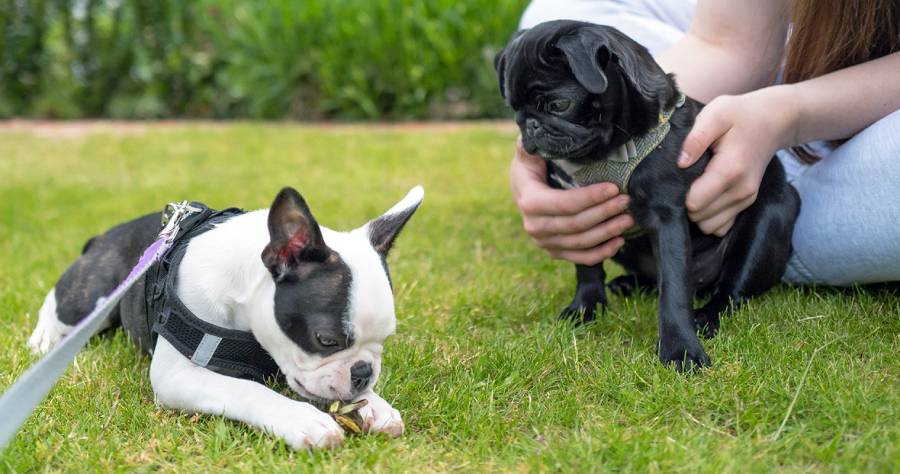
Boston Terriers are generally good with other dogs when they are properly socialized and introduced. Their social and playful temperament can make them suitable companions for other dogs, including dogs living in the same household. However, breed tendencies do not guarantee compatibility between every Boston Terrier and every dog.
Whether two dogs get along depends on 6 main factors: individual temperament, socialization history, previous experiences with dogs, age, size, and play style. A Boston Terrier that has had positive interactions with other dogs from an early age is more likely to recognize appropriate social signals and respond calmly during new encounters. In contrast, fear, poor socialization, resource guarding, or previous negative experiences can make interactions more difficult.
The characteristics of the other dog matter as well. A friendly Boston Terrier may still struggle with a dog whose play is too intense, whose energy level is substantially different, or whose behavior repeatedly causes discomfort. Size differences can also affect physical safety even when both dogs are socially compatible.
This guide explains how Boston Terriers typically behave around other dogs, what affects their compatibility, how to introduce two dogs safely, and which behaviors indicate that an interaction is going well or requires intervention.
Are Boston Terriers good with other dogs?
Boston Terriers are generally good with other dogs when they have been properly socialized and the dogs have compatible temperaments. Their playful and people-oriented nature can extend to interactions with other dogs, making many Boston Terriers suitable for multi-dog households. However, compatibility varies between individual dogs, so being a Boston Terrier does not automatically mean a dog will accept every canine companion.
Early experiences have a major influence on how a Boston Terrier responds to other dogs. Regular, positive exposure to dogs during puppyhood helps a Boston Terrier learn canine communication, including when another dog wants to play, needs more space, or wants an interaction to stop. An adult Boston Terrier with limited social experience may need slower introductions because unfamiliar dogs can create excitement, uncertainty, or fear.
Compatibility also depends on the other dog. Two socially friendly dogs can still have difficulty living together when their energy levels and play styles are substantially different. For example, a Boston Terrier that enjoys chasing and physical play may repeatedly overwhelm a quieter dog that prefers short interactions. Successful companionship requires both dogs to respect each other’s signals and disengage when the other dog has had enough.
Living peacefully together is also different from constantly playing together. Two compatible dogs may play regularly, but they should also be able to eat, rest, move around the home, and receive attention without persistent conflict. Calm coexistence is therefore an important indicator that a Boston Terrier is genuinely comfortable with another dog.
Why do Boston Terriers usually get along with other dogs?
Boston Terriers can get along with other dogs because their social temperament and playful behavior can support positive dog-to-dog interactions. These characteristics are most beneficial when they are combined with appropriate socialization, because temperament creates a behavioral tendency while experience teaches the dog how to interact appropriately.
Playfulness can make another compatible dog an attractive social partner for a Boston Terrier. Activities such as chasing, exploring, and reciprocal play provide opportunities for interaction, but successful play requires both dogs to participate voluntarily. Healthy play is typically flexible: one dog may chase and then be chased, physical activity is interrupted by pauses, and either dog can leave without immediately being pursued. This reciprocity helps distinguish mutually enjoyable interaction from one dog simply tolerating the other.
Socialization strengthens these interactions by teaching a Boston Terrier how to respond to different canine behaviors. Positive exposure to dogs of different ages, sizes, and play styles can help the dog become familiar with a wider range of social signals. For example, a Boston Terrier that recognizes another dog’s attempt to disengage can stop playing rather than continuing to chase or initiate physical contact.
Socialization should focus on the quality of interactions rather than the number of dogs a Boston Terrier meets. Repeated stressful encounters can reinforce fear or defensive behavior instead of improving sociability. Controlled experiences with calm, appropriate dogs provide a better opportunity to build useful social skills than forcing a Boston Terrier to interact with unfamiliar dogs when it is uncomfortable.
Breed characteristics therefore provide only part of the explanation. A Boston Terrier’s relationship with other dogs develops from the combination of temperament, learned social skills, previous experiences, and the behavior of the dogs it encounters. This is why two Boston Terriers raised in different environments can show noticeably different responses to the same dog.
What determines whether a Boston Terrier gets along with another dog?
There are 6 main factors that determine whether a Boston Terrier gets along with another dog: individual temperament, socialization history, previous experiences, age, size, and energy level or play style. These factors interact with each other, which means breed alone cannot reliably determine whether two individual dogs will be compatible.
Individual temperament directly affects how a Boston Terrier approaches and responds to other dogs. A confident, socially relaxed dog may approach another dog calmly, investigate without excessive pressure, and disengage when the other dog requests space. A more fearful or easily overstimulated Boston Terrier may respond to the same encounter by retreating, barking, becoming tense, or attempting to increase the distance between itself and the unfamiliar dog. Compatibility improves when both dogs can communicate without repeatedly creating stress for each other.
Socialization history determines how much experience a Boston Terrier has interpreting canine behavior. Positive exposure to different dogs helps the Boston Terrier learn that dogs vary in size, movement, vocalization, and interaction style. Socialization is most useful when these experiences remain controlled and positive. Repeated exposure to stressful interactions does not necessarily make a dog more social and can instead teach it to associate unfamiliar dogs with discomfort.
Previous experiences can influence behavior even after a Boston Terrier has developed basic social skills. A dog that has repeatedly enjoyed calm interactions may approach future encounters differently from one that has been frightened, chased, or attacked. For example, a Boston Terrier with a negative history involving large dogs may become uncomfortable around a large dog even when that particular dog behaves appropriately. The response can therefore reflect learned associations rather than the current dog’s actual intentions.
Age also affects compatibility because puppies, adults, and senior dogs often have different interaction needs. A Boston Terrier puppy may initiate play frequently and continue seeking attention after an older dog wants to rest. An adult Boston Terrier may tolerate this behavior for a limited period, while a senior dog may find persistent puppy activity stressful. Compatible age does not require the dogs to be the same age, but their needs must be managed so that neither dog is repeatedly pressured into unwanted interaction.
Size matters primarily because it changes the physical consequences of play. A Boston Terrier can be socially compatible with both smaller and larger dogs, but a substantial size difference increases the possibility of accidental injury during running, wrestling, or body contact. Owners should therefore evaluate how the dogs actually play rather than assuming that friendly behavior automatically makes physical interaction safe.
Energy level and play style determine whether both dogs enjoy similar forms and amounts of interaction. One Boston Terrier may enjoy frequent chasing and wrestling, while another may prefer short periods of play followed by rest. A companion dog with a similar communication style can make interaction easier. The strongest compatibility occurs when both dogs can initiate interaction, respond to each other’s signals, and stop without conflict.
Are Boston Terriers aggressive toward other dogs?
Boston Terriers are not automatically aggressive toward other dogs, but an individual Boston Terrier can display aggressive behavior because of fear, poor socialization, resource guarding, territorial behavior, previous negative experiences, or physical discomfort. Aggression should therefore be evaluated according to the circumstances and the individual dog’s behavior rather than attributed to breed alone.
Fear can produce defensive behavior when a Boston Terrier believes another dog is threatening or cannot create enough distance. A fearful dog may initially avoid interaction, move away, lower its body, or seek its owner. Growling, snapping, or lunging can occur when earlier attempts to create distance do not work. Punishing these warning behaviors without addressing the underlying fear can remove useful communication while leaving the cause of the response unchanged.
Resource guarding creates a different type of conflict. A Boston Terrier may become tense when another dog approaches valued resources such as food, treats, toys, resting places, or attention from a person. The behavior can range from positioning the body between the other dog and the resource to staring, growling, snapping, or fighting. Managing access to high-value resources is particularly important when introducing a new dog into a Boston Terrier’s home.
Territorial behavior can also make home introductions more difficult than meetings in neutral environments. A Boston Terrier that interacts calmly with a dog outdoors may respond differently when that dog enters its sleeping, feeding, or resting areas. This difference is one reason the first meeting between unfamiliar dogs is better handled in a controlled environment before expecting them to share household space.
Owners should also distinguish aggressive behavior from normal canine communication. Growling, for example, communicates discomfort and does not automatically mean a Boston Terrier intends to attack. Warning signs that deserve attention include a persistently stiff body, hard staring, repeated attempts to avoid the other dog, escalating growling, snapping, lunging, or interactions in which one dog repeatedly tries to escape while the other continues pursuing it.
A sudden behavioral change requires particular attention. A Boston Terrier that previously tolerated other dogs but suddenly becomes defensive or irritable may be responding to pain or physical discomfort. In that situation, the change should not automatically be treated as a training problem, and veterinary evaluation may be appropriate before attempting to modify the dog’s social behavior.
Are Boston Terriers good with small dogs?
Boston Terriers can get along well with small dogs when both dogs have compatible temperaments, appropriate social skills, and mutually comfortable play styles. Similar body size can make some interactions easier to manage, but size alone does not determine whether two dogs will form a good relationship.
Temperament is more important than simply pairing a Boston Terrier with another small breed. A calm Boston Terrier may live comfortably with a small dog that prefers moderate interaction, while a highly energetic Boston Terrier may be better matched with a dog that enjoys frequent play. Problems can develop when one dog repeatedly initiates chasing, wrestling, or physical contact while the other tries to move away.
Play intensity requires particular attention when the companion dog is substantially smaller or more physically delicate than the Boston Terrier. Even friendly play can become uncomfortable when one dog repeatedly knocks the other over, pins it, or ignores attempts to disengage. Owners should look for reciprocal interaction rather than assuming that the absence of fighting means both dogs are enjoying themselves.
A positive interaction allows both dogs to make choices. The Boston Terrier and the smaller dog should be able to approach, play, pause, and move away without being persistently followed. A good match is therefore based on compatible behavior rather than simply matching two dogs because they are both small.
Are Boston Terriers good with large dogs?
Boston Terriers can get along with large dogs, but social compatibility and physical safety must be evaluated separately. A Boston Terrier may be completely comfortable with a much larger dog while still facing a greater risk of accidental injury during rough play because of the difference in body weight and strength.
The large dog’s behavior is especially important. A large dog that adjusts its play intensity, responds when the Boston Terrier disengages, and avoids excessive body contact may be a suitable companion. In contrast, a friendly but highly physical dog can unintentionally overwhelm a Boston Terrier through repeated tackling, wrestling, or forceful chasing.
Supervision should therefore focus on how the two dogs interact rather than size alone. Reciprocal chasing, frequent pauses, loose body movements, and voluntary re-engagement suggest that both dogs are participating. Repeated pinning, attempts to escape, hiding, persistent pursuit, or a noticeable change from relaxed to stiff body language indicate that the interaction should be interrupted.
Owners should not assume that a large dog is unsuitable simply because it is large, nor that friendly behavior eliminates physical risk. A Boston Terrier and a large dog are more likely to interact successfully when the larger dog can moderate its behavior and both dogs respect each other’s attempts to stop playing.
Do male and female Boston Terriers get along with other dogs differently?
Sex can influence dog-to-dog relationships, but it is not enough by itself to determine whether a Boston Terrier will get along with another dog. Individual temperament, socialization, previous experiences, age, and behavior during interactions provide more useful information when evaluating a specific pairing.
A male and female pairing may work well when both dogs communicate appropriately and have compatible activity levels. Two males or two females can also live successfully together under the same conditions. Problems should not automatically be attributed to the dogs being the same sex because fear, competition over resources, incompatible play styles, and previous learning can produce similar conflicts.
Reproductive status may also affect behavior in individual dogs, but it should not be treated as a simple explanation for every social problem. For example, tension around another dog may involve access to food, toys, resting areas, or human attention rather than sex itself. Identifying the context in which the behavior occurs provides more useful information than relying on a male-versus-female rule.
When choosing a companion for a Boston Terrier, prioritize the behavior of the two individual dogs over sex-based assumptions. A pairing that shows relaxed communication, reciprocal interaction, and an ability to share space calmly provides stronger evidence of compatibility than the dogs’ sexes alone.
Can a Boston Terrier live with a second dog?
A Boston Terrier can live successfully with a second dog when the two dogs have compatible temperaments and their introduction and shared resources are managed appropriately. A second dog should therefore be selected according to the existing Boston Terrier’s behavior and needs rather than simply choosing a particular breed, size, or sex.
Before adding another dog, evaluate how the Boston Terrier already responds to dogs. A dog that regularly remains relaxed around familiar dogs provides a different starting point from one that consistently avoids them, guards resources, or becomes highly aroused during interactions. Existing behavioral problems should not be expected to disappear simply because another dog enters the household.
Age and energy level also affect daily compatibility. For example, introducing an energetic puppy to an older Boston Terrier can create tension when the puppy repeatedly initiates play while the adult wants to rest. The pairing can still work, but the owner needs to provide separate rest periods and prevent the puppy from continually disturbing the older dog. Similar management may be necessary whenever the dogs have substantially different activity levels.
Shared resources require planning during the transition. Each dog should have reliable access to food, water, resting space, and opportunities to move away from interaction. Feeding separately can prevent unnecessary competition, while controlling access to high-value chews or toys can reduce conflict during the early stages of living together.
Owners should also allow the relationship to develop instead of expecting immediate friendship. Some dogs begin playing during their first meetings, while others initially prefer distance and gradually become comfortable sharing space. The goal of a successful multi-dog household is not constant interaction; it is creating an environment in which both the Boston Terrier and the second dog can interact, disengage, rest, and access important resources without persistent stress or conflict.
How should you introduce a Boston Terrier to another dog?
Introduce a Boston Terrier to another dog gradually in a controlled environment, beginning outside the home and progressing to supervised interaction in shared spaces. A structured introduction gives both dogs time to observe each other, communicate, and create distance when necessary instead of forcing immediate face-to-face contact.
The introduction should move according to the dogs’ behavior rather than a fixed time limit. Loose body posture, voluntary approaches, brief sniffing, and the ability to disengage indicate that the dogs are comfortable enough to continue. Stiff posture, prolonged staring, repeated avoidance, growling, lunging, or persistent attempts to escape indicate that more distance or a break is needed.
Where should the two dogs meet for the first time?
Let the Boston Terrier and the other dog meet in a neutral, controlled location where neither dog regularly eats, sleeps, or guards resources. A quiet outdoor area can work better than immediately bringing an unfamiliar dog into the Boston Terrier’s home because it reduces competition over familiar space and allows the dogs to move around more freely.
Begin with enough distance for both dogs to remain relaxed. Walking in the same direction can allow them to become aware of each other without requiring prolonged face-to-face contact. The distance can gradually decrease when both dogs continue showing relaxed behavior.
Avoid creating unnecessary pressure by forcing the dogs together so they can sniff each other. A Boston Terrier that chooses to approach and then move away is communicating normally. Allowing this movement gives each dog greater control over the encounter and provides useful information about whether either dog wants additional interaction.
How should you manage their first interaction?
Keep the first interaction supervised, brief, and flexible enough for either dog to disengage. The goal is not to make the Boston Terrier play immediately but to determine whether both dogs can remain comfortable in each other’s presence.
Watch the entire interaction rather than focusing on a single behavior. Healthy play can include chasing, wrestling, vocalization, and physical contact when both dogs participate voluntarily. Look for reciprocity: the dogs may switch roles during chasing, pause before resuming play, or separate briefly and then approach each other again.
Intervene when the interaction becomes consistently one-sided. For example, separate the dogs if the Boston Terrier repeatedly pursues another dog that is hiding, attempting to leave, or continually seeking protection from a person. The same rule applies when the other dog persistently overwhelms the Boston Terrier.
Keep leashes managed so they provide safety without maintaining constant tension. A tight leash can restrict movement and make normal communication more difficult. The handler should remain attentive and create additional distance when either dog begins showing sustained discomfort.
When should you bring the new dog into the home?
Bring the new dog into the home after the dogs have demonstrated that they can remain relatively relaxed around each other during controlled interactions. A successful outdoor meeting is useful, but it does not guarantee identical behavior indoors because the home contains resting areas, food, toys, people, and other resources that may change the dogs’ responses.
Keep the first indoor interactions supervised. Allow each dog access to space where it can rest without being continually approached by the other. This is especially important when one dog is more energetic or persistent than the other.
Do not require the dogs to share beds, crates, toys, or other valued items simply to encourage bonding. Relationships develop through repeated safe experiences, not through forced proximity. A Boston Terrier and a new companion may initially spend limited time together and gradually become more comfortable over several interactions.
Increase unsupervised access only after both dogs consistently demonstrate calm behavior together. Dogs that still show tension around resources, persistent unwanted pursuit, or escalating conflict need continued management rather than more freedom.
How should you manage food, toys, and sleeping areas?
Manage food, high-value toys, and sleeping areas separately during the early stages of a new dog relationship. Resource management reduces avoidable competition while the Boston Terrier and the other dog are still learning how to share the household.
Feed the dogs from separate bowls with enough distance to prevent either dog from approaching the other’s food. Remove bowls after meals when necessary rather than leaving food available in a shared space. High-value chews and favorite toys should also be controlled if either dog becomes tense when the other approaches.
Provide each dog with a reliable resting area. Separate beds, crates, or designated spaces allow a Boston Terrier or its companion to disengage without being followed. Rest is particularly important when an energetic dog lives with an older or less active companion.
Human attention can function as a valued resource as well. Observe whether either dog pushes between the other dog and a person, blocks access, becomes stiff, or displays escalating behavior during attention. Structured individual time with each dog can reduce competition while maintaining positive human-dog relationships.
A successful introduction is complete when both dogs can repeatedly share space without persistent fear, unwanted pursuit, or conflict over resources. Friendship and play are positive outcomes, but peaceful coexistence is the more important requirement for a stable multi-dog household.
How can you tell if a Boston Terrier and another dog get along?
A Boston Terrier and another dog are getting along when both dogs show relaxed body language, participate voluntarily in interactions, respect attempts to disengage, and can remain calm while sharing the same space. Playing together is a positive sign, but compatibility should be evaluated across multiple situations rather than judged from play alone.
Reciprocal play is one of the clearest positive indicators. During a healthy interaction, both dogs participate rather than one dog constantly chasing, pinning, or approaching the other. They may switch roles during chasing or wrestling, pause for several seconds, and then voluntarily return to each other. Play bows, loose movements, and repeated re-engagement can also indicate that both dogs want the interaction to continue.
The ability to stop interacting is equally important. A compatible Boston Terrier should be able to move away, investigate the environment, rest, or interact with its owner without being continually pursued by the other dog. The companion dog should receive the same freedom. Two dogs that repeatedly respect each other’s attempts to disengage demonstrate stronger social compatibility than dogs whose interactions require frequent human intervention.
Calm behavior around everyday resources provides another useful measure. A Boston Terrier and another dog should eventually be able to move around the home, settle in their own resting areas, and receive routine attention without persistent tension. Owners should remain attentive around food, treats, favorite toys, and other high-value resources because otherwise friendly dogs may behave differently when competition is introduced.
Compatibility does not require the dogs to become inseparable. Some Boston Terriers frequently sleep and play beside their canine companions, while others maintain more independent routines. Two dogs that can peacefully share a home while respecting each other’s boundaries can have a successful relationship even when they rarely play together.
Read more: Are Boston Terriers Good With Cats? What to Know
Can Boston Terriers go to dog parks safely?
Boston Terriers can use dog parks safely when they are comfortable around unfamiliar dogs, respond appropriately to canine social signals, and can be closely supervised. Being friendly with a dog at home does not automatically mean a Boston Terrier will be comfortable in a group of unfamiliar dogs.
Dog parks create a different social environment from a multi-dog household. The Boston Terrier may encounter dogs with different sizes, energy levels, play styles, and social skills within a short period. Owners also have less control over the behavior of unfamiliar dogs than they do when arranging a controlled one-on-one introduction.
Observe the Boston Terrier before and during group interaction. Loose movement, voluntary approaches, appropriate pauses, and the ability to leave play indicate that the dog is managing the environment. Persistent hiding, attempts to stay near the exit, repeated avoidance, stiff posture, escalating vocalization, or difficulty disengaging indicate that the environment may be creating too much pressure.
Physical compatibility matters as well. A Boston Terrier may enjoy playing with a much larger dog, but substantial differences in weight and strength can increase the consequences of collisions or rough physical play. Owners should intervene before an interaction becomes unsafe rather than waiting for an actual fight.
Dog parks are also not necessary for every Boston Terrier. A Boston Terrier can have appropriate canine social interaction through controlled meetings with compatible dogs instead of interacting with a large group of unfamiliar dogs. The objective is positive social experience, not exposure to the greatest possible number of dogs.
When should you get professional help if your Boston Terrier does not get along with other dogs?
Seek professional help when a Boston Terrier repeatedly fights, bites, lunges at other dogs, displays severe fear, guards resources aggressively, or shows behavior that becomes more intense despite careful management. Professional assessment is also appropriate when owners cannot safely identify or control the situations that trigger conflict.
Repeated aggression deserves attention because each incident provides another opportunity for the behavior to become established. For example, a Boston Terrier that repeatedly lunges until another dog moves away may learn that lunging successfully creates distance. Simply increasing exposure to other dogs does not address the underlying fear, frustration, or other motivation driving the behavior.
Severe resource guarding also requires careful management. Growling over a valued item communicates discomfort, but repeated snapping, biting, or fighting around food, toys, resting areas, or people creates a greater safety concern in a multi-dog household. Preventing access to predictable conflict situations can reduce immediate risk while the underlying behavior is evaluated.
A veterinarian should be considered when dog-directed behavior changes suddenly. Pain, illness, or physical discomfort can reduce a dog’s tolerance for interaction. A Boston Terrier that previously lived peacefully with another dog but suddenly begins reacting when approached or touched may therefore need a medical evaluation before the change is treated exclusively as a behavioral issue.
A qualified dog behavior professional can help assess triggers, body language, environmental factors, and patterns surrounding repeated conflicts. The objective should be to identify why the behavior occurs and establish a management or behavior-modification plan appropriate for the individual dog.
Do not force repeated interactions when a Boston Terrier consistently shows fear or escalating aggression toward another dog. Creating distance, preventing further conflict, and obtaining appropriate professional guidance is safer than expecting the dogs to resolve persistent problems on their own.