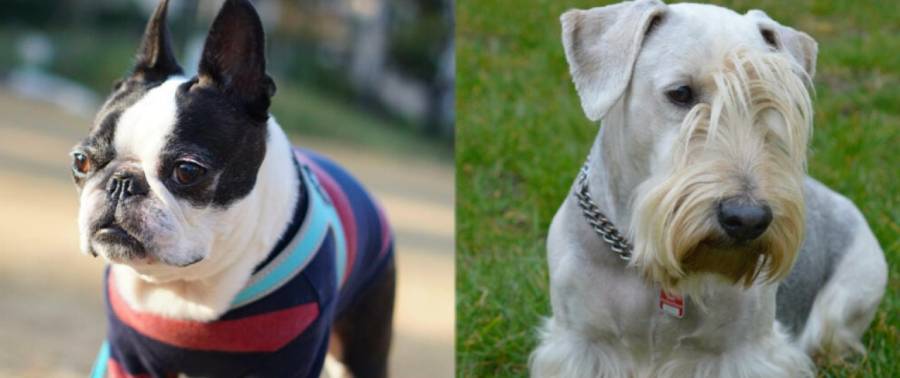
Boston Terriers and Miniature Schnauzers are small dog breeds with different temperaments, coat types, grooming requirements, exercise needs, and physical characteristics. Boston Terriers are compact companion dogs with short coats, short muzzles, and a generally sociable disposition. Miniature Schnauzers have distinctive beards and eyebrows, double coats, and an alert temperament shaped partly by their history as working farm dogs.
The differences between these breeds affect everyday ownership. Their coats require different levels of maintenance, their tendency to bark differs, and their exercise and mental stimulation needs are not identical. Breed-specific health concerns also influence the type of preventive care owners should consider. These factors can matter when choosing a dog for an apartment, a household with children, or a home with other pets.
This Boston Terrier vs Miniature Schnauzer comparison examines their size, appearance, temperament, exercise needs, trainability, barking, grooming, shedding, health, lifespan, family compatibility, and ownership requirements. Comparing these characteristics side by side provides a clearer picture of what living with each breed involves and which characteristics align with different household environments and lifestyles.
What Are the Main Differences Between a Boston Terrier and a Miniature Schnauzer?
The main differences between a Boston Terrier and a Miniature Schnauzer are their body structure, coat, grooming needs, temperament, barking tendency, and exercise requirements. Both are small dogs, but the Boston Terrier was developed primarily as a companion breed, while the Miniature Schnauzer developed from German farm dogs used for tasks such as ratting. These different backgrounds contribute to noticeable differences in their appearance and behavior.
| Characteristic | Boston Terrier | Miniature Schnauzer |
|---|---|---|
| Breed group | Non-Sporting | Terrier |
| Height | 15–17 inches | 12–14 inches |
| Weight | Under 25 pounds | 11–20 pounds |
| Coat | Short, smooth coat | Wiry double coat |
| Grooming | Relatively simple | More intensive |
| Shedding | Low to moderate | Minimal |
| Temperament | Friendly, social, lively | Friendly, alert, spirited |
| Exercise | Moderate daily activity | Regular physical and mental activity |
| Barking | Generally less vocal | More inclined to alert bark |
| Typical lifespan | 11–13 years | 12–15 years |
The physical differences are particularly easy to recognize. A Boston Terrier has a compact, square body, large upright ears, a short muzzle, and a smooth coat. A Miniature Schnauzer has a more rectangular profile and a wiry coat, with prominent eyebrows and facial hair forming its characteristic beard. The Schnauzer coat also requires substantially more maintenance because regular brushing and trimming are necessary to maintain its texture and appearance.
Their behavioral tendencies create additional differences in daily ownership. Boston Terriers tend to focus strongly on human companionship and generally have moderate exercise requirements. Miniature Schnauzers are alert, energetic dogs that benefit from both physical exercise and mental stimulation. Their watchdog tendencies also make barking an important consideration, particularly for owners living in apartments or other environments where noise matters.
Neither breed’s characteristics guarantee the behavior of an individual dog. Genetics, early socialization, training, age, health, and the home environment influence how an individual Boston Terrier or Miniature Schnauzer behaves. Breed characteristics are therefore most useful for understanding general tendencies rather than predicting every dog’s personality.
How Do Boston Terriers and Miniature Schnauzers Differ in Size?
Boston Terriers are generally taller and can be heavier than Miniature Schnauzers, although their adult size ranges overlap. Boston Terriers typically stand 15–17 inches at the shoulder and weigh less than 25 pounds. Miniature Schnauzers generally stand 12–14 inches and weigh 11–20 pounds. This makes both breeds small enough for many homes where space is limited.
The difference becomes clearer when body structure is considered alongside measurements. Boston Terriers have compact, muscular bodies with relatively square proportions. Their weight can therefore be greater than their height initially suggests. Miniature Schnauzers have sturdy but more rectangular bodies, with their characteristic facial furnishings and leg hair making their outline appear somewhat different from that of a smooth-coated dog.
Size also affects practical aspects of ownership. Both breeds are manageable enough for most adults to lift and transport when necessary, and neither requires the indoor space associated with large breeds. However, a dog’s small body size does not determine how much activity or stimulation it requires. A Miniature Schnauzer can require substantial daily engagement despite being shorter than a Boston Terrier.
Weight should also be evaluated according to the individual dog’s frame and body condition rather than breed averages alone. Two dogs of the same breed and weight can have different body conditions depending on muscle mass and body fat. Maintaining an appropriate weight is particularly important because excess weight increases stress on joints and can complicate existing health problems.
How Do Boston Terriers and Miniature Schnauzers Look Different?
Boston Terriers have short, smooth coats and compact, square bodies, while Miniature Schnauzers have wiry double coats, rectangular bodies, and distinctive facial furnishings. The difference is noticeable even though both breeds are small. A Boston Terrier has a cleaner, smoother outline, whereas a Miniature Schnauzer has a more textured appearance created by its beard, eyebrows, and longer hair on parts of the legs.
The Boston Terrier has a short muzzle, large round eyes, and small, erect ears positioned toward the corners of its skull. Its body is compact and balanced, with a naturally short tail. The smooth coat occurs in brindle, seal, or black with characteristic white markings. These markings commonly appear around the muzzle, between the eyes, and across the chest, creating the contrasting pattern strongly associated with the breed.
The Miniature Schnauzer has a more rectangular outline and a longer muzzle. Its most recognizable features are the bushy eyebrows and beard formed by longer facial hair. The breed has a double coat consisting of a hard, wiry outer coat and a close undercoat. Recognized coat colors include salt and pepper, black and silver, and solid black. Coat presentation can vary depending on whether the dog is clipped or its coat is maintained through hand stripping.
These coat differences also affect daily care. A Boston Terrier’s short coat requires relatively straightforward maintenance, while a Miniature Schnauzer’s coat needs regular brushing and periodic trimming or clipping. Appearance is therefore connected directly to grooming commitment rather than being only a cosmetic distinction between the breeds.
How Does a Boston Terrier’s Temperament Compare With a Miniature Schnauzer’s?
Boston Terriers tend to be sociable, people-oriented companion dogs, while Miniature Schnauzers tend to be more alert, vigilant, and inclined to respond to activity around their environment. Both breeds can be affectionate and engaged with their families, but they express these characteristics differently because they were developed for different purposes.
Boston Terriers generally seek frequent interaction with people and are known for their lively, friendly disposition. Their companion-oriented temperament can make them enthusiastic participants in household activities, play, and training. They can also be sensitive to a person’s tone and training methods, so consistent positive reinforcement is more appropriate than harsh correction. Their sociability does not eliminate the need for early exposure to different people, dogs, environments, and everyday situations.
Miniature Schnauzers combine companionship with a stronger alert-dog tendency. Their historical role included working around farms and controlling vermin, which helps explain characteristics such as vigilance, confidence, and responsiveness to movement or unfamiliar sounds. These tendencies can make a Miniature Schnauzer attentive to visitors and environmental changes, but they can also contribute to barking or reactive behavior when appropriate training and socialization are absent.
Both breeds have playful personalities, but temperament should not be treated as a fixed trait shared identically by every member of a breed. Genetics establish tendencies, while socialization, training, previous experiences, health, and the home environment influence the behavior an individual dog ultimately displays. A well-socialized Miniature Schnauzer may be highly sociable with strangers, for example, while an individual Boston Terrier may be more reserved than the breed’s general profile suggests.
Which Breed Needs More Exercise, a Boston Terrier or a Miniature Schnauzer?
Miniature Schnauzers generally require more consistent physical activity and mental stimulation than Boston Terriers. Both breeds need daily exercise, but the Miniature Schnauzer’s energetic working background makes regular walks, interactive play, and mentally engaging activities particularly important. Boston Terriers are also playful and active, but their exercise should be adjusted carefully because their short muzzle can make strenuous activity more difficult, especially in hot or humid conditions.
Boston Terriers benefit from moderate daily activity divided into manageable sessions. Walks, indoor games, retrieving toys, and supervised play provide exercise without requiring prolonged high-intensity activity. Their brachycephalic facial structure can reduce their ability to cool themselves efficiently through panting, so vigorous exercise during hot weather requires particular caution. Owners should monitor breathing, fatigue, and environmental temperature rather than using exercise duration alone to determine an appropriate activity level.
Miniature Schnauzers benefit from a combination of physical exercise and tasks that engage their attention. Walks provide physical movement, while scent games, food puzzles, retrieving, and short training sessions add mental stimulation. Without sufficient outlets for their energy and alertness, some Miniature Schnauzers may redirect those behaviors toward excessive barking, digging, chasing, or other unwanted activities.
Exercise requirements also change according to age and health. Puppies should not follow the same exercise routine as healthy adults, while senior dogs may need shorter or lower-impact sessions. Individual energy level matters as well. Breed tendencies provide a starting point, but an exercise routine should ultimately reflect the dog’s physical condition, behavior, environment, and veterinary needs.
Which Is Easier to Train, a Boston Terrier or a Miniature Schnauzer?
Both Boston Terriers and Miniature Schnauzers are trainable, but Miniature Schnauzers tend to be highly alert and quick to engage with structured tasks, while Boston Terriers often respond particularly well to short, positive, reward-based sessions. Neither breed should be evaluated by intelligence alone because successful training also depends on motivation, attention, consistency, socialization, and the owner’s training technique.
Boston Terriers are strongly oriented toward human interaction, which can work in an owner’s favor during training. Food rewards, toys, praise, and short repetitions can help maintain engagement. Long or repetitive sessions may be less productive if the dog loses interest. Consistent rules are also important because allowing a behavior in one situation and correcting it in another makes the expected response harder for the dog to learn.
Miniature Schnauzers are attentive dogs capable of learning commands and routines quickly, but their alertness and independent responses to environmental stimuli can create additional training priorities. For example, a Miniature Schnauzer that notices people, dogs, or sounds outside the home may need specific training for quiet behavior, recall, leash manners, and disengagement from distractions. Mental tasks such as scent work and obedience exercises can provide productive outlets for these traits.
Early socialization is important for both breeds because obedience and social behavior are related but separate skills. A dog can reliably perform commands while still reacting poorly to unfamiliar people, animals, or environments. Controlled exposure to different surfaces, sounds, people, friendly dogs, handling, and everyday situations helps puppies develop a broader range of appropriate responses.
Training outcomes ultimately depend more on consistent practice than on choosing one of these breeds solely for perceived trainability. Boston Terriers may suit owners who enjoy short, interactive training sessions, while Miniature Schnauzers can benefit from households prepared to provide regular training alongside physical and mental enrichment.
Which Barks More, a Boston Terrier or a Miniature Schnauzer?
Miniature Schnauzers generally have a stronger tendency to bark than Boston Terriers. Miniature Schnauzers are alert dogs that readily notice unfamiliar people, animals, sounds, and movement around their territory. Boston Terriers can bark as well, but barking is generally less central to their typical behavior.
A Miniature Schnauzer may bark when someone approaches the home, a dog passes a window, or an unfamiliar sound occurs outside. This behavior is connected to the breed’s alertness and working background rather than simply being unnecessary noise. Barking can nevertheless become excessive when repeated responses are reinforced or when the dog lacks sufficient exercise, mental stimulation, and training.
Boston Terriers can bark in response to visitors, excitement, play, attention seeking, or environmental triggers, but many are less persistent watchdogs. This difference can matter in apartments and other homes where neighbors share walls or common spaces. A smaller body does not automatically make a dog quieter, so barking tendency should be considered separately from size when comparing the two breeds.
Training can reduce unwanted barking in either breed. Owners can teach a quiet cue, reward calm behavior, limit repeated exposure to visual triggers, and provide appropriate physical and mental activity. Individual behavior still varies according to genetics, socialization, training, and environment, so breed tendencies do not guarantee how vocal a particular dog will be.
Which Needs More Grooming, a Boston Terrier or a Miniature Schnauzer?
Miniature Schnauzers require considerably more coat grooming than Boston Terriers. A Boston Terrier has a short, smooth coat that needs relatively simple routine care, while a Miniature Schnauzer has a double coat and longer facial and leg furnishings that require regular brushing and trimming.
Boston Terriers generally need brushing to remove loose hair and distribute natural skin oils. Their short coat does not require routine clipping or shaping. Bathing can be performed when the dog becomes dirty rather than simply to maintain a haircut. Their facial folds and skin should also be monitored because moisture and debris can accumulate in areas where skin touches skin.
Miniature Schnauzers require more hands-on coat maintenance. Their beard and leg furnishings can collect food, water, dirt, and debris, while the coat can develop tangles without regular brushing. Many pet Miniature Schnauzers are professionally clipped on a recurring schedule. Hand stripping is another coat-maintenance method used to preserve the texture of a wiry coat, although it requires more time and specialized technique.
Grooming involves more than coat care for both breeds. Nail trimming, dental care, ear checks, and routine skin inspection remain necessary regardless of coat type. The major difference is the amount of ongoing coat maintenance: owners choosing a Miniature Schnauzer should expect more brushing and periodic coat trimming than owners choosing a Boston Terrier.
Which Sheds More, a Boston Terrier or a Miniature Schnauzer?
Boston Terriers generally shed more noticeable hair than Miniature Schnauzers, while Miniature Schnauzers are considered a low-shedding breed. The difference results largely from their coat structures. A Boston Terrier has a short, smooth coat that naturally releases hair, whereas the Miniature Schnauzer’s wiry double coat tends to release less loose hair into the home when properly maintained.
Low shedding does not mean low maintenance. Miniature Schnauzers illustrate this distinction clearly: less hair may accumulate on furniture and clothing, but their coat requires considerably more brushing and trimming. Boston Terriers present the opposite tradeoff because their short coats are easier to maintain even though owners may notice more loose hairs around the home.
A Miniature Schnauzer’s low-shedding coat is also sometimes described as hypoallergenic, but no dog breed can be guaranteed to cause no allergic reaction. Dog allergies can involve proteins found in dander, saliva, and urine rather than hair alone. A dog that sheds less may distribute less hair carrying allergens around a home, but low shedding does not eliminate the allergens themselves.
For owners comparing maintenance requirements, shedding and grooming should therefore be evaluated separately. The Boston Terrier is generally the simpler choice in terms of coat grooming, while the Miniature Schnauzer generally releases less noticeable hair into the household but requires a more demanding grooming routine.
What Health Problems Affect Boston Terriers and Miniature Schnauzers?
Boston Terriers and Miniature Schnauzers have different breed-associated health risks, with Boston Terriers requiring particular attention to breathing and eye problems and Miniature Schnauzers having notable risks involving metabolic and urinary conditions. These predispositions do not mean that every dog will develop a disease. Genetics, breeding practices, body condition, diet, preventive care, and age all influence an individual dog’s health.
The physical structure of the Boston Terrier contributes to several of its health considerations. Its short muzzle and prominent eyes create risks that differ from those associated with the Miniature Schnauzer’s body structure. Owners should therefore consider health not simply by comparing the number of conditions associated with each breed, but by understanding how those conditions could affect everyday care, exercise, veterinary monitoring, and quality of life.
Miniature Schnauzers have their own breed-specific considerations. Conditions involving blood lipids, the pancreas, and urinary tract are particularly relevant when discussing preventive care. Maintaining an appropriate body condition, providing suitable nutrition, scheduling veterinary examinations, and investigating symptoms promptly are important for both breeds.
What Health Problems Are Common in Boston Terriers?
Important health problems associated with Boston Terriers include brachycephalic airway problems, eye disorders, patellar luxation, and deafness. Their short skull and muzzle are particularly important because these anatomical characteristics can restrict airflow in affected dogs.
Brachycephalic airway problems can interfere with normal breathing and temperature regulation. Signs can include noisy breathing, exercise intolerance, gagging, and difficulty recovering after strenuous activity. Because dogs primarily regulate body temperature through panting, impaired airflow can also increase the risks associated with exercise in hot or humid weather. This is why temperature and breathing should be considered when planning a Boston Terrier’s exercise routine.
The breed’s large, prominent eyes are another area requiring attention. Their position makes them more exposed to trauma and several ocular disorders. Owners should seek veterinary assessment for signs such as persistent squinting, redness, cloudiness, excessive tearing, or rubbing at an eye because eye problems can progress quickly.
Orthopedic and hereditary concerns also occur within the breed. Patellar luxation involves displacement of the kneecap and can cause intermittent skipping, lameness, or discomfort. Hereditary deafness is another consideration, making health screening by responsible breeders relevant when obtaining a puppy.
What Health Problems Are Common in Miniature Schnauzers?
Important health concerns in Miniature Schnauzers include hyperlipidemia, pancreatitis, urinary stones, and several inherited eye conditions. Some of these disorders are associated with metabolic processes rather than the structural breathing problems that are particularly relevant to Boston Terriers.
Hyperlipidemia refers to abnormally elevated levels of lipids such as triglycerides or cholesterol in the blood. Miniature Schnauzers have a recognized predisposition to primary hyperlipidemia. Persistent abnormalities can occur without obvious early symptoms, but they may be associated with other medical problems and require veterinary assessment rather than diagnosis based on appearance or behavior alone.
Pancreatitis is inflammation of the pancreas and can cause symptoms such as vomiting, abdominal discomfort, reduced appetite, lethargy, and dehydration. Because Miniature Schnauzers have a breed predisposition, unexplained digestive symptoms warrant veterinary attention. Owners should also avoid assuming that every episode of vomiting or abdominal discomfort is pancreatitis because several conditions can produce similar signs.
Urinary stones are another relevant concern. Stones can form within the urinary system and may cause frequent urination, straining, blood in the urine, or discomfort. An inability to pass urine requires urgent veterinary care because urinary obstruction can become life-threatening. Eye health also deserves routine attention because inherited ocular disorders occur within the breed.
Health screening and responsible breeding reduce avoidable risks but cannot guarantee a disease-free dog. Prospective owners should ask breeders about relevant health testing, family health history, and veterinary records rather than relying only on the apparent health of the puppy’s parents.
How Long Do Boston Terriers and Miniature Schnauzers Live?
Boston Terriers typically have a lifespan of about 11–13 years, while Miniature Schnauzers commonly live about 12–15 years. These ranges indicate general breed expectations rather than the lifespan of an individual dog. Some dogs live beyond these ranges, while disease, accidents, inherited disorders, or other health problems can shorten life.
Genetics is one factor affecting longevity, but daily management also contributes to long-term health. Maintaining an appropriate body condition reduces unnecessary strain on joints and other body systems. Balanced nutrition supports normal physiological functions, while regular exercise helps maintain muscle condition and cardiovascular fitness. Preventive veterinary care can also identify dental disease, weight changes, heart abnormalities, eye problems, and other conditions before they produce more serious complications.
The health priorities differ between the breeds. Boston Terrier owners need to pay particular attention to breathing, heat tolerance, and eye health because of the breed’s anatomy. Miniature Schnauzer owners should be aware of metabolic, pancreatic, and urinary problems associated with the breed. Recognizing these differences helps owners focus preventive care on risks that are especially relevant to their dog.
Lifespan should therefore be considered together with health profile rather than as an isolated number. A difference of several years in a breed range does not predict how long two individual dogs will live. Breeding quality, preventive healthcare, nutrition, body condition, environment, and management throughout the dog’s life all contribute to longevity.
Are Boston Terriers or Miniature Schnauzers Better Suited to Families With Children?
Both Boston Terriers and Miniature Schnauzers can live successfully with children, but they bring different behavioral characteristics to a family household. Boston Terriers tend to be sociable, playful, and strongly oriented toward human companionship, while Miniature Schnauzers tend to be energetic, alert, and actively engaged with their surroundings. The suitability of either breed depends on the individual dog’s temperament, socialization, training, and the way children interact with it.
Boston Terriers can fit households that want a small companion dog involved in everyday family activities. Their playful nature can make interactive games an important part of the relationship with children. Their compact size also makes them easier to manage than a large dog, but small size does not make rough handling safe. Children should be taught not to pull ears, disturb a sleeping dog, climb on it, or interfere while it is eating.
Miniature Schnauzers can also be affectionate and playful family dogs. Their higher alertness and energetic behavior mean they benefit from structured activity and consistent household rules. Training is particularly useful for managing behaviors such as jumping, chasing, or barking when children and their friends create excitement around the home.
Adult supervision remains important when young children interact with either breed. Supervision protects both the child and the dog and allows adults to interrupt interactions before either becomes uncomfortable. Families should therefore evaluate the individual dog’s behavior and the children’s ability to interact appropriately rather than selecting a breed based only on a general reputation for being good with children.
Do Boston Terriers or Miniature Schnauzers Get Along Better With Other Pets?
Both Boston Terriers and Miniature Schnauzers can live with other pets, but Boston Terriers generally have a more companion-oriented social profile, while Miniature Schnauzers may require additional management around small animals because of their historical ratting background. Early socialization and controlled introductions have a major influence on whether either breed develops positive relationships with other household animals.
Boston Terriers can live successfully with other dogs when properly introduced and socialized. Regular positive experiences with dogs during development can help establish appropriate communication and play behavior. Individual temperament still matters because not every Boston Terrier will enjoy sharing its home or resources with another dog.
Miniature Schnauzers can also coexist with other dogs, particularly when socialization begins early. Their alertness can make them responsive to unfamiliar animals, so calm introductions are preferable to immediately allowing unrestricted interaction. Owners should monitor body language and prevent repeated situations that cause fear, frustration, or conflict.
Cats and smaller pets require additional consideration. Dogs introduced to cats while young may learn to treat them as members of the household, but individual prey and chase behavior varies. The Miniature Schnauzer’s history as a farm ratter is particularly relevant around rodents and other small animals. Secure housing and separation may therefore be necessary for pets such as hamsters, gerbils, mice, or similar small mammals.
Successful multi-pet households depend on more than breed selection. Gradual introductions, separate feeding areas, access to individual resting spaces, supervision, and appropriate training can reduce competition and conflict. Existing pets should also be considered because compatibility depends on the behavior of every animal involved.
Which Breed Is Better Suited to Apartment Living?
Both Boston Terriers and Miniature Schnauzers can adapt to apartment living, but Boston Terriers generally present fewer challenges related to coat maintenance and alert barking, while Miniature Schnauzers require more attention to exercise, mental stimulation, and noise management. Apartment suitability depends on behavior and daily care rather than body size alone.
Boston Terriers have several characteristics compatible with smaller homes. Their compact bodies require little physical indoor space, their coats are straightforward to maintain, and moderate exercise can be provided through daily walks and indoor play. Owners still need to provide regular activity because living in an apartment does not eliminate a dog’s physical or mental needs.
Heat management is particularly important for Boston Terriers living in warm climates. Their short muzzle can reduce efficient cooling during physical activity, so exercise may need to be scheduled during cooler periods of the day. Indoor temperature control and careful observation during walks become especially important during hot or humid weather.
Miniature Schnauzers are also small enough to live comfortably in apartments, but their alert nature creates a different challenge. Hallway sounds, elevators, neighbors, visitors, and activity outside windows can trigger barking. Training calm responses and limiting repeated exposure to visual or auditory triggers can therefore be important in buildings where noise affects nearby residents.
Daily activity is equally important. Miniature Schnauzers benefit from walks, play, training, scent-based activities, and other forms of mental enrichment even when they have limited indoor space. A house with a large yard does not automatically meet these needs, just as an apartment does not automatically prevent them from being met.
For apartment owners, the practical distinction is therefore not simply which breed is smaller. Boston Terriers require particular attention to temperature and breathing during exercise, while Miniature Schnauzers require greater attention to coat care, stimulation, and barking management. These differences provide a more useful basis for evaluating apartment compatibility than size alone.
How Much Does It Cost to Own a Boston Terrier Compared With a Miniature Schnauzer?
The cost of owning a Boston Terrier versus a Miniature Schnauzer differs most in grooming and breed-specific healthcare rather than routine expenses such as food, basic supplies, and preventive care. Both are small dogs, so their food requirements are generally lower than those of large breeds. However, coat maintenance and potential medical needs can create substantially different expenses over the dog’s lifetime.
Miniature Schnauzers generally have higher recurring grooming costs. Their wiry double coats require regular brushing and periodic clipping or other professional coat maintenance. Owners who use a professional groomer need to include recurring appointments in their budget. Home grooming can reduce professional costs, but it requires suitable tools, time, and the ability to maintain the coat without causing skin irritation or injury.
Boston Terriers have simpler coat-care requirements because their short, smooth coats do not need routine clipping. Brushing, occasional bathing, nail trimming, dental care, and ear care make up most routine grooming. This reduces one recurring expense compared with maintaining a Miniature Schnauzer’s coat.
Veterinary expenses can change the cost comparison considerably. Boston Terriers have breed-associated concerns involving their brachycephalic anatomy, eyes, knees, and other conditions. A dog with significant airway or eye problems may require diagnostic procedures, specialist treatment, or surgery. Miniature Schnauzers have different health risks, including hyperlipidemia, pancreatitis, and urinary stones, which can require diagnostic testing, dietary management, medication, or other veterinary treatment.
Initial acquisition cost varies widely for both breeds and should not be used as the sole measure of affordability. Adoption fees, breeder prices, geographic location, pedigree, health testing, and availability all influence the initial amount. A lower purchase price can also provide little financial advantage if a dog later develops preventable or poorly screened hereditary problems.
Prospective owners should therefore budget for the entire ownership period rather than only the cost of obtaining a puppy. Food, veterinary examinations, vaccinations, parasite prevention, dental care, training, grooming, toys, bedding, equipment, emergency treatment, and pet insurance where applicable can all contribute to lifetime expenses.
What Type of Owner Is Better Suited to a Boston Terrier or Miniature Schnauzer?
Boston Terriers tend to align with owners seeking a sociable small companion with relatively simple coat care, while Miniature Schnauzers tend to align with owners prepared for more grooming, mental stimulation, exercise, and barking management. This distinction does not make either breed universally more suitable because household environment and owner expectations determine which characteristics are easier to accommodate.
| Owner situation | Boston Terrier traits to consider | Miniature Schnauzer traits to consider |
|---|---|---|
| Apartment living | Compact, moderate activity needs, generally less alert barking | Compact but barking and stimulation need active management |
| Limited grooming time | Short coat requires relatively simple maintenance | Wiry double coat requires regular brushing and trimming |
| Active household | Enjoys play and walks but heat tolerance requires attention | Energetic and benefits from regular physical and mental activity |
| Noise-sensitive home | Generally less inclined toward persistent alert barking | Alert nature can result in more frequent barking |
| Family with children | Social and playful; interactions still require supervision | Playful and energetic; consistent rules and supervision are important |
| Multi-dog household | Can coexist well with appropriate socialization | Can coexist well with appropriate introductions and socialization |
| Home with small pets | Individual chase behavior requires assessment | Ratting background makes management around small mammals especially important |
| Training-focused owner | Responds well to short, positive sessions | Benefits from structured training and mentally engaging tasks |
| Hot climate | Brachycephalic anatomy requires careful heat management | Still requires heat precautions but does not have the same short-muzzle structure |
Boston Terriers can fit owners who prioritize companionship and want a dog whose coat does not require professional trimming. Their exercise needs still require daily commitment, but their brachycephalic anatomy means owners must balance activity with careful management of heat and breathing. Someone who regularly participates in prolonged strenuous outdoor exercise should consider this limitation rather than assuming every small dog can comfortably match that lifestyle.
Miniature Schnauzers can fit owners who enjoy interacting actively with their dogs through walking, play, training, and enrichment. Their intelligence and alertness provide opportunities for structured activities but also create responsibilities. Owners need to manage barking, provide mental stimulation, and commit to regular coat care rather than expecting a low-shedding coat to be maintenance-free.
Household priorities can make specific differences more important than others. An apartment resident with noise restrictions may place greater emphasis on barking, while a person with limited time for grooming may focus on coat maintenance. A household with rodents or other small mammals should consider chase and prey-related behavior, while an owner living in a hot climate should give greater weight to the Boston Terrier’s brachycephalic anatomy.
The practical comparison is therefore based on which set of ownership requirements fits the household more closely. Boston Terriers bring companion-oriented behavior, straightforward coat maintenance, and specific heat and respiratory considerations. Miniature Schnauzers bring alertness, greater grooming requirements, low shedding, and a stronger need for consistent physical and mental engagement.
Read more: Boston Terrier vs Rat Terrier: Key Differences
Where Did Boston Terriers and Miniature Schnauzers Originate?
Boston Terriers originated in the United States, while Miniature Schnauzers originated in Germany. Their different development histories help explain several modern differences in temperament, body structure, coat type, and behavior. The Boston Terrier developed toward the companion role for which it is known today, while the Miniature Schnauzer developed as a smaller working farm dog with practical duties that included controlling vermin.
The Boston Terrier was developed in Boston, Massachusetts, during the late 19th century. Early dogs behind the breed were considerably different from the smaller companion dogs seen today, but selective breeding gradually produced a compact dog with distinctive white markings, erect ears, and a short muzzle. The breed’s strong association with Boston also explains its name and its identity as an American-developed breed.
Modern Boston Terriers retain characteristics consistent with their long-established companion role. They tend to be strongly people-oriented, enjoy participation in household activities, and generally require less coat maintenance than wire-coated working breeds. Their compact proportions and smooth coats also distinguish them physically from the Miniature Schnauzer.
The Miniature Schnauzer was developed in Germany from smaller Standard Schnauzers and other dogs selected to produce a compact working breed. Farmers needed small dogs capable of controlling rats and performing useful tasks around farms. This background contributes context to several characteristics still associated with Miniature Schnauzers, including alertness, responsiveness to environmental activity, and an inclination to pursue small moving animals.
Its working history also provides context for the Miniature Schnauzer’s need for engagement. Physical exercise alone does not always satisfy an alert dog developed to respond actively to its surroundings. Training, scent-based activities, interactive games, and other forms of mental stimulation give these tendencies a structured outlet.
Breed history does not determine the behavior of every modern dog, but it helps explain why two similarly sized breeds can have different ownership requirements. The Boston Terrier’s development emphasizes companionship, while the Miniature Schnauzer’s background combines companionship with traits inherited from a working farm role.
Are Boston Terriers and Miniature Schnauzers Similar Breeds?
Boston Terriers and Miniature Schnauzers share several practical similarities: both are small dogs, can form close relationships with their families, require daily exercise, respond to training, and can adapt to different household environments. Their similarities explain why prospective owners may consider both breeds even though their coats, behavioral tendencies, grooming requirements, and health profiles differ.
Both breeds are compact enough for homes with limited indoor space. Neither requires the physical room associated with a large dog, and both can live in apartments when their daily needs are consistently met. Apartment suitability still depends on management: Boston Terriers need appropriate exercise and careful heat management, while Miniature Schnauzers need sufficient stimulation and control of unwanted barking.
Both breeds also benefit from early socialization and reward-based training. Exposure to different people, dogs, environments, sounds, surfaces, and routine handling helps develop appropriate responses to everyday situations. Training provides another shared requirement because small size does not remove the need for reliable behaviors such as recall, leash manners, calm greetings, and appropriate responses around other animals.
Companionship is another point of overlap. Boston Terriers are particularly associated with a people-oriented companion temperament, while Miniature Schnauzers can also develop strong attachments to household members despite their more alert working background. Both breeds benefit from regular interaction rather than being treated as dogs that can meet all of their needs independently.
The largest distinctions emerge in coat maintenance, alertness, barking, physical structure, and breed-specific health considerations. Boston Terriers have smooth coats that require relatively simple grooming but have brachycephalic anatomy that requires attention to breathing and heat. Miniature Schnauzers shed relatively little but require substantially more coat maintenance and tend to be more alert and vocal.
These differences make Boston Terriers and Miniature Schnauzers suitable for comparison but not interchangeable as pets. Evaluating the breeds according to exercise, grooming, noise, training, health, household composition, and environmental conditions provides a more accurate picture of everyday ownership than choosing between them based on size or appearance alone.