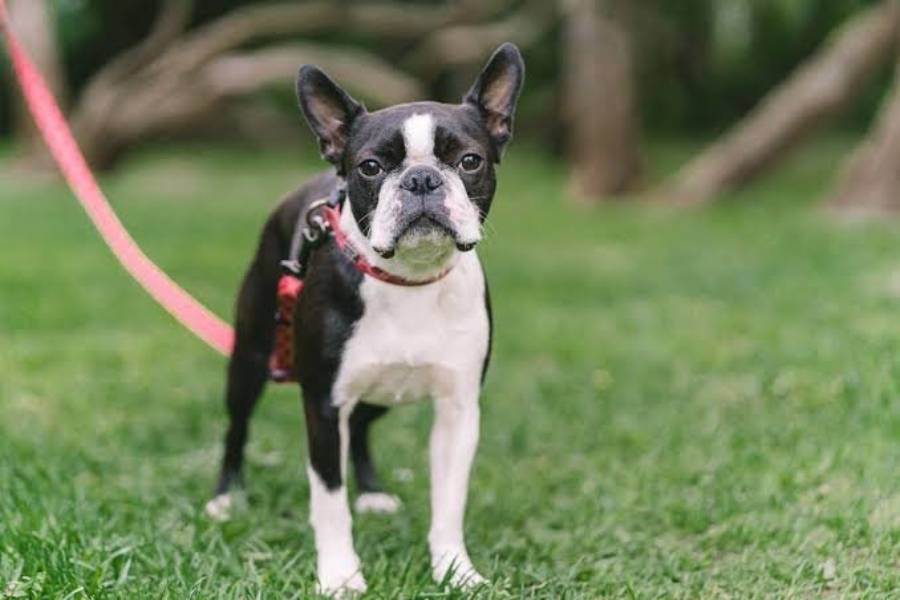
The most effective way to stop a Boston Terrier from pulling on the leash is to stop forward movement when the leash becomes tight and reward the dog when the leash is loose. This teaches the dog that pulling does not get it closer to a person, smell, dog, or other destination, while walking with a loose leash allows the walk to continue. Consistent reinforcement is important because allowing pulling to work on some walks can strengthen the behavior you are trying to stop.
Boston Terriers may pull because they are excited to explore, distracted by people or other dogs, moving at a different pace from their owner, or have never learned where to walk on a leash. Stopping the behavior therefore requires more than physically holding the dog back. The goal is to teach a replacement behavior: walking near you while keeping slack in the leash.
Training should begin in a low-distraction environment before progressing to busier sidewalks, unfamiliar places, and encounters with other dogs or people. This guide explains how to teach loose-leash walking, respond when your Boston Terrier pulls, manage distractions, choose suitable walking equipment, avoid common training mistakes, and determine when additional training help is appropriate.
How Do You Stop a Boston Terrier From Pulling on the Leash?
To stop a Boston Terrier from pulling on the leash, prevent pulling from moving the dog forward and consistently reward walking with a loose leash. There are 6 main steps: start in a low-distraction area, reward a loose leash, stop when the leash becomes tight, resume when the leash loosens, reinforce the desired walking position, and gradually introduce longer distances and stronger distractions. The key is consistency: pulling should not produce the outcome your Boston Terrier wants, while loose-leash walking should.
Start training somewhere your Boston Terrier can concentrate, such as inside the house, in a quiet yard, or on a familiar low-traffic route. Walk a few steps and reward the dog while the leash remains slack. Treats can initially be delivered frequently near the position where you want the dog to walk. This makes staying close to you more rewarding than reaching the end of the leash. As the behavior becomes reliable, gradually increase the number of successful steps required before each reward.
Stop moving as soon as your Boston Terrier pulls the leash tight. Avoid continuing toward the object, person, smell, or location the dog is trying to reach. Moving forward at this point can reinforce pulling because the dog learns that applying tension to the leash works. Wait for the leash to become loose again or encourage the dog to redirect its attention toward you. Once slack returns, resume the walk. Forward movement itself then becomes part of the reward for maintaining a loose leash.
Reinforce the behavior you want instead of concentrating only on correcting pulling. Reward your Boston Terrier for walking in the desired area, checking in with you, responding to direction changes, and keeping the leash slack. For example, if your dog walks five steps beside you without creating leash tension, mark that behavior and provide a reward. Over repeated sessions, increase the number of steps while maintaining the same rule: a loose leash allows progress, while a tight leash stops progress.
Increase difficulty only after your Boston Terrier succeeds in an easier environment. A dog that walks well inside the house may start pulling again on a sidewalk because smells, people, traffic, and other dogs compete for its attention. Progress from low-distraction locations to moderately distracting areas before practicing in busy environments. This progression allows the dog to learn the same loose-leash behavior under increasingly difficult conditions instead of expecting it to perform immediately in every setting.
What Should You Do the Moment Your Boston Terrier Starts Pulling?
Stop walking as soon as your Boston Terrier creates tension on the leash. Keep your response predictable rather than pulling the dog backward or continuing to follow it. When your Boston Terrier turns back, moves closer, or otherwise creates slack in the leash, reinforce that response and begin moving forward again. The sequence should remain consistent: pulling stops progress, while a loose leash restarts progress.
Changing direction can also help when simply stopping does not regain your dog’s attention. Turn and walk several steps in another direction, then reward your Boston Terrier for following without pulling. The purpose is not to jerk the leash or surprise the dog. The direction change teaches the dog to pay attention to your movement instead of assuming that it can determine the walking direction by pulling.
Timing matters because the consequence needs to correspond closely with the behavior. If your Boston Terrier pulls toward another dog and reaches that dog while the leash remains tight, the interaction itself may reward pulling. If forward movement stops immediately when tension appears, pulling no longer produces the same result. Repeating this pattern across walks creates a clear behavioral rule your Boston Terrier can learn.
How Do You Teach a Boston Terrier to Walk on a Loose Leash?
Teach a Boston Terrier to walk on a loose leash by rewarding the dog for staying within a consistent walking area while keeping tension out of the leash. Loose-leash walking does not require the dog to maintain a strict competition-style heel throughout the walk. The practical goal is for your Boston Terrier to move with you without continuously reaching the end of the leash.
Begin by choosing the side or general area where you want your Boston Terrier to walk. Take several steps and reward the dog before it reaches the end of the leash. Delivering the reward near your leg can help establish where rewards are available. For example, start by rewarding after several successful steps, then gradually extend the distance as your dog demonstrates that it can remain near you without pulling.
Reward useful voluntary behaviors as well. A Boston Terrier that looks back at you, matches your change of direction, or moves closer after noticing a distraction is making choices that support loose-leash walking. Reinforcing these behaviors gives the dog a reason to monitor your movement rather than focusing exclusively on the environment. This becomes increasingly important when walks include changing directions, unfamiliar smells, people, and other dogs.
Build distance gradually rather than expecting a complete walk immediately. A Boston Terrier may succeed for a short stretch before becoming distracted and pulling again. Increase the length of successful loose-leash walking in manageable increments, then introduce more challenging environments. If pulling returns frequently after moving to a busier location, reduce the difficulty and practice where the dog can succeed again. Progress comes from repeatedly reinforcing the correct behavior, not from keeping the dog in a situation where it spends most of the walk pulling.
Why Does Your Boston Terrier Pull on the Leash?
There are 5 main reasons a Boston Terrier pulls on the leash: pulling has been rewarded with forward movement, excitement about the walk, environmental distractions, a faster natural walking pace, and inconsistent loose-leash training. Identifying the cause matters because repeatedly stopping a dog without addressing what motivates the pulling can make training slower.
The first reason is reinforcement. A Boston Terrier can learn that pulling works if leash tension repeatedly gets it closer to something it wants. For example, the dog sees an interesting patch of grass, pulls toward it, and the owner follows. Reaching the grass rewards the pulling even though the owner did not intentionally provide a reward. The same pattern can occur when pulling leads to greeting another dog, approaching a person, or reaching the park faster.
Excitement is another common cause. Going outside provides access to smells, movement, people, animals, and places that are more stimulating than the home environment. An excited Boston Terrier may immediately accelerate when the walk begins and spend more time responding to the surroundings than monitoring the person holding the leash. Starting training in a quieter environment reduces this competition for attention and makes the desired walking behavior easier to reinforce.
Distractions can produce pulling even after a Boston Terrier has learned to walk well in calm locations. Dogs, people, squirrels, food smells, unfamiliar objects, and interesting scent trails can temporarily become more valuable than staying near the owner. This explains why loose-leash walking should be practiced at different levels of distraction rather than taught in one location and assumed to be reliable everywhere.
Walking pace also affects leash tension. A Boston Terrier may naturally move faster than its owner, especially at the beginning of an exciting walk. If the dog repeatedly reaches the end of the leash, pulling can become part of its normal walking pattern. Training establishes a different rule: the dog can explore and move forward, but it must adjust its movement enough to keep the leash loose.
Inconsistent rules are the fifth cause. Allowing a Boston Terrier to pull during regular walks while requiring a loose leash only during dedicated training sessions gives the dog two conflicting patterns. The dog may learn that pulling sometimes works, which gives it a reason to continue trying. Everyone who regularly walks the dog should therefore follow the same basic rule: forward progress happens with a loose leash rather than a tight one.
How Can You Stop a Boston Terrier From Pulling Toward Dogs and People?
Stop a Boston Terrier from pulling toward dogs and people by creating enough distance for the dog to remain responsive, rewarding attention and loose-leash behavior, and decreasing that distance gradually as the dog improves. Training directly beside an exciting person or dog is often too difficult at the beginning because the distraction can compete strongly with the owner’s cues and rewards.
Start at a distance where your Boston Terrier notices the person or dog but can still respond to you. Reward behaviors such as looking toward you, remaining on a loose leash, or following you when you move. For example, if your Boston Terrier notices another dog across the street but can turn back toward you when prompted, reinforce that response before moving closer. The objective is to teach the dog that seeing a distraction does not automatically mean rushing toward it.
Reduce distance gradually after your Boston Terrier can remain responsive at the current distance. Moving too close too quickly can cause pulling to return because the distraction becomes harder to ignore. If your dog can maintain a loose leash at 30 feet but begins pulling continuously at 10 feet, increase the distance again and continue practicing at a level where successful responses are possible. Distance functions as a way to control training difficulty.
Do not use access to every dog or person as the automatic outcome of pulling. A Boston Terrier that reaches another dog after dragging its owner across the sidewalk can learn that pulling is an effective way to initiate social interaction. Instead, approach only while the leash remains loose. Stop or move away when pulling begins, then resume the approach after the dog regains control. This applies the same loose-leash rule used during the rest of the walk.
A Boston Terrier that becomes too excited to take a familiar treat, respond to a practiced cue, or redirect attention may be too close to the distraction for productive training. Increase the distance instead of repeatedly giving cues the dog cannot follow in that moment. Once the dog can respond again, reinforce calm attention and continue at that easier level.
Practice with controlled distractions before relying entirely on unpredictable encounters during normal walks. A familiar person standing at a distance or a calm dog handled by another person can provide a more manageable training setup. As your Boston Terrier becomes successful, introduce greater movement, shorter distances, and less predictable environments. The progression should move from situations where the dog can reliably succeed toward the situations that previously triggered pulling.
What Leash and Harness Should You Use for a Boston Terrier That Pulls?
A Boston Terrier that pulls should use walking equipment that provides secure control without relying on pressure around the neck to stop the behavior. A well-fitted harness paired with a standard fixed-length leash is a practical setup for leash training because it allows the owner to manage the dog while teaching loose-leash walking. Equipment can make pulling easier to manage, but it does not replace training.
A standard fixed-length leash gives the owner a predictable working distance and makes changes in leash tension easier to recognize. The leash should provide enough length for normal movement without giving the dog so much range that it repeatedly builds momentum before reaching the end. During training, the important signal is simple: slack in the leash allows movement, while tension causes forward movement to stop.
Harness fit deserves particular attention with a Boston Terrier because the breed has a brachycephalic, or short-muzzled, anatomy. A harness distributes restraint across the body instead of concentrating it around the neck. It should fit securely without restricting the dog’s normal shoulder movement or allowing the dog to back out of it. Owners should check the fit regularly, especially with growing puppies or dogs whose body weight changes.
A front-clip harness can provide additional management for a Boston Terrier that pulls strongly. Because the leash attaches toward the front of the body, forward pulling can turn the dog’s body rather than allowing it to drive directly ahead. This can make a strong pull easier for the owner to control. However, a front-clip or no-pull harness does not teach the dog why it should keep the leash loose. The dog still needs reinforcement for walking in the desired position.
Is a Harness or Collar Better for a Boston Terrier That Pulls?
A properly fitted harness is generally more suitable than relying on a collar to physically control a Boston Terrier that repeatedly pulls. The practical reason is that a pulling dog creates repeated leash tension, and attaching the leash to a harness moves that restraint away from the neck. A collar can still carry identification tags and may be appropriate in other contexts, but it should not be treated as the mechanism that teaches loose-leash walking.
The choice of equipment should remain separate from the training objective. Switching from a collar to a harness may make walks easier to manage, but a Boston Terrier can still learn to pull while wearing a harness if pulling continues to move it toward desired destinations. Conversely, consistent reinforcement of loose-leash walking teaches a behavioral pattern that is not dependent on one piece of equipment.
Check the equipment before each walk for fit, wear, and security. The harness should remain secure when the Boston Terrier changes direction without rubbing excessively or interfering with normal movement. If a dog shows coughing, breathing difficulty, unusual exercise intolerance, pain, or persistent discomfort during walks, stop the activity and seek appropriate veterinary guidance rather than trying to solve the problem through leash-training equipment alone.
What Boston Terrier Leash Training Mistakes Make Pulling Worse?
There are 6 common leash-training mistakes that can make pulling harder to change: continuing forward on a tight leash, rewarding inconsistently, introducing strong distractions too early, increasing difficulty too quickly, relying entirely on equipment, and using different walking rules from one walk to another. These mistakes matter because dogs learn from the consequences that repeatedly follow their behavior.
The first mistake is continuing to walk while the leash is tight. If your Boston Terrier pulls and still reaches the tree, person, dog, or smell it wants to investigate, pulling has produced a useful result. Correct this pattern by stopping forward movement when tension appears and resuming after the leash becomes loose. The consequence of pulling then changes from gaining access to temporarily losing forward progress.
The second mistake is inconsistent reinforcement. Rewarding loose-leash walking during a five-minute training session but allowing pulling throughout a 30-minute walk creates competing rules. The dog receives far more opportunities to practice pulling than to practice the desired behavior. Apply the same basic leash rule during regular walks and focused training so the Boston Terrier experiences a predictable relationship between leash tension and movement.
The third mistake is starting around distractions that are too difficult. A Boston Terrier learning loose-leash walking on a crowded sidewalk may have to process passing dogs, people, traffic, smells, and unfamiliar sounds at the same time. Begin where the dog can successfully respond, then introduce stronger distractions individually or gradually. Training difficulty should increase after success rather than before it.
The fourth mistake is progressing too quickly. Walking correctly for several steps in a quiet location does not mean a Boston Terrier is ready to maintain the same behavior for an entire walk through a busy neighborhood. Increase one challenge at a time, such as distance, duration, environmental activity, or proximity to another dog. If pulling increases sharply after a progression, return temporarily to the previous successful level.
The fifth mistake is expecting a no-pull harness to solve the behavior by itself. A harness can change leverage and make pulling easier to manage, but management is different from training. Continue rewarding the Boston Terrier for loose-leash walking even when the equipment reduces pulling. Otherwise, the dog may return to its previous behavior when walking conditions or equipment change.
The sixth mistake is allowing different people to use different rules. One family member may stop whenever the Boston Terrier pulls, while another may allow the dog to drag them toward interesting smells. The second pattern continues to reward the behavior and can slow progress for everyone. People who regularly walk the dog should agree on the same response to leash tension and the same behaviors they intend to reinforce.
How Long Does It Take to Train a Boston Terrier to Stop Pulling?
There is no fixed number of days required to train a Boston Terrier to stop pulling because progress depends on the dog’s previous reinforcement history, training consistency, age, environment, and exposure to distractions. A dog that has practiced pulling successfully for years may require more repetition than a puppy that is learning leash rules for the first time. Progress should therefore be measured by changes in walking behavior rather than by expecting the problem to disappear after a specific number of sessions.
Look for improvement in stages. Early progress may mean your Boston Terrier creates leash tension less frequently or returns to you faster after you stop walking. The next stage is maintaining a loose leash for longer stretches in a familiar environment. More advanced progress occurs when the dog can maintain the same behavior around smells, people, other dogs, and unfamiliar locations. These observable changes provide a more useful measure of training than counting days alone.
Training consistency directly affects this progression. A Boston Terrier receives conflicting information if pulling stops forward movement during training but works during ordinary walks. In contrast, applying the same rule each time the leash becomes tight gives the dog repeated opportunities to learn the relationship between its behavior and the outcome. Everyone who regularly walks the dog should follow the same approach whenever possible.
Expect temporary setbacks when training conditions become harder. A Boston Terrier that walks with a loose leash on a quiet street may start pulling again in a new park or when another dog appears. This does not necessarily mean the previous training has failed. It indicates that the dog has not yet learned to perform the behavior reliably at that level of distraction. Increase distance from the distraction or return to an easier environment, reinforce successful walking again, and then rebuild the difficulty gradually.
Read more: How to Stop a Boston Terrier From Barking
How Often Should You Practice Leash Training With a Boston Terrier?
Practice leash training regularly in short, focused sessions and reinforce the same loose-leash rules during normal walks. Frequent successful repetitions are more useful than a long session in which the Boston Terrier spends most of the time pulling. The purpose of a focused session is to create repeated opportunities to reward correct walking while the owner can control distance, distractions, and training difficulty.
A training session can focus on one specific skill, such as following direction changes, maintaining leash slack for progressively longer distances, or staying responsive around a mild distraction. Keeping the objective specific makes it easier to determine whether the dog is improving. For example, a session in a quiet area might focus entirely on completing increasingly longer stretches without creating leash tension before adding people or dogs as distractions.
Regular walks should reinforce the same behavior rather than becoming periods when leash rules disappear. Stop forward progress when your Boston Terrier pulls and continue when slack returns. Reward good walking periodically, particularly when the dog makes a useful choice such as checking in with you instead of moving toward a distraction. This turns everyday walks into additional reinforcement opportunities without requiring every walk to function as a formal training session.
Adjust practice difficulty according to the dog’s performance. Reduce distractions or shorten the training objective if your Boston Terrier repeatedly fails to maintain a loose leash. Increase distance, duration, or environmental difficulty after the dog succeeds consistently at the current level. Changing one variable at a time makes it easier to identify what causes pulling to return and prevents the training process from becoming unnecessarily difficult.
When Should You Get Professional Help for a Boston Terrier That Pulls?
Get professional help when leash pulling is accompanied by intense lunging, fear, aggression, persistent inability to respond around triggers, or little improvement despite consistent training. Ordinary pulling caused by excitement or an established walking habit can often be addressed through structured loose-leash training, but more complex behavior may require an individualized assessment.
Lunging deserves additional attention when it occurs consistently around specific triggers such as dogs, strangers, vehicles, or unfamiliar environments. The behavior may involve more than a desire to move forward. For example, a dog attempting to increase distance from another dog because it is frightened requires a different training approach from a dog pulling forward because it wants to greet. Treating both situations as simple leash pulling can overlook the motivation driving the behavior.
Professional guidance is also appropriate when the owner cannot safely control the Boston Terrier during walks. A qualified trainer or behavior professional can observe the dog’s behavior, identify triggers, assess the current reinforcement pattern, and create a training plan suited to the individual dog. Look for approaches that teach and reinforce desired behavior rather than depending entirely on physical corrections.
Veterinary evaluation is appropriate when pulling or walking behavior changes suddenly or occurs with physical signs such as coughing, breathing difficulty, pain, limping, unusual fatigue, or exercise intolerance. Training addresses learned behavior, while physical discomfort or health problems require a different type of assessment. This distinction is particularly important when a dog that previously walked normally begins resisting the leash, stopping unexpectedly, or behaving differently during exercise.
The long-term goal is not simply to physically prevent your Boston Terrier from reaching the end of the leash. Successful leash training teaches the dog that keeping the leash loose, monitoring your movement, and responding around distractions are the behaviors that allow the walk to continue. Consistent reinforcement of that rule across training sessions and everyday walks gives the dog a clear, repeatable pattern to follow.
1 thought on “How to Stop a Boston Terrier From Pulling on Leash”