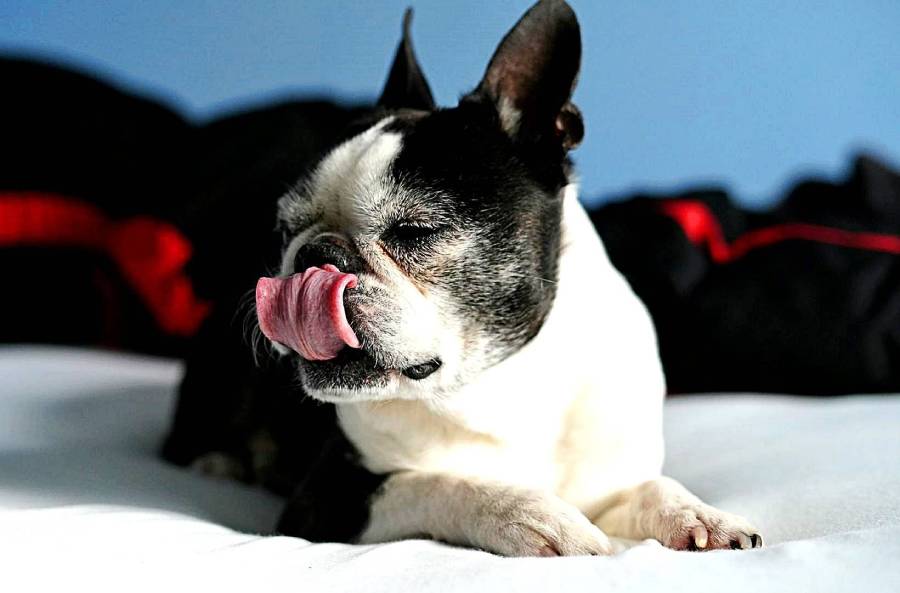
Boston Terriers lick for 8 main reasons: affection, attention, grooming, interesting tastes or smells, boredom, stress or anxiety, allergies, and physical discomfort. Occasional licking is a normal canine behavior, especially when a Boston Terrier licks its owner during social interaction or briefly grooms its body. Excessive licking deserves more attention when the behavior becomes persistent, suddenly increases, or focuses repeatedly on one area.
The target of the licking provides an important clue to its cause. A Boston Terrier that frequently licks its owner may be seeking attention or repeating a behavior that receives a response. Licking the paws or one specific area of skin can indicate itching, irritation, injury, or pain, while repeated licking of floors and furniture may be associated with interesting scents, food residue, boredom, or repetitive behavior. The accompanying signs matter as well. Red skin, hair loss, swelling, wounds, limping, or noticeable behavioral changes make a physical problem more likely and warrant closer attention.
This article explains the 8 common reasons Boston Terriers lick so much, how to recognize excessive licking, and what owners can do based on the underlying cause.
Why Do Boston Terriers Lick So Much?
Boston Terriers lick so much for 8 main reasons: affection, attention-seeking, grooming, taste and smell, boredom, anxiety or stress, allergies and skin irritation, and physical discomfort. The meaning of the behavior depends on what the dog licks, when the licking occurs, and whether physical or behavioral changes appear at the same time.
Affection is a common reason Boston Terriers lick their owners. Licking is a social behavior dogs can direct toward people they are comfortable interacting with. A Boston Terrier may lick an owner’s hands, face, or legs during greetings, petting, or other positive interactions. Short episodes that occur in these contexts and stop easily are generally different from persistent licking that is difficult to interrupt.
Attention-seeking can turn licking into a learned behavior. A Boston Terrier can learn that licking produces an immediate response from its owner. Talking to the dog, touching it, laughing, or pushing it away can all provide attention after the behavior occurs. The sequence becomes licking → owner response → repeated licking. This pattern is more likely when the dog approaches a person specifically to lick and stops after receiving another form of interaction.
Grooming causes Boston Terriers to lick themselves as part of normal body care. Briefly licking the paws, legs, or coat does not automatically indicate a problem. The pattern becomes more significant when the dog repeatedly targets the same location or continues licking long enough to leave the skin wet, red, irritated, or damaged. Location and duration therefore provide more useful information than the presence of self-licking alone.
Taste and smell can trigger licking because dogs investigate their environment with their mouths and noses. Human skin can contain sweat and salt, while floors, furniture, and other surfaces may carry food residue or interesting scents. For example, a Boston Terrier that licks someone’s legs after exercise may be responding to sweat rather than displaying an abnormal behavior. Surface licking that becomes persistent requires a different assessment from occasional investigation.
Boredom can increase repetitive licking when a Boston Terrier lacks sufficient physical activity or mental stimulation. Licking provides an activity that requires no toys, space, or interaction with another animal. A dog that spends long periods without walks, play, training, or enrichment may consequently repeat self-directed behaviors. The relevant clue is context: licking associated with inactivity may decrease when the dog’s daily opportunities for exercise and engagement increase.
Anxiety and stress can also produce repetitive licking. A Boston Terrier may lick itself, an owner, or nearby objects during situations that cause emotional arousal or uncertainty. Changes in routine, unfamiliar environments, separation, or other stressful events can coincide with an increase in the behavior. Stress-related licking should be evaluated alongside other behavioral changes rather than identified from licking alone.
Allergies and skin irritation can cause repeated licking because itching creates an urge to target the affected skin. The paws are particularly important to monitor because dogs can repeatedly lick itchy or irritated feet. Environmental substances such as grass or pollen may contact the paws, while other skin problems can produce similar behavior. Repeated licking can then worsen the irritation by keeping the area moist and exposing it to continued friction from the tongue.
Pain or another physical problem can cause a Boston Terrier to concentrate on one part of its body. An injury, wound, irritated skin, or another source of discomfort may cause localized licking. For example, repeatedly licking one paw warrants inspection for visible irritation or injury, especially when the behavior begins suddenly. Licking accompanied by swelling, bleeding, limping, an open wound, or obvious pain requires more attention than ordinary grooming.
The most useful distinction is therefore not simply whether a Boston Terrier “licks a lot.” Owners should consider the target, frequency, duration, trigger, and accompanying physical signs. These factors help separate normal social or grooming behavior from persistent licking that may have a behavioral, environmental, or physical cause.
Why Does My Boston Terrier Lick Me So Much?
A Boston Terrier may lick you frequently because of affection, attention-seeking, your skin’s taste or scent, or learned behavior. The timing of the licking helps distinguish these causes. Licking during greetings and petting has a different context from repeatedly approaching you and licking until you respond.
Affection-related licking typically occurs during positive social interaction. A Boston Terrier may lick your hands or face while receiving attention, sitting close to you, or greeting you after a period apart. In this context, licking functions as one part of the dog’s interaction with you rather than an isolated problem. The behavior is less concerning when it is brief, easy to interrupt, and not accompanied by signs of distress.
Attention-seeking licking develops when your response reinforces the behavior. For example, your Boston Terrier may lick your hand, receive petting, and learn that licking starts an interaction. Even telling the dog to stop can provide the attention it was seeking. Repeated reinforcement can make the behavior more frequent because the dog has learned a predictable connection between licking and your response.
Taste and scent provide another explanation. Sweat leaves salt and other compounds on human skin, and food residue or personal-care products can create additional scents. A Boston Terrier that concentrates on exposed hands, arms, or legs may therefore be investigating something it can smell or taste. The location and situation help distinguish this behavior from generalized repetitive licking.
Frequent owner-directed licking does not automatically mean that a Boston Terrier has anxiety or another behavioral problem. The broader pattern determines whether the behavior deserves intervention. Licking that suddenly increases, becomes difficult to interrupt, occurs alongside restlessness or other behavioral changes, or extends to persistent self-licking provides more reason to investigate the underlying cause.
Why Does My Boston Terrier Lick His Paws So Much?
A Boston Terrier may lick his paws excessively because of allergies, skin irritation, something caught on or between the paws, an injury, infection, or pain. Occasional paw licking can be part of normal grooming, but repeated licking of the same paw or several paws deserves closer attention, especially when the skin or coat begins to change.
Allergies and skin irritation are important causes to consider when paw licking occurs repeatedly. A Boston Terrier’s feet come into direct contact with grass, pollen, dust, cleaning products, and other substances in its environment. Irritated or itchy skin creates an urge to lick, chew, or rub the affected area. Owners may notice that the dog licks several paws rather than concentrating exclusively on one spot, although the licking pattern alone cannot confirm an allergy.
A foreign object or local irritation can cause a Boston Terrier to focus on one paw. Small pieces of plant material, dirt, or other debris can become lodged around the paw pads or between the toes. Minor cuts and irritated paw pads can produce a similar response. A sudden change from little paw licking to repeatedly targeting one foot is therefore a reason to inspect the paw carefully for visible abnormalities.
Injury or pain can also cause localized licking. A Boston Terrier may repeatedly lick an area that feels painful even when the source of discomfort is not immediately visible. Limping, reluctance to place weight on a leg, swelling, sensitivity when the paw is touched, or a sudden reduction in normal activity makes physical discomfort more concerning. Persistent licking accompanied by these signs warrants veterinary evaluation rather than assuming the behavior is a habit.
Repeated paw licking can also create a self-perpetuating cycle. Itching or discomfort triggers licking, while continued moisture and friction from licking can further irritate the skin and encourage more licking. The original trigger may therefore become harder to identify after the skin has already been repeatedly disturbed. Redness, hair loss, raw skin, unusual odor, discharge, swelling, or an open wound indicates that the problem has progressed beyond ordinary grooming.
Owners should assess paw licking by looking at location, frequency, duration, and visible changes. Briefly cleaning the paws after being outside is different from spending several minutes repeatedly licking the same foot. Checking these details helps determine whether the behavior is normal grooming or a sign that the Boston Terrier’s paws need further attention.
Why Does My Boston Terrier Lick the Air, Floor, or Furniture?
A Boston Terrier may lick the air, floor, or furniture because of interesting tastes and smells, food residue, boredom, learned repetitive behavior, or physical discomfort. The object being licked and the circumstances surrounding the behavior provide more information than surface licking by itself.
Floors and furniture collect scents that dogs can detect even when people notice nothing unusual. Food crumbs, spilled drinks, cooking residue, or scents carried indoors on shoes can make a particular surface worth investigating. A Boston Terrier that briefly licks the kitchen floor after food preparation, for example, has an identifiable environmental reason for the behavior.
Boredom can contribute when surface licking becomes a repetitive activity without an obvious external trigger. Boston Terriers need regular opportunities for physical activity, social interaction, play, and mental engagement. A dog with few activities available may repeatedly investigate or lick nearby objects because the behavior itself provides stimulation. The connection becomes more plausible when licking occurs primarily during long periods of inactivity and decreases when the dog becomes engaged in another activity.
Surface licking can also become learned behavior. An owner who consistently reacts when a Boston Terrier licks furniture may unintentionally make the behavior effective at gaining attention. The same reinforcement mechanism applies to licking people: a behavior that reliably produces interaction is more likely to be repeated.
Repeated air licking deserves attention to its surrounding context. A brief episode is different from frequent or prolonged air licking accompanied by swallowing, drooling, restlessness, appetite changes, or other unusual physical behaviors. Licking the air or household surfaces does not identify a specific medical condition by itself, so persistent episodes should be assessed together with accompanying signs rather than interpreted as a diagnosis.
The practical distinction is between occasional exploratory licking and a new, persistent, or difficult-to-interrupt pattern. When a Boston Terrier suddenly begins licking the air, floor, or furniture frequently, owners should record when it happens, how long it lasts, what the dog was doing beforehand, and whether any other physical or behavioral changes occur.
How Can You Tell If a Boston Terrier Is Licking Too Much?
A Boston Terrier is licking too much when the behavior becomes persistent, difficult to interrupt, concentrated on one body area, or associated with visible skin or behavioral changes. Frequency alone does not determine whether licking is excessive. The pattern, duration, target, and accompanying symptoms provide more useful information.
Normal licking usually has a clear purpose and stops naturally. A Boston Terrier may briefly lick its paws after coming indoors, groom part of its coat, or lick an owner during a greeting. These behaviors become more concerning when the dog repeatedly returns to licking after being interrupted or spends prolonged periods targeting the same location.
Physical changes provide some of the clearest signs of excessive licking. Repeated contact with the tongue can leave an area persistently wet and contribute to additional irritation. Owners should look for redness, hair loss, swelling, raw skin, wounds, discharge, or other changes around frequently licked areas. Paw licking may also occur alongside chewing or biting at the feet.
A sudden change in licking behavior is also significant. A Boston Terrier that rarely licked one paw but suddenly begins targeting it throughout the day has experienced a behavioral change even if the total duration seems limited. The same principle applies to sudden increases in licking the body, owner, floor, furniture, or air. Identifying what changed around the time the behavior started can help narrow down possible triggers.
The easiest way to assess the behavior is to monitor 5 factors: target, frequency, duration, trigger, and physical signs. For example, “my Boston Terrier licks his left front paw for several minutes after every walk and the skin between his toes looks red” provides substantially more useful information than “my Boston Terrier licks a lot.”
When Should You Take a Boston Terrier to the Vet for Excessive Licking?
Take a Boston Terrier to a veterinarian when excessive licking is persistent or recurrent, begins suddenly without an obvious explanation, causes skin damage, or occurs with signs of pain or illness. Veterinary evaluation is particularly important when licking appears to be a response to physical discomfort rather than ordinary grooming or social interaction.
Visible damage warrants closer attention. Open wounds, bleeding, persistent redness, swelling, discharge, significant hair loss, or raw skin indicate that either an underlying problem or the licking itself is affecting the tissue. Preventing access to the area may limit additional damage temporarily, but it does not identify or resolve the original cause.
Signs of pain also change the level of concern. A Boston Terrier that repeatedly licks a paw while limping, avoids putting weight on a leg, reacts when an area is touched, or becomes less willing to move normally may be experiencing physical discomfort. Similarly, localized licking that begins abruptly should not automatically be treated as boredom or attention-seeking without checking the affected area.
Veterinary attention is also appropriate when persistent licking occurs alongside broader changes such as reduced appetite, unusual restlessness, lethargy, repeated scratching, noticeable skin changes, or a significant change in normal behavior. These additional observations give the veterinarian more context for determining why the licking has increased.
Owners can make the veterinary assessment more useful by documenting the behavior before the appointment. Record where the Boston Terrier licks, when the behavior occurs, how long each episode lasts, how frequently it happens, and what other changes appear at the same time. Photos of skin changes or short videos of unusual licking behavior can also help show a pattern that may not occur during the examination.
How Do You Stop a Boston Terrier From Licking So Much?
Stop excessive licking in a Boston Terrier by identifying and addressing the cause of the behavior rather than focusing only on preventing the licking itself. The appropriate response differs depending on whether the dog is licking because of attention, boredom, stress, skin irritation, pain, or another physical problem. Simply interrupting the behavior may stop an individual episode without removing the trigger that causes it to return.
Start by observing the licking pattern. Identify what your Boston Terrier licks, when the behavior begins, how long it continues, and what happens immediately before and after it. For example, a dog that repeatedly licks an owner and then receives petting has a different pattern from a dog that spends several minutes licking a red paw after every walk. Matching the response to the pattern makes management more effective.
Avoid punishing a Boston Terrier for excessive licking. Punishment does not address itching, pain, anxiety, or another underlying trigger and may add stress to the situation. Instead, use the dog’s behavior and accompanying physical signs to determine whether the problem can be managed through changes in routine or requires veterinary assessment.
How Do You Stop Behavioral Licking?
Reduce behavioral licking by changing the reinforcement pattern and giving your Boston Terrier appropriate alternatives for physical and mental activity. This approach is most relevant when licking is associated with attention-seeking, boredom, or a repetitive habit rather than visible skin irritation or pain.
For attention-seeking licking, avoid consistently rewarding the licking itself with the interaction the dog wants. Redirect the Boston Terrier toward an appropriate behavior and provide attention when that alternative behavior occurs. Consistency matters because occasionally rewarding licking can maintain the learned connection between licking and owner attention.
For boredom-related licking, increase structured activity rather than waiting until the licking starts. Daily walks, interactive play, short training sessions, food-based enrichment, and appropriate toys give the dog other ways to engage with its environment. The goal is not simply to keep the Boston Terrier busy at every moment but to provide predictable opportunities for physical exercise, problem-solving, and social interaction.
Stress-related licking requires identifying the situations associated with the behavior. Track whether licking increases during separation, schedule changes, unfamiliar situations, household disruptions, or other identifiable events. Reducing avoidable triggers and creating a predictable routine may help when stress contributes to the pattern. Persistent repetitive behavior that does not improve after environmental changes deserves professional assessment.
How Do You Manage Paw and Skin Licking?
Manage paw and skin licking by checking the affected area and addressing the irritation or discomfort that is driving the behavior. Repeatedly stopping a Boston Terrier from reaching an itchy paw does not resolve an allergy, injury, skin problem, or other underlying source of discomfort.
Inspect the paws and frequently licked skin for redness, swelling, cuts, foreign material, damaged paw pads, hair loss, moisture, wounds, or discharge. The location also provides useful context. Repeated licking of one paw may point toward a localized problem, while licking several areas may require a broader assessment. These patterns provide clues but are not sufficient to diagnose the cause.
Pay attention to environmental timing as well. Paw licking that consistently increases after walks may justify checking what the dog encounters outdoors and cleaning visible dirt or residue from the paws appropriately after returning home. Persistent irritation should not be managed indefinitely through cleaning or home interventions because continued licking can further damage already irritated skin.
A veterinarian should assess recurrent paw or skin licking when the cause is unclear, the skin is damaged, or other symptoms appear. Treating the underlying problem is more important than suppressing the licking response.
What Should You Do If Your Boston Terrier Keeps Licking?
If your Boston Terrier keeps licking despite reasonable changes to its routine and environment, document the pattern and have persistent or recurrent behavior evaluated when necessary. Continued licking indicates that the original trigger may still be present or that the behavior has become established enough to require additional intervention.
Keep a simple record of the target, frequency, duration, trigger, and accompanying signs. For example, note whether your Boston Terrier licks one paw for 10 minutes after walks, repeatedly licks furniture while resting, or seeks out an owner and licks until attention is provided. Specific observations make it easier to identify patterns than descriptions such as “he licks constantly.”
Do not assume persistent licking is purely behavioral when physical signs are present. Redness, swelling, wounds, hair loss, limping, pain, discharge, or other noticeable changes shift the priority toward identifying a physical cause. Similarly, a sudden and substantial change in a Boston Terrier’s normal licking pattern deserves more attention than a stable behavior the dog has displayed occasionally for years.
The objective is therefore not to eliminate every instance of licking. Normal grooming, exploration, and social licking are part of canine behavior. Intervention becomes important when licking is persistent, damaging, associated with discomfort, or disruptive enough to indicate that the Boston Terrier’s underlying needs are not being addressed.
Are Boston Terriers More Prone to Licking Than Other Dogs?
There is not enough evidence to conclude that Boston Terriers naturally lick more than other dog breeds. Individual Boston Terriers may lick frequently, but frequent licking in one dog does not establish licking as a breed-wide characteristic. The behavior should be evaluated according to its context and cause rather than attributed automatically to the breed.
Boston Terriers can lick for the same broad behavioral and physical reasons seen in other dogs, including social interaction, attention-seeking, grooming, boredom, stress, skin irritation, and discomfort. What matters to an owner is whether a particular Boston Terrier’s licking represents its normal behavior or a noticeable change from its usual pattern.
Individual variation can be substantial. One Boston Terrier may frequently lick people during greetings but rarely lick its paws, while another may show little owner-directed licking and begin licking its feet when the skin becomes irritated. These behaviors have different triggers even though both dogs belong to the same breed.
For this reason, comparing a Boston Terrier with its own established behavior is more useful than assuming how often the breed should lick. A sudden increase, persistent localized licking, or licking accompanied by physical changes provides more actionable information than breed identity alone.
Read more: Boston Terrier Aging Signs: What Owners Should Know
What Other Signs Should You Watch for With Excessive Licking?
Watch for scratching, paw chewing, face rubbing, redness, hair loss, swelling, wounds, limping, restlessness, and other changes in normal behavior when a Boston Terrier licks excessively. Accompanying signs help determine whether licking is an isolated behavior or part of a broader problem.
Scratching and paw chewing are particularly relevant when licking affects the skin or feet. A Boston Terrier may alternate between licking, chewing, and scratching when an area feels itchy or uncomfortable. Repeated face rubbing can provide another sign that the dog is responding to irritation rather than simply grooming.
Changes to the skin provide additional evidence. Redness, thinning hair, raw areas, persistent moisture, swelling, or visible wounds indicate that the affected area needs attention. These changes may result from an underlying problem, repeated licking, or a combination of both. Continued licking can aggravate already irritated tissue, creating a cycle in which discomfort produces licking and licking produces additional irritation.
Movement and general behavior should also be monitored. Limping or reluctance to use a limb can accompany licking caused by pain or injury. Restlessness, reduced interest in normal activities, appetite changes, or a noticeable shift in temperament provides broader context that should not be ignored when licking increases at the same time.
No single accompanying behavior identifies the cause by itself. A combination of licking location, physical changes, behavioral changes, and timing provides a clearer picture of what may be triggering the behavior and whether veterinary assessment is appropriate.
What Should You Monitor If Your Boston Terrier Licks Frequently?
Monitor 5 factors when your Boston Terrier licks frequently: target, frequency, duration, trigger, and physical signs. Tracking these factors creates a clear record of the behavior and helps distinguish normal licking from a persistent pattern that requires intervention.
Target means identifying exactly what the Boston Terrier licks. Record whether the dog targets an owner, one paw, several paws, another body area, the floor, furniture, or the air. Repeatedly returning to one specific body part provides different information from licking several unrelated objects.
Frequency describes how often the licking episodes occur. Instead of recording that the dog licks “a lot,” note whether it happens once after every walk, several times during the evening, or repeatedly throughout the day. Specific observations make changes easier to recognize.
Duration records how long an episode lasts. A Boston Terrier that cleans a paw for several seconds presents a different pattern from one that repeatedly works on the same area for several minutes and returns to it shortly afterward.
Trigger identifies what happens immediately before the licking. Relevant triggers can include returning from a walk, being left alone, greeting an owner, eating, resting for a long period, or encountering a particular environment. Repeated associations can help distinguish environmental and behavioral patterns.
Physical signs include redness, swelling, hair loss, wounds, moisture, discharge, limping, pain, or other visible changes. These observations are especially important when the Boston Terrier repeatedly licks its paws or another specific body area.
A useful record might state: “My Boston Terrier licks both front paws for five minutes after evening walks, and the skin between the toes becomes red.” This observation provides target, duration, trigger, and a physical sign. It is considerably more informative than saying that the dog “licks too much.”
Monitoring does not require owners to diagnose the cause themselves. Its purpose is to establish a specific behavioral pattern, identify changes, and provide useful information if professional evaluation becomes necessary. For most Boston Terriers, occasional social, exploratory, and grooming-related licking is normal. Persistent licking, skin damage, pain, or a sudden change from the dog’s established behavior provides a stronger reason to investigate the underlying cause.
1 thought on “Why Do Boston Terriers Lick So Much? 8 Reasons”