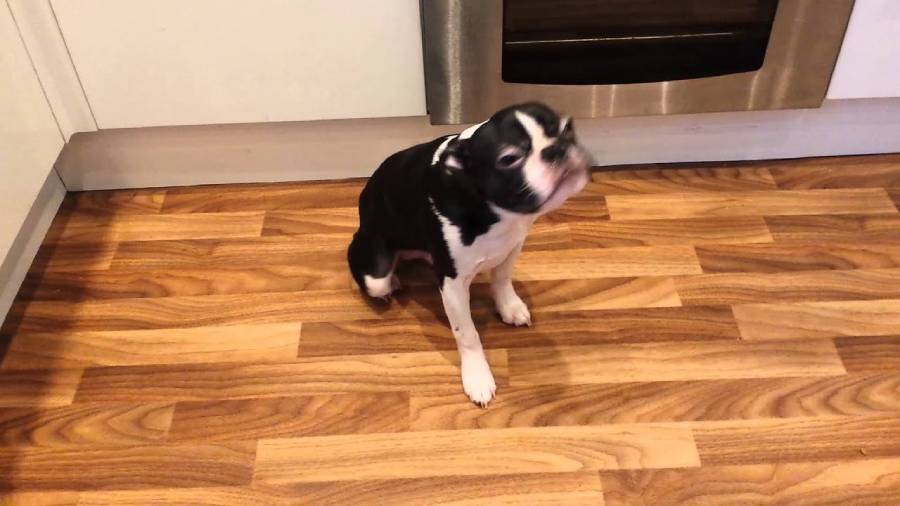
Boston Terriers reverse sneeze when irritation in the nose, throat, or nasopharyngeal area triggers a reflex that causes rapid, repeated inhalations through the nose. During an episode, a Boston Terrier may suddenly stand still, extend its neck, and make loud snorting or honking sounds while repeatedly drawing air inward. The episode can look alarming, but an occasional reverse sneeze that ends quickly and is followed by normal breathing is generally different from choking or a persistent breathing problem.
Several triggers can initiate reverse sneezing, including dust, pollen, strong odors, excitement, eating, drinking, and irritation around the upper airway. A Boston Terrier’s brachycephalic anatomy is also relevant because the breed has a short muzzle and compact upper airway structures. However, a flat face alone does not explain every reverse sneezing episode, and similar respiratory sounds can have other causes.
Owners should therefore pay attention to how often reverse sneezing occurs, how long each episode lasts, what happens immediately beforehand, and whether other symptoms appear. Understanding these patterns makes it easier to identify potential triggers and determine when recurring respiratory symptoms warrant veterinary evaluation.
Why Do Boston Terriers Reverse Sneeze?
Boston Terriers reverse sneeze when irritation or stimulation in the upper airway triggers a reflex that causes repeated, forceful inhalations through the nose. Unlike a regular sneeze, which rapidly pushes air outward to clear the nasal passages, a reverse sneeze pulls air inward. This difference produces the characteristic snorting, gasping, or honking sound that owners hear during an episode.
The response typically begins when tissue around the nose, throat, or nasopharynx becomes irritated. The nasopharynx is the area behind the nasal cavity that connects with the throat. Irritation in this region can trigger involuntary respiratory movements, causing the dog to take several rapid breaths through the nose. A Boston Terrier may extend its head and neck, stand with its legs apart, or appear temporarily stiff while these inhalations occur. Once the irritation subsides and the reflex stops, normal breathing usually resumes.
Reverse sneezing can start suddenly because the trigger does not need to be present for a long time. Airborne irritants such as dust or pollen may stimulate the upper airway, while excitement, eating, or drinking can coincide with an episode in some dogs. This explains why a Boston Terrier may appear completely normal before an episode and return to its usual behavior shortly afterward.
The sound of reverse sneezing can make the event appear more severe than it is. However, the term describes a breathing pattern rather than a diagnosis of the underlying cause. Owners should therefore consider the entire episode, including its duration, frequency, possible trigger, recovery, and any additional respiratory signs.
Are Boston Terriers More Prone to Reverse Sneezing Than Other Dogs?
Boston Terriers have brachycephalic anatomy, which makes the structure of their upper airway particularly relevant when evaluating reverse sneezing and other respiratory noises. Brachycephalic dogs have shortened skulls and muzzles compared with dogs that have longer facial structures. In Boston Terriers, this compact anatomy means several structures involved in breathing occupy a relatively small area.
The short muzzle itself should not be treated as the sole cause of reverse sneezing. Reverse sneezing can occur in dogs with different skull shapes because the immediate event is a respiratory reflex triggered by irritation or stimulation. Brachycephalic anatomy instead provides important context when a Boston Terrier repeatedly makes unusual respiratory sounds. The dog’s anatomy and the immediate trigger are two separate factors that should not be confused.
This distinction is particularly important because Boston Terriers can produce several types of respiratory noise. Snorting, coughing, gagging, noisy breathing, and reverse sneezing may sound similar to an owner who has not encountered them before. A brief episode consisting of repeated inward breaths followed by a rapid return to normal is different from persistent noisy breathing or respiratory difficulty that continues after the apparent episode has ended.
Owners should consequently avoid assuming that every snorting sound is a reverse sneeze simply because Boston Terriers are brachycephalic. Identifying the breathing pattern, duration, frequency, accompanying symptoms, and circumstances surrounding each episode provides more useful information than breed anatomy alone. Recurrent or changing respiratory signs also deserve closer attention because another upper-airway condition may produce symptoms that resemble reverse sneezing.
What Triggers Reverse Sneezing in Boston Terriers?
Reverse sneezing in Boston Terriers can be triggered by anything that irritates or stimulates the nose, throat, or upper airway. Common triggers include airborne irritants, excitement, eating, drinking, and pressure around the neck. The specific trigger differs between dogs, so identifying what happens immediately before each episode is often more useful than focusing on the sound alone.
Airborne substances are one potential trigger. Dust, pollen, smoke, perfume, cleaning products, and other strong odors can enter or irritate the nasal passages when a Boston Terrier breathes. Irritation around the nasal cavity and nasopharynx can then initiate the reflex responsible for rapid inward breaths. Owners may notice a pattern in which episodes occur after the dog goes outside, enters a dusty room, encounters a strong fragrance, or is exposed to another environmental irritant.
Excitement can also coincide with reverse sneezing. A Boston Terrier may breathe more rapidly when playing, greeting someone, anticipating food, or becoming highly stimulated. Changes in airflow and upper-airway activity during these periods can contribute to an episode in a susceptible dog. An episode that repeatedly occurs during the same activity provides a useful pattern for identifying a possible trigger.
Eating and drinking are other situations owners may notice before reverse sneezing. Rapid eating or drinking changes activity around the mouth, throat, and upper airway. A Boston Terrier that consistently reverse sneezes immediately after meals or drinking water should therefore be observed for the timing, duration, and frequency of these episodes rather than assuming the food or water itself is necessarily the cause.
Pressure around the neck may also be relevant. Pulling against a collar can place pressure around the throat, especially when a dog becomes excited during a walk. If reverse sneezing repeatedly begins while a Boston Terrier pulls on the leash, the association between neck pressure and the episode is worth noting. This pattern can also be useful information to share with a veterinarian if the episodes become frequent.
The most useful way to identify a trigger is to look for repetition. Owners can record what the Boston Terrier was doing, where it was, what it had recently eaten or drunk, how long the episode lasted, and whether other symptoms occurred. A video can provide additional information because respiratory sounds that owners describe as reverse sneezing may sometimes represent coughing, gagging, or another type of noisy breathing.
Can Allergies Trigger Reverse Sneezing in Boston Terriers?
Allergens can contribute to nasal or upper-airway irritation that may trigger reverse sneezing, but reverse sneezing alone does not prove that a Boston Terrier has an allergy. Pollen and other airborne particles can come into contact with tissues in the nasal passages and surrounding airway, creating irritation that precedes an episode.
The distinction between a trigger and an underlying condition is important. A Boston Terrier may reverse sneeze after exposure to pollen because the upper airway has been irritated, but the same respiratory reflex can occur in other situations. Reverse sneezing should therefore not be used by itself to diagnose environmental allergies.
Look for a broader pattern when allergies are suspected. Repeated episodes associated with particular environments or seasons provide more context than a single reverse sneeze. Other recurring signs should also be considered rather than attributing every episode to allergies.
Reducing exposure to an identifiable irritant may reduce episodes when that irritant is genuinely acting as a trigger. However, a sudden increase in reverse sneezing, episodes without an obvious trigger, or additional respiratory symptoms should not automatically be explained by pollen, dust, or seasonal allergies. These changes can justify veterinary evaluation to determine whether another problem is affecting the Boston Terrier’s upper airway.
Is Reverse Sneezing Dangerous for Boston Terriers?
Occasional reverse sneezing is generally not dangerous for a Boston Terrier when the episode is brief and the dog returns to normal breathing and behavior afterward. The rapid inhalations and loud snorting sounds can make an episode appear serious, but the appearance of the event does not necessarily indicate that the dog’s airway is blocked. What matters most is how long the episode lasts, how often it happens, how the dog recovers, and whether other respiratory symptoms occur.
A typical isolated episode begins suddenly and consists of repeated inward breaths through the nose. The Boston Terrier may extend its neck and appear focused on breathing until the reflex stops. Once the episode ends, the dog should be able to breathe normally and resume its usual activity. This pattern is different from persistent respiratory distress, in which abnormal breathing continues rather than resolving with the episode.
Frequency also provides important context. A Boston Terrier that has an occasional episode with an identifiable trigger presents a different pattern from a dog whose reverse sneezing suddenly becomes frequent or progressively worse. A change from the dog’s established pattern deserves more attention because reverse sneezing describes the respiratory event rather than explaining why that event has started occurring more often.
Additional symptoms increase the importance of veterinary assessment. Persistent coughing, abnormal nasal discharge, lethargy, collapse, or difficulty breathing outside a reverse sneezing episode should not be attributed automatically to reverse sneezing. These signs can occur with other respiratory conditions and require evaluation based on the dog’s complete clinical picture.
Boston Terrier owners should be particularly careful about interpreting respiratory noises because brachycephalic dogs can experience other upper-airway problems. A snorting sound does not confirm reverse sneezing, and a known history of reverse sneezing does not mean every future breathing problem has the same cause. A new, prolonged, or substantially different respiratory event should therefore be evaluated on its own characteristics.
How Can You Help a Boston Terrier During a Reverse Sneezing Episode?
The first step during a Boston Terrier’s reverse sneezing episode is to keep the dog calm and observe whether normal breathing returns when the episode ends. Excitement can increase respiratory activity, so creating a calm environment allows the owner to monitor the event without adding unnecessary stimulation.
Remove an obvious environmental irritant when it can be done safely. For example, move the Boston Terrier away from smoke, perfume, cleaning sprays, or a dusty area if an episode begins immediately after exposure. Removing the suspected trigger does not prove that it caused the reverse sneeze, but repeated episodes following the same exposure can reveal a useful pattern.
Avoid placing additional pressure around the dog’s neck during the episode. If the event begins while the Boston Terrier is pulling against a collar, stop the activity and allow the dog to settle. Observing whether episodes repeatedly occur under the same circumstances can help determine whether neck pressure or excitement is associated with the pattern.
Monitor the episode instead of relying only on how loud it sounds. Note the approximate duration, breathing pattern, body position, activity immediately before the episode, and recovery afterward. These details help distinguish an isolated reverse sneeze from a respiratory problem that continues after the characteristic snorting has stopped.
Recording a video is useful when episodes recur. A veterinarian cannot always reproduce an intermittent respiratory event during an examination, whereas a clear recording can show the dog’s posture, breathing pattern, sounds, and approximate duration. Keep a simple record of recurring episodes as well, including possible triggers and accompanying symptoms.
Do not assume that every apparent reverse sneeze should be managed at home. A Boston Terrier that does not return to normal breathing, develops significant breathing difficulty, collapses, or shows other signs of acute respiratory distress requires prompt veterinary attention. Home observation is appropriate only when the event behaves like a brief reverse sneezing episode and the dog recovers normally.
How Can You Tell Reverse Sneezing From Choking or Coughing in a Boston Terrier?
Reverse sneezing differs from choking and coughing mainly in the direction of airflow, the sound, the dog’s behavior, and what happens after the episode. During reverse sneezing, a Boston Terrier repeatedly draws air inward through the nose, producing a rapid snorting or honking sound. Coughing primarily involves forcefully pushing air outward, while choking occurs when an object or other obstruction interferes with normal airflow.
A Boston Terrier having a reverse sneezing episode may suddenly stop what it is doing, extend its neck, and take several rapid inhalations. Despite the dramatic sound, the dog typically returns to normal breathing and behavior when a brief episode ends. This recovery pattern is an important observation because respiratory distress caused by an obstruction does not necessarily disappear in the same way.
Coughing has a different respiratory pattern. Instead of repeated nasal inhalations, a cough forcefully expels air and may be followed by gagging or swallowing. Owners sometimes describe coughing, gagging, snorting, and reverse sneezing using similar terms, so the sound alone is not enough to identify what is happening. Watching the dog’s chest, mouth, nose, posture, and recovery provides more useful information.
Choking requires greater caution because an airway obstruction can become an emergency. A choking dog may show obvious distress and have difficulty moving air normally. The event may also begin while eating, chewing, or playing with an object. An episode should not be assumed to be reverse sneezing when the Boston Terrier cannot breathe normally or does not recover as expected.
The main differences can be summarized as follows:
| Sign | Reverse Sneezing | Coughing | Choking |
|---|---|---|---|
| Airflow pattern | Repeated inward breaths | Forceful outward airflow | Airflow may be obstructed |
| Typical sound | Snorting or honking | Coughing, sometimes followed by gagging | Distress sounds may occur |
| Common posture | Neck may extend during episode | Varies with the cause | May show obvious distress |
| After the event | Often returns to normal after a brief episode | May continue or recur | Normal breathing may not return |
| Level of concern | Depends on frequency and other symptoms | Depends on cause and persistence | Can require urgent veterinary care |
A video of a recurring episode can help a veterinarian distinguish these respiratory events. This is particularly useful with Boston Terriers because their normal respiratory sounds and brachycephalic anatomy can make owner descriptions alone less precise.
Can BOAS Be Mistaken for Reverse Sneezing in Boston Terriers?
Brachycephalic obstructive airway syndrome (BOAS) can produce respiratory noises that owners may confuse with reverse sneezing, but BOAS and reverse sneezing are not the same condition. Reverse sneezing describes an episodic respiratory reflex, whereas BOAS involves structural upper-airway abnormalities associated with brachycephalic anatomy.
Boston Terriers are brachycephalic dogs, meaning they have shortened skull and muzzle structures. This anatomy can affect the amount of space available in the upper airway. BOAS is associated with anatomical abnormalities that can interfere with airflow, so affected dogs may show persistent or recurring breathing problems rather than only an isolated episode of rapid nasal inhalation.
Timing helps distinguish the patterns. A reverse sneezing episode typically has a recognizable beginning and end. The Boston Terrier may make repeated snorting sounds for a short period and then return to its previous breathing pattern. Respiratory problems associated with BOAS can be more persistent and may become noticeable during exercise, excitement, sleep, or exposure to heat.
Exercise tolerance provides additional context. A Boston Terrier that repeatedly struggles with physical activity, develops pronounced noisy breathing, or takes an unusually long time to recover after exercise presents a different pattern from a dog that experiences an occasional reverse sneeze and immediately returns to normal. These signs do not diagnose BOAS on their own, but they provide a reason for veterinary assessment.
Owners should not use reverse sneezing as an explanation for every abnormal respiratory sound in a Boston Terrier. The breed’s brachycephalic anatomy makes it particularly important to recognize changes from the dog’s normal breathing pattern. Persistent breathing difficulty, worsening respiratory noise, reduced exercise tolerance, or respiratory problems outside identifiable reverse sneezing episodes warrant veterinary evaluation rather than being treated as routine reverse sneezing.
Read more: Why Do Boston Terriers Snort? Causes & Warning Signs
When Should a Boston Terrier See a Vet for Reverse Sneezing?
A Boston Terrier should see a veterinarian when reverse sneezing becomes more frequent, lasts longer than its usual episodes, changes noticeably in pattern, or occurs with other respiratory or general health symptoms. An isolated episode followed by normal breathing is different from a new pattern that develops repeatedly or progressively worsens. Changes from the dog’s normal baseline provide important information when deciding whether veterinary assessment is needed.
Increasing frequency is one reason to arrange an examination. For example, a Boston Terrier that previously reverse sneezed occasionally but begins having multiple episodes within a short period has experienced a meaningful change. Keeping a record of the number of episodes, their approximate duration, and the circumstances in which they occur gives a veterinarian more specific information than simply reporting that the dog reverse sneezes frequently.
Additional respiratory symptoms also require attention. Persistent coughing, abnormal nasal discharge, noisy breathing outside the episodes, or difficulty breathing should not automatically be classified as reverse sneezing. These signs broaden the range of possible causes because respiratory infections, airway irritation, structural airway problems, and other conditions can produce symptoms that overlap with an owner’s description of reverse sneezing.
Changes in general behavior provide further context. Reduced activity, unusual lethargy, decreased exercise tolerance, or difficulty recovering after physical activity indicate that the issue may extend beyond an occasional upper-airway reflex. This distinction is especially relevant for Boston Terriers because brachycephalic airway problems can also affect breathing and exercise tolerance.
Seek prompt veterinary care when the Boston Terrier has significant difficulty breathing, collapses, or fails to return to normal breathing after an apparent episode. Suspected choking or airway obstruction should also be treated differently from routine reverse sneezing. These situations involve potential respiratory compromise rather than a typical brief episode that resolves spontaneously.
A video can make veterinary evaluation more informative when the episodes are intermittent. Record the dog’s head and body position, respiratory sounds, and breathing movements when it is safe to do so. Combining a video with information about frequency, duration, triggers, and accompanying symptoms helps the veterinarian evaluate what the owner is observing.
Can You Prevent Reverse Sneezing in Boston Terriers?
Reverse sneezing cannot always be prevented, but reducing identifiable upper-airway triggers may decrease episodes in some Boston Terriers. Prevention should focus on patterns specific to the individual dog rather than attempting to eliminate every possible environmental factor.
Start by identifying repeatable triggers. Record where the dog was, what it was doing, and what happened immediately before an episode. For example, episodes that repeatedly occur after exposure to a particular household spray provide a clearer pattern than isolated episodes occurring under unrelated circumstances. The same approach can be used to evaluate possible associations with dust, pollen, smoke, excitement, eating, drinking, or leash activity.
Reduce exposure to respiratory irritants when a consistent association exists. Keeping a Boston Terrier away from cigarette smoke, strong fragrances, aerosol sprays, and excessively dusty environments can reduce unnecessary upper-airway irritation. Environmental management is particularly relevant when episodes repeatedly follow exposure to the same substance.
Manage excitement when it appears to be a trigger. A Boston Terrier that consistently reverse sneezes during highly stimulating greetings or intense activity may benefit from calmer transitions between rest and excitement. The objective is not to restrict normal activity but to determine whether rapid changes in respiratory activity consistently precede the episodes.
Pay attention to collar pressure as well. If reverse sneezing repeatedly occurs when the Boston Terrier pulls against a collar, reducing unnecessary pressure around the neck removes one potential source of throat stimulation. The association should be evaluated as a pattern rather than assuming collar pressure causes every episode.
Prevention ultimately depends on understanding the individual Boston Terrier’s respiratory pattern. Track four details when episodes recur: trigger, frequency, duration, and accompanying symptoms. A stable pattern of brief episodes with normal recovery is different from reverse sneezing that becomes progressively more frequent or occurs alongside persistent respiratory problems. Veterinary evaluation is appropriate when that pattern changes, even when the owner believes the original episodes were harmless.
1 thought on “Why Do Boston Terriers Reverse Sneeze? Causes & Help”