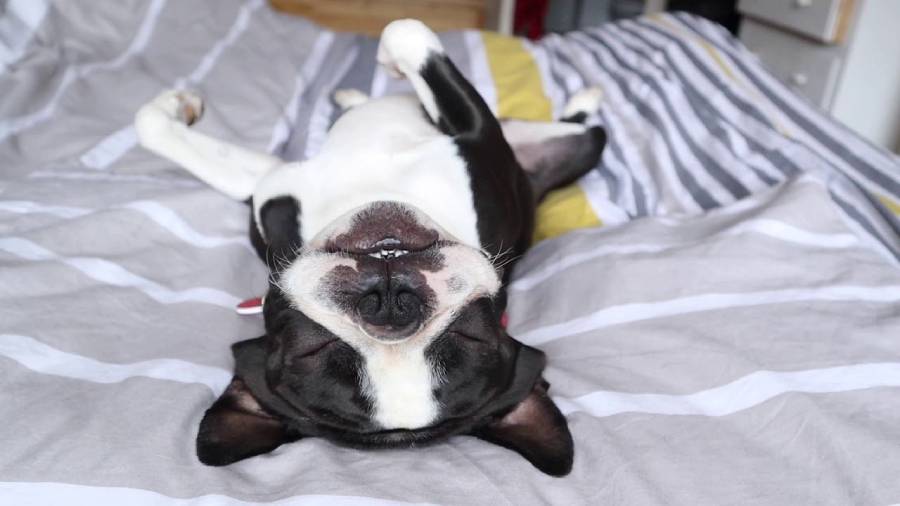
Boston Terriers snore mainly because their short, flat muzzles create less space for air to move through the upper airway. As a brachycephalic breed, Boston Terriers have compact facial structures that can include narrow nostrils, shortened nasal passages, and soft tissues that partially restrict airflow. When a Boston Terrier sleeps, relaxed tissues around the airway can vibrate as air passes through them, producing the familiar snoring sound.
Snoring is relatively common in Boston Terriers, but it should not automatically be considered harmless. A Boston Terrier that has always snored lightly but otherwise breathes, sleeps, plays, and exercises normally presents a different situation from a dog whose snoring suddenly becomes louder or occurs alongside labored breathing. Excess body weight, nasal congestion, allergies, sleeping position, and structural airway abnormalities can also increase snoring.
Persistent or worsening snoring can sometimes occur alongside brachycephalic obstructive airway syndrome (BOAS), a condition involving upper-airway obstruction in flat-faced dogs. For this reason, owners should evaluate snoring in context rather than judging the sound alone. Understanding what causes Boston Terrier snoring, what normal snoring looks like, and which respiratory signs require veterinary attention makes it easier to determine when the noise is simply characteristic of the breed and when it deserves further investigation.
Why Do Boston Terriers Snore?
Boston Terriers snore primarily because their short, flat facial structure restricts the amount of space available for airflow through the nose and upper airway. Boston Terriers are brachycephalic dogs, meaning their skulls are shorter from front to back than those of longer-muzzled breeds. Their shortened muzzle does not necessarily mean that every structure inside the nose and throat is reduced proportionally. As a result, air may have to pass through relatively narrow spaces before reaching the lungs.
Snoring occurs when airflow causes soft tissues in the upper airway to vibrate during breathing. This effect becomes more noticeable during sleep because muscles and tissues around the throat relax. If the available airway is already narrow, relaxation can further affect the passage of air and make breathing more turbulent. The resulting vibration produces the low, rough sound owners recognize as snoring.
A Boston Terrier can therefore snore without having an illness. A dog that has snored consistently for years while breathing comfortably when awake, exercising normally, and showing no signs of respiratory distress may simply have airway anatomy that makes snoring more likely. However, breed anatomy should not be used to dismiss every breathing noise as normal. Loud or worsening snoring can become more significant when it occurs with other signs of airway obstruction.
What Are the Most Common Causes of Snoring in Boston Terriers?
There are 7 main factors that can cause or worsen snoring in Boston Terriers: brachycephalic anatomy, stenotic nares, an elongated soft palate, sleeping position, excess body weight, allergies or nasal congestion, and respiratory infections. These factors do not have the same significance. Brachycephalic anatomy is the underlying reason Boston Terriers are predisposed to snoring, while conditions such as congestion or excess weight can further restrict an already compact airway.
Brachycephalic anatomy is the primary structural factor behind Boston Terrier snoring. The breed’s short muzzle and compact upper airway create less room for unrestricted airflow than the anatomy of many longer-muzzled dogs. When air moves through these confined passages during sleep, turbulence and tissue vibration can produce snoring. The severity varies between individual dogs because not every Boston Terrier has exactly the same airway anatomy.
Stenotic nares can increase resistance to airflow through the nose. Stenotic nares are abnormally narrow nostrils that limit the opening through which a dog inhales. A Boston Terrier with significantly narrowed nostrils must draw air through a smaller entrance, increasing respiratory effort and potentially contributing to noisy breathing. Narrow nostrils are particularly important when snoring occurs alongside signs such as difficult breathing or reduced exercise tolerance.
An elongated soft palate can partially obstruct airflow through the throat. The soft palate is tissue located toward the back of the roof of the mouth. In brachycephalic dogs, this tissue can extend far enough into the airway to interfere with normal airflow. Air passing around the tissue can create vibration and noise, particularly when the dog is asleep and the surrounding muscles are relaxed.
Sleeping position can change how easily air moves through a Boston Terrier’s airway. Positions that alter the alignment of the head, neck, or throat can make snoring louder in some dogs. An owner may notice, for example, that the dog snores strongly in one position but becomes quieter after shifting its head or body. Position-related changes can modify snoring, but they do not eliminate an underlying structural airway problem when one is present.
Excess body weight can worsen existing airway restriction. Additional tissue around the neck and upper airway can reduce the space available for airflow, placing extra pressure on a respiratory system that may already be anatomically restricted. Weight is therefore a relevant factor when an overweight Boston Terrier develops louder snoring or other breathing difficulties.
Allergies and nasal congestion can temporarily make snoring more noticeable. Inflammation, mucus, or swelling within the nasal passages reduces the space through which air can travel. A Boston Terrier with environmental allergies or nasal irritation may consequently snore more than usual. A change from the dog’s established snoring pattern is more informative than snoring alone because it indicates that something affecting airflow may have changed.
Respiratory infections can also cause new or worsening snoring by inflaming or congesting the respiratory passages. In this situation, snoring may occur together with other changes such as nasal discharge, coughing, sneezing, reduced activity, or changes in breathing. Sudden snoring accompanied by signs of illness should therefore be considered differently from the stable snoring pattern a Boston Terrier has displayed for most of its life.
Is It Normal for Boston Terriers to Snore?
Snoring is relatively common in Boston Terriers because their brachycephalic anatomy naturally creates a more restricted upper airway, but frequent snoring should not automatically be considered normal or harmless. The most useful distinction is not whether a Boston Terrier snores, but whether the dog can breathe comfortably during sleep, while awake, and during physical activity.
A Boston Terrier that has always snored lightly may have a stable snoring pattern associated with its individual anatomy. The sound may become more noticeable during deep sleep or in certain sleeping positions as tissues around the upper airway relax. If the dog wakes normally, breathes without obvious effort, remains active, and does not show other respiratory symptoms, the snoring alone provides limited information about whether an airway disorder is present.
The situation is different when the dog’s established pattern changes. Snoring that becomes substantially louder, begins suddenly, or occurs alongside noisy breathing while the dog is awake deserves more attention. Changes can indicate that airflow has become more restricted due to factors such as congestion, inflammation, weight gain, or an underlying structural airway problem.
Owners should therefore avoid using snoring frequency alone to determine whether their Boston Terrier has healthy breathing. A dog can snore regularly without obvious functional impairment, while another dog may have clinically important airway restriction accompanied by additional respiratory signs. Evaluating breathing effort, exercise tolerance, recovery after activity, and changes from the dog’s usual behavior provides more useful context.
When Is Boston Terrier Snoring a Sign of a Breathing Problem?
Boston Terrier snoring becomes more concerning when it occurs with signs that the dog is struggling to move enough air through its airway. Important warning signs include labored breathing, noisy breathing while awake, gagging or choking, reduced exercise tolerance, excessive respiratory effort, disrupted sleep, abnormal gum or tongue color, and collapse. These signs indicate a broader respiratory problem rather than an isolated sleep sound.
Labored breathing is an important distinction because normal breathing should not require obvious physical effort. A Boston Terrier experiencing airway restriction may visibly work harder to inhale, use pronounced chest or abdominal movements, or adopt a posture that appears to make breathing easier. Snoring accompanied by this type of respiratory effort warrants veterinary assessment because the concern is airflow restriction rather than the volume of the snore itself.
Noisy breathing while awake also provides useful information. Snoring occurs during sleep, when relaxed tissues can vibrate as air passes through the upper airway. Persistent snorting, rasping, or other pronounced breathing sounds while a Boston Terrier is awake can indicate that airflow resistance is present outside sleep as well. The significance increases when these sounds become more pronounced during excitement, exercise, or warm conditions.
Exercise intolerance can indicate that airway restriction is affecting normal activity. A Boston Terrier that stops unusually quickly during walks, struggles to recover after modest exercise, or consistently cannot tolerate activity that was previously manageable may not be moving air efficiently enough to meet increased oxygen demands. This change is particularly relevant when it appears together with increasingly noisy breathing.
Gagging, choking, or repeated sleep disruption can also accompany upper-airway problems. These signs should be evaluated in context, especially when they are new or becoming more frequent. A Boston Terrier repeatedly waking, changing position, or appearing unable to settle because of its breathing presents a different situation from a dog that snores steadily while sleeping comfortably.
Abnormal gum or tongue color and collapse require prompt veterinary attention. Healthy gums and tongues normally receive adequate oxygenated blood, while a blue, gray, or markedly abnormal coloration can indicate inadequate oxygenation or a serious respiratory problem. Collapse associated with breathing difficulty is likewise not ordinary Boston Terrier snoring. These signs shift the issue from a characteristic sleep noise to a potentially urgent respiratory problem.
The practical distinction is therefore based on function. Stable snoring without breathing difficulty may reflect the Boston Terrier’s brachycephalic anatomy, whereas snoring accompanied by respiratory effort, declining exercise tolerance, significant color changes, or collapse requires veterinary evaluation.
What Is BOAS in Boston Terriers?
Brachycephalic obstructive airway syndrome (BOAS) is a group of upper-airway abnormalities that can restrict breathing in flat-faced dogs such as Boston Terriers. The condition is associated with brachycephalic anatomy rather than snoring alone. Affected dogs can have one or several structural abnormalities that increase resistance as air moves from the nose toward the lungs.
Stenotic nares and an elongated soft palate are two airway abnormalities associated with BOAS. Narrow nostrils restrict the initial passage of air through the nose, while excessive soft-palate tissue can interfere with airflow farther back in the upper airway. When multiple areas are affected, a Boston Terrier may need to generate greater pressure to inhale enough air. This increased respiratory effort can contribute to noisy breathing and other signs of impaired airflow.
Snoring can occur in a Boston Terrier with BOAS because restricted airflow creates turbulence around soft tissues. However, respiratory effects are not necessarily limited to sleep. A dog with clinically significant airway obstruction may also show noisy breathing while awake, difficulty tolerating exercise, prolonged recovery after activity, gagging, or increased breathing difficulty under physical stress. These functional changes provide more context than the loudness of snoring by itself.
BOAS can vary in severity between individual Boston Terriers. Two dogs of the same breed can have noticeably different nostril openings, soft-tissue anatomy, and ability to move air through the upper airway. For this reason, the fact that Boston Terriers are brachycephalic does not establish that every Boston Terrier has the same degree of airway obstruction.
Is Snoring Always a Sign of BOAS in Boston Terriers?
No, snoring alone does not mean that a Boston Terrier has BOAS. Snoring is a breathing sound, while BOAS is an airway disorder that requires evaluation of the dog’s anatomy and respiratory function. A Boston Terrier may snore because relaxed tissues vibrate during sleep without showing the broader functional problems associated with significant airway obstruction.
The distinction becomes important because treating every snoring Boston Terrier as having BOAS can be misleading, while dismissing all snoring as a normal breed characteristic can also overlook respiratory problems. Owners should consider the complete pattern: breathing effort while awake, tolerance for exercise, recovery after activity, sleep quality, and whether respiratory noises have changed over time. A veterinarian can assess the dog when these signs suggest that airflow restriction extends beyond ordinary sleep-related snoring.
Why Has My Boston Terrier Suddenly Started Snoring?
A Boston Terrier that suddenly starts snoring may have experienced a change affecting airflow through its nose or upper airway. Possible explanations include nasal congestion, airway inflammation, allergies, a respiratory infection, weight gain, or a change in sleeping position. New snoring should therefore be evaluated differently from a stable sound the dog has made throughout its life.
Temporary nasal congestion can make an otherwise quiet sleeper begin to snore because swelling or material within the nasal passages reduces the space available for airflow. Allergic irritation can produce a similar effect by causing inflammation within the respiratory passages. If congestion is responsible, owners may notice additional changes such as sneezing or nasal discharge rather than snoring as the only new sign.
A respiratory infection can also change breathing sounds. Inflammation and secretions can increase resistance within the respiratory tract, making airflow noisier during sleep. Snoring that appears together with coughing, nasal discharge, reduced energy, changes in appetite, or other signs of illness provides a stronger reason for veterinary assessment than an isolated episode of snoring.
Weight gain can produce a more gradual change. Additional tissue around the neck and upper airway may further reduce breathing space in a Boston Terrier that already has compact brachycephalic anatomy. Owners who notice progressively louder snoring alongside increased body weight should therefore consider weight as one of the factors that may be affecting airflow.
Sleeping position provides a simpler explanation in some cases. A Boston Terrier may begin snoring after placing its head or neck in a position that changes the shape of the upper airway. The sound may decrease or disappear when the dog moves. Repeated or persistent new snoring, however, should not automatically be attributed to sleeping position, particularly when breathing has also changed while the dog is awake.
The timing and accompanying signs help distinguish these possibilities. A single episode associated with an unusual sleeping position differs from snoring that appears every night and progressively worsens. Sudden snoring accompanied by labored breathing, pronounced respiratory noise while awake, abnormal gum or tongue color, or collapse requires veterinary attention because the primary concern is no longer the snoring sound but the dog’s ability to breathe adequately.
Does Sleeping Position Affect a Boston Terrier’s Snoring?
Sleeping position can affect how loudly a Boston Terrier snores because the position of the head, neck, and body can change the amount of space available in the upper airway. When a dog falls asleep, muscles around the throat relax. A position that further narrows or bends the airway can increase airflow resistance and make soft-tissue vibration more noticeable.
Owners may notice that their Boston Terrier snores loudly in one position but becomes quieter after turning over or repositioning its head. For example, the angle of the neck can influence how air passes through the throat, while pressure from surrounding soft tissues may affect an already compact airway. These changes explain why snoring intensity can vary during the same sleeping period without any permanent change in the dog’s anatomy.
Sleeping position is a contributing factor rather than the underlying reason Boston Terriers are predisposed to snoring. Their brachycephalic facial structure remains the primary anatomical factor. Repositioning may reduce noise when posture contributes to airway narrowing, but it cannot correct structural abnormalities such as stenotic nares or an elongated soft palate.
The dog’s overall breathing pattern therefore matters more than whether one sleeping position produces louder snoring. Snoring that disappears after a position change and is not accompanied by respiratory difficulty has a different context from loud snoring associated with labored breathing, repeated waking, or breathing problems while awake. Owners should evaluate these accompanying signs rather than repeatedly repositioning a dog whose breathing appears impaired.
How Can You Reduce a Boston Terrier’s Snoring?
There are 5 practical ways to help reduce factors that can worsen Boston Terrier snoring: maintain an appropriate body weight, address nasal or allergy problems, adjust the sleeping environment, limit excessive respiratory stress, and have persistent breathing problems evaluated by a veterinarian. These measures can improve factors that contribute to snoring, but they cannot change the Boston Terrier’s underlying brachycephalic skull structure.
Maintain an appropriate body weight. Excess body weight can add tissue around the neck and upper airway, potentially making an already restricted breathing passage more difficult for air to move through. Weight management is especially relevant when a Boston Terrier’s snoring has become louder alongside noticeable weight gain. Owners should use an appropriate feeding and activity plan rather than assuming that snoring itself will improve simply by changing the dog’s food.
Address allergies and nasal congestion. Swelling, inflammation, and secretions within the nasal passages can further restrict airflow and increase breathing noise. If a Boston Terrier develops snoring alongside recurring sneezing, nasal discharge, or other signs of irritation, identifying the underlying problem is more useful than trying to suppress the sound. Persistent respiratory symptoms should be discussed with a veterinarian rather than treated with human medications without veterinary guidance.
Improve the sleeping environment and observe sleeping position. A comfortable sleeping area allows the dog to change positions naturally, and owners can observe whether snoring consistently becomes louder in a particular posture. Environmental irritants that appear to trigger nasal symptoms should also be considered. Position adjustments may reduce posture-related snoring, but they should not be treated as a solution for obvious breathing difficulty.
Limit excessive respiratory stress. Boston Terriers rely on their respiratory system not only for breathing but also for managing body heat through panting. Situations that substantially increase respiratory demand can be harder for a dog with restricted upper-airway anatomy. Exercise should therefore be appropriate for the individual dog’s respiratory tolerance, particularly when conditions increase the amount of effort required to breathe.
Get persistent or worsening breathing symptoms evaluated by a veterinarian. Home adjustments cannot correct significant structural airway obstruction. A veterinary examination can help determine whether snoring is primarily a sleep-related noise or part of a broader respiratory problem. This distinction becomes particularly important when the dog has stenotic nares, suspected BOAS, declining exercise tolerance, or breathing noises that occur while awake.
The goal should not necessarily be to make a Boston Terrier completely silent while sleeping. Because brachycephalic anatomy itself predisposes the breed to noisy airflow, some dogs may continue to snore despite appropriate weight and good general health. The more useful goal is to minimize avoidable factors that restrict airflow and confirm that persistent snoring is not accompanied by impaired respiratory function.
When Should You Take a Snoring Boston Terrier to the Vet?
Take a snoring Boston Terrier to a veterinarian when the snoring is new, becomes progressively worse, or occurs with signs that breathing is becoming more difficult. Snoring by itself does not establish that a Boston Terrier has an airway disorder. The more important indicators are changes in respiratory effort, exercise tolerance, sleep quality, and the dog’s ability to breathe comfortably while awake.
Persistent or gradually worsening snoring is appropriate to discuss during a veterinary examination, particularly when the dog’s normal breathing pattern has changed. A veterinarian can examine the nostrils, mouth, throat, and overall respiratory function to determine whether congestion, excess body weight, or brachycephalic airway abnormalities may be contributing. This assessment is especially relevant when the dog also has noisy breathing while awake or takes longer than usual to recover after physical activity.
Exercise intolerance is another reason to seek veterinary assessment. A Boston Terrier that previously completed normal walks but begins stopping frequently, breathing with substantially greater effort, or struggling to recover after moderate activity may have more than a sleep-related snoring problem. Exercise increases the body’s demand for airflow, so airway restriction can become more apparent during physical activity than during rest.
Owners should also arrange an evaluation when snoring occurs with recurring gagging, choking, sleep disruption, nasal symptoms, or persistent respiratory noises while the dog is awake. These signs can have different causes and cannot be diagnosed from the sound of snoring alone. A veterinary examination is needed to determine whether the problem originates in the nasal passages, throat, brachycephalic airway anatomy, or another part of the respiratory system.
Breathing difficulty, abnormal gum or tongue color, and collapse require more urgent veterinary attention. Blue, gray, or otherwise markedly abnormal coloration of the gums or tongue can indicate inadequate oxygenation. Collapse associated with respiratory distress is also fundamentally different from ordinary snoring during comfortable sleep. In these situations, the priority is the dog’s ability to breathe rather than determining why it snores.
A useful rule is to compare the Boston Terrier with its own established breathing pattern. Stable snoring in a dog that breathes comfortably and functions normally has a different significance from a sudden or progressive change accompanied by respiratory impairment. Monitoring these changes gives a veterinarian more useful information than simply describing the dog as a loud snorer.
Why Does My Boston Terrier Make Other Noises While Sleeping?
Boston Terriers can make several breathing and non-breathing noises while sleeping, and not every sound is snoring. Snoring specifically results from airflow causing tissues in the upper airway to vibrate. Other sounds can occur when a dog changes its breathing pattern, moves during sleep, dreams, or briefly adjusts the position of its mouth, head, or neck.
The timing of the sound helps distinguish ordinary sleep noises from respiratory concerns. A brief noise that occurs while a Boston Terrier moves, twitches, or changes sleeping position has a different context from continuous harsh breathing that persists throughout sleep. Likewise, a dog that makes occasional sounds while dreaming but returns to quiet, effortless breathing is displaying a different pattern from a dog that repeatedly wakes because it appears to struggle for air.
Owners should pay particular attention when similar respiratory noises occur while the Boston Terrier is awake. Persistent noisy breathing outside sleep suggests that the sound is not caused solely by the relaxation that occurs during sleep. The concern becomes greater when awake breathing noises occur with increased respiratory effort, exercise intolerance, gagging, or other functional changes.
The type of sound alone cannot identify its underlying cause. Snoring, snorting, and other upper-airway noises can sound similar to an owner without a veterinary respiratory assessment. Observing when the noise occurs, how long it lasts, whether it has changed, and whether the dog appears comfortable provides more useful information.
Read more: Why Do Boston Terriers Shake? Causes & Warning Signs
Do Boston Terriers Snore More Than Other Dogs?
Boston Terriers are predisposed to snoring because they are brachycephalic dogs with short muzzles and compact upper airways. This anatomical characteristic is shared with other flat-faced breeds, including French Bulldogs, Pugs, and English Bulldogs. Dogs with longer muzzles generally have different upper-airway proportions, so the structural conditions that contribute to noisy airflow in brachycephalic dogs are less pronounced.
The important distinction is therefore anatomical rather than simply breed-specific. Boston Terriers do not snore because snoring is a unique behavior of the breed. Their facial and airway structure increases the likelihood that airflow will encounter resistance and cause soft tissues to vibrate during sleep. Other brachycephalic breeds can snore for the same basic reason.
Individual variation remains significant within the breed. One Boston Terrier may sleep relatively quietly, while another may snore regularly because its nostrils, soft palate, and other upper-airway structures create greater airflow resistance. Snoring frequency or volume should therefore not be used to compare respiratory health between two dogs without considering their individual anatomy and other breathing signs.
Breed predisposition also does not make severe respiratory noise automatically normal. Boston Terriers, French Bulldogs, Pugs, and other brachycephalic dogs can experience airway obstruction, including abnormalities associated with BOAS. The fact that noisy breathing is common in flat-faced breeds should not replace an assessment of whether an individual dog can breathe and exercise comfortably.
Do Boston Terrier Puppies Snore?
Boston Terrier puppies can snore because they already have the brachycephalic facial structure that predisposes the breed to noisy airflow during sleep. Relaxation during sleep can allow upper-airway tissues to vibrate as the puppy breathes, producing snoring even at a young age. Occasional snoring therefore does not by itself establish that a Boston Terrier puppy has a respiratory disorder.
The same distinction between sound and respiratory function applies to puppies. A puppy that occasionally snores while sleeping comfortably presents a different pattern from one that consistently struggles to breathe, makes pronounced respiratory noises while awake, or has difficulty tolerating normal activity. Owners should evaluate the complete breathing pattern rather than assuming that all puppy snoring is harmless because Boston Terriers are flat-faced.
Changes over time are also useful to observe. Recording when snoring occurs, whether it is becoming louder, and whether breathing noises are also present while the puppy is awake can provide useful context during veterinary visits. Video recordings of unusual breathing episodes can also help owners accurately show a veterinarian what happens at home.
Snoring accompanied by obvious respiratory effort, repeated sleep disruption, exercise intolerance, abnormal gum or tongue color, or collapse should not be treated as an expected feature of a Boston Terrier puppy. These signs concern the puppy’s respiratory function rather than the snoring sound itself and warrant veterinary attention.
1 thought on “Why Do Boston Terriers Snore? 7 Common Causes”