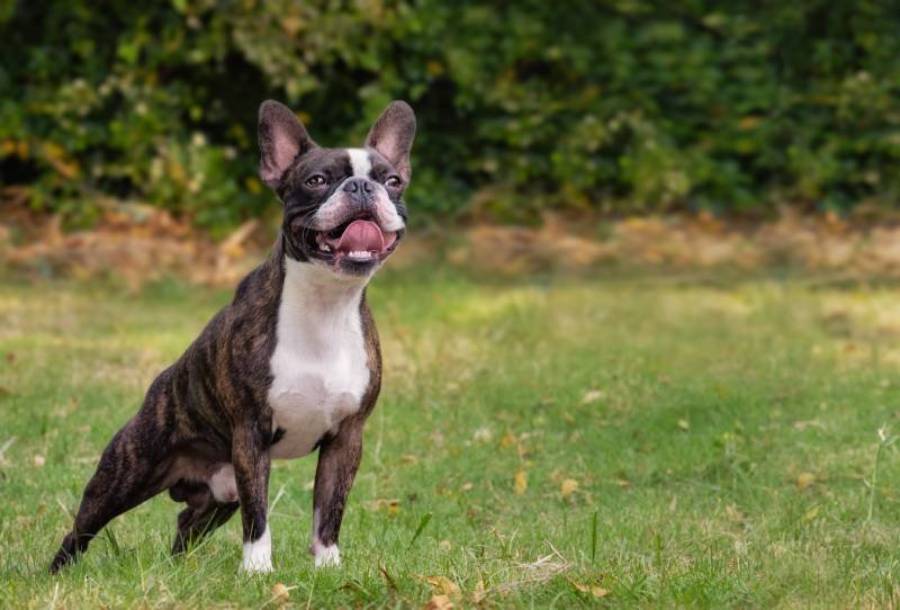
You can stop a Boston Terrier from barking excessively by identifying the trigger, managing the situation, and consistently rewarding quiet behavior. The goal is not to prevent your Boston Terrier from barking completely. Barking is a normal form of canine communication, but it becomes a problem when it is frequent, prolonged, or triggered by everyday situations that the dog has not learned to handle calmly.
Boston Terriers may bark for several distinct reasons, including attention, boredom, excitement, fear, anxiety, or territorial responses to people and animals. The cause matters because each type of barking requires a different response. Ignoring attention-seeking barking, for example, may help prevent the behavior from being rewarded, while barking caused by fear requires management and gradual training around the trigger.
Effective barking control therefore starts with finding out what happens immediately before your Boston Terrier barks and what the dog receives afterward. From there, you can teach a quiet cue, reinforce calm behavior, manage common triggers, and provide appropriate physical exercise and mental stimulation. The following methods focus on reducing unwanted barking without expecting your Boston Terrier to remain silent in situations where barking is a normal response.
How Do You Stop a Boston Terrier From Barking?
To stop a Boston Terrier from barking excessively, identify what triggers the barking, prevent the behavior from being unintentionally rewarded, and reinforce quiet behavior consistently. The training method should match the cause of the barking because a Boston Terrier barking for attention requires a different response from one barking because of fear, excitement, or an environmental trigger.
Start by identifying exactly what happens before your Boston Terrier begins barking. Common triggers include someone approaching the front door, another dog passing outside, being left alone, wanting attention, or becoming excited before a walk. Observe what happens after the barking as well. For example, if your Boston Terrier barks at you and you immediately start playing, the dog may learn that barking produces play. Repeating this sequence can strengthen the behavior rather than stop it.
Next, manage predictable triggers while teaching an alternative behavior. If your Boston Terrier repeatedly barks at people through a window, reducing access to that view can prevent the dog from rehearsing the behavior while training takes place. If barking occurs when the dog wants attention, wait for a quiet moment before providing attention rather than responding during the barking. Management does not replace training; it reduces opportunities to practice unwanted barking while the dog learns a different response.
Reward quiet behavior as soon as it occurs. When your Boston Terrier stops barking, mark the quiet moment with a consistent word or cue and provide a reward such as a small treat, praise, or access to a desired activity. Reward timing matters because giving the reward while the dog is still barking can reinforce the behavior you are trying to reduce. Begin with short periods of silence and gradually require longer periods before providing the reward.
Teach a consistent quiet cue once your Boston Terrier can reliably pause between barks. Use the same cue each time rather than switching between phrases such as “quiet,” “stop,” and “no barking.” Give the cue during a manageable situation, reward the dog when it becomes quiet, and repeat the process across different barking triggers. The objective is to create a predictable association between the cue, quiet behavior, and a positive consequence.
Finally, address the conditions that make unnecessary barking more likely. Provide appropriate daily exercise, mental stimulation, social interaction, and opportunities to rest. These measures are particularly relevant when barking is connected to boredom or excess arousal, but they do not replace trigger-specific training. A Boston Terrier that barks because of fear, separation-related distress, or another persistent behavioral problem needs the underlying cause addressed rather than simply being told to stay quiet.
Why Does My Boston Terrier Bark So Much?
A Boston Terrier may bark excessively because of attention-seeking, boredom, excitement, fear or anxiety, or territorial and environmental triggers. Identifying which of these 5 causes is responsible for the barking is important because each cause requires a different response. Barking that repeatedly achieves a desired result can become a learned behavior, while barking triggered by fear or environmental stimuli requires the trigger itself to be addressed.
Attention-seeking barking occurs when a Boston Terrier learns that making noise produces a response from its owner. The desired response may be petting, eye contact, food, play, being allowed outside, or access to a favorite object. For example, a Boston Terrier that barks beside its owner and immediately receives a toy can learn that barking starts playtime. The behavior can become more frequent when different family members respond inconsistently, because the dog continues trying a behavior that sometimes succeeds.
Boredom-related barking occurs when a Boston Terrier lacks sufficient opportunities for physical activity, interaction, or mental engagement. A dog that spends long periods without an appropriate activity may use barking as one way to respond to under-stimulation. This type of barking may appear alongside behaviors such as repeatedly following the owner, searching for activities, or reacting strongly to minor sounds and movements around the home. Providing exercise and enrichment can address under-stimulation, but the specific barking habit may still require separate training.
Excitement can also trigger repeated barking when a Boston Terrier becomes highly aroused by an anticipated event. Common examples include seeing a leash before a walk, greeting a familiar person, preparing to play, or noticing another dog. If the desired event immediately follows the barking, the sequence can reinforce the behavior. Teaching calm behavior before giving access to the walk, person, or activity creates a different pattern in which calmness rather than barking leads to the desired outcome.
Fear and anxiety require a different approach because the barking may function as a response to something the dog perceives as threatening or stressful. Potential triggers include unfamiliar people, unfamiliar dogs, sudden noises, changes in the environment, or being separated from the owner. Punishing the barking does not address the emotional response producing it. Instead, the owner needs to identify the trigger, manage exposure, and gradually teach the Boston Terrier a calmer response at an intensity the dog can tolerate.
Territorial and environmental barking is commonly associated with specific sights and sounds around the home. A Boston Terrier may repeatedly react when a person approaches the door, an animal enters the yard, a delivery arrives, or movement occurs outside a window. The sequence can reinforce itself when the trigger eventually disappears: the dog barks, the person or animal moves away, and the dog experiences the outcome of the trigger leaving. Managing visual or physical access to predictable triggers can therefore be an important first step while calmer behavior is being trained.
The pattern surrounding the barking provides more useful information than the barking alone. Record what happens immediately before your Boston Terrier barks, what the dog does while barking, and what happens immediately afterward. Repeated patterns can reveal whether the dog is seeking something, reacting to something, or responding to a particular emotional or environmental situation.
How Can You Tell What Is Triggering Your Boston Terrier’s Barking?
You can identify what triggers your Boston Terrier’s barking by observing what happens immediately before the barking starts, where it occurs, what or who is present, and what happens immediately afterward. Recording these details across several barking episodes helps reveal repeated patterns and separates attention-seeking barking from responses caused by excitement, fear, boredom, or environmental stimuli.
Start with what happens immediately before the first bark. The trigger may be obvious, such as a doorbell ringing, another dog appearing outside, or the owner picking up a leash. Other triggers are less noticeable. A Boston Terrier may start barking when its owner stops giving attention, leaves the room, prepares to leave the house, or when a particular sound occurs outside. Identifying this preceding event is more useful than focusing only on how loud or persistent the barking becomes.
Next, consider the location and circumstances. Barking that repeatedly occurs beside a window may be connected to people, dogs, vehicles, or other movement outside. Barking near the front door may be triggered by visitors or sounds in the hallway. Barking that begins primarily when the Boston Terrier is left alone points toward a different set of causes than barking that occurs while the owner is present. The same dog can also have more than one barking trigger, so each recurring situation should be evaluated separately.
Pay particular attention to what happens after the barking. For example, a Boston Terrier barks at its owner, the owner starts petting the dog, and the barking stops. In that sequence, attention may be reinforcing the behavior. In another situation, the dog sees a person through the window, barks repeatedly, and stops when the person walks away. Although the owner did not provide a reward, the disappearance of the trigger may still contribute to the repeated barking pattern.
A simple barking log can make these patterns easier to identify. Record the time, location, immediate trigger, duration of the barking, the dog’s behavior, and what happened afterward. After several entries, compare the episodes instead of treating each one as an isolated event. If most barking starts when attention stops, attention is a likely factor. If it consistently begins when people or dogs appear outside, environmental triggers deserve more attention.
Identifying the trigger should come before choosing a training technique. The correct response depends on what is maintaining the barking. Removing attention may help with attention-seeking behavior, while managing distance and exposure is more appropriate for a Boston Terrier reacting to something it fears. Once the pattern is clear, training can target the cause instead of simply trying to suppress the sound.
How Do You Train a Boston Terrier to Be Quiet on Command?
To train a Boston Terrier to be quiet on command, wait for a pause in the barking, give a consistent quiet cue, and immediately reward the dog for remaining silent. Repeat the sequence during manageable barking situations and gradually increase how long the dog must remain quiet before receiving the reward. The cue becomes useful through repeated association with quiet behavior rather than through repeatedly saying the word while the dog continues barking.
Begin in a situation where the barking is predictable but your Boston Terrier is still responsive to you. After the dog barks, wait for a brief natural pause. Give a simple cue such as “quiet” during that pause and immediately reward the silence with a small treat, praise, or another reward the dog values. This timing is important. Giving the reward while the dog is actively barking risks reinforcing barking instead of the quiet behavior that should follow it.
Keep the first requirement easy. A brief moment of silence is enough during the early training sessions. Once your Boston Terrier reliably becomes quiet after the cue, gradually extend the required duration from a brief pause to several seconds and then longer periods. Increasing the duration too quickly can cause the dog to bark again before earning the reward, making the exercise unnecessarily difficult.
Use one cue consistently. Switching between “quiet,” “stop,” “enough,” and other phrases makes the signal less predictable. Repeating the cue continuously can also reduce its usefulness. Say the selected cue once when your Boston Terrier has an opportunity to respond, then reinforce the correct behavior. The objective is for the dog to learn that the cue predicts a specific action: stop barking and remain quiet.
Practice with different triggers only after the behavior works in easier situations. A Boston Terrier that responds to “quiet” during a low-level household distraction may not immediately respond when a visitor arrives or another dog passes nearby. Introduce more difficult triggers gradually and at an intensity where the dog can still respond. For example, training around another dog may need to begin at a greater distance before the Boston Terrier can remain calm at closer distances.
Rewards can also be adjusted as the behavior becomes reliable. Food is useful because it can be delivered immediately, but praise, play, or access to a desired activity can reinforce quiet behavior when appropriate. If your Boston Terrier barks before a walk, for example, opening the door after a period of calm behavior can make access to the walk itself part of the reinforcement.
A quiet command works best when it is combined with trigger management rather than used as the only solution. The cue tells your Boston Terrier what to do after barking starts, while management and behavior training reduce how often unnecessary barking begins. This distinction is especially important when barking is caused by fear, anxiety, or another trigger that requires more than obedience training.
Should You Ignore a Boston Terrier When It Barks?
You should ignore a Boston Terrier’s barking when the behavior is clearly used to gain attention, but ignoring is not appropriate for every type of barking. Barking caused by fear, anxiety, environmental triggers, or physical discomfort requires the underlying cause to be addressed. The purpose of ignoring attention-seeking barking is to prevent attention from becoming a reward, not to make the dog stop communicating.
Attention can reinforce barking even when the owner considers the response negative. Looking at your Boston Terrier, talking to it, touching it, picking up a toy, or telling it to stop can provide the interaction the dog was seeking. For example, if your Boston Terrier barks while you are working and you respond by petting it, the sequence becomes barking followed by attention. Repeating that sequence can make attention-seeking barking more persistent.
Remove attention during this type of barking and provide it when the dog becomes quiet. Avoid eye contact, conversation, play, and petting while the barking continues. Once your Boston Terrier pauses and remains calm, reward the quiet behavior with attention or another appropriate reward. This changes the consequence of the behavior: barking no longer produces attention, while quiet behavior does.
Do not use the same strategy when your Boston Terrier is barking because it is frightened or distressed. A dog reacting strongly to an unfamiliar person, another dog, a sudden noise, or being left alone may need trigger management and gradual behavior training. Simply waiting for prolonged distress to stop does not teach the dog that the trigger is safe or change the emotional response responsible for the barking.
Environmental barking also requires active management. If your Boston Terrier spends long periods barking at pedestrians through a window, allowing the behavior to continue while ignoring it gives the dog repeated opportunities to practice the same response. Restricting access to the view, increasing distance from the trigger, and reinforcing calm behavior can be more appropriate than ignoring the barking.
Treat sudden or unexplained changes in barking differently as well. A Boston Terrier that begins vocalizing much more frequently without an obvious behavioral or environmental trigger may require veterinary attention, particularly when the change occurs alongside other unusual behaviors or signs of discomfort. Ignore barking only after you have identified attention as the likely reward maintaining the behavior.
How Do You Stop a Boston Terrier From Barking at People?
To stop a Boston Terrier from barking at people, determine which people trigger the response, control the dog’s exposure to them, and reward calm behavior before the barking escalates. The appropriate training setup depends on whether the dog reacts to visitors entering the home, strangers approaching outside, people passing a window, or familiar people during excited greetings.
Start by preventing repeated uncontrolled barking at predictable triggers. If your Boston Terrier reacts to pedestrians through a front window, restrict the view or move the dog farther from the window while training. If visitors trigger barking, create enough distance between the dog and the entrance for the dog to remain responsive. Management reduces opportunities to rehearse the barking pattern and creates conditions in which calm behavior can be reinforced.
Introduce the trigger at a manageable intensity. Your Boston Terrier should be able to notice the person without becoming so aroused that it cannot respond to you or accept a reward. Reward the dog for looking at the person and remaining calm, redirecting attention toward you, or performing another trained behavior. Repeat the exercise until the presence of a person reliably predicts calm behavior and reinforcement rather than immediate prolonged barking.
Distance is an important variable. If your Boston Terrier remains calm when a person is 30 feet away but begins barking when the person reaches 10 feet, start training beyond the distance that triggers the stronger reaction. Reduce the distance gradually as the dog succeeds. Moving closer too quickly can push the dog beyond the point at which it can respond effectively to training.
Excited greeting barking requires a slightly different consequence. If your Boston Terrier barks because it wants to reach a familiar person, avoid making barking the behavior that gains access to the greeting. Wait for calm behavior before allowing the interaction to continue. The dog then learns that calmness moves the greeting forward, while barking does not.
Avoid yelling at a Boston Terrier for barking at people. Raising your voice does not explain which behavior should replace barking and can increase arousal during an already stimulating situation. Manage the trigger, maintain a workable distance, and reinforce the specific calm behavior you want your Boston Terrier to repeat.
How Do You Stop a Boston Terrier From Barking at Other Dogs?
To stop a Boston Terrier from barking at other dogs, begin training at a distance where your dog can notice another dog without immediately escalating into persistent barking. Reward calm behavior at that distance, then gradually reduce the space between the dogs as your Boston Terrier becomes more capable of staying calm. Barking at other dogs may be associated with excitement, fear, frustration, or a strong response to the other dog’s presence, so identifying the context remains important.
Start by finding your Boston Terrier’s workable distance from another dog. For example, your dog may notice another dog across the street while remaining able to look at you and respond to a familiar cue. At a shorter distance, the same dog may begin pulling and barking continuously. Training should begin at the greater distance rather than after the dog has already reached the point of intense barking.
Reward the behaviors you want to see when another dog appears. These behaviors can include remaining quiet, looking back at you, walking calmly, or disengaging from the other dog. Deliver the reward while your Boston Terrier is still able to respond rather than waiting until prolonged barking has started. With repetition, seeing another dog can become a cue to perform a calmer alternative behavior.
Reduce distance gradually instead of forcing close interactions. If your Boston Terrier begins barking repeatedly, pulling strongly toward the other dog, or stops responding to familiar cues, increase the distance again. This adjustment does not end the training session; it returns the dog to a situation in which learning is more achievable. Successful repetitions at manageable distances are more useful than repeatedly placing the dog in situations it cannot yet handle calmly.
Avoid allowing barking to become the route to meeting another dog. A Boston Terrier that barks and pulls before immediately being allowed to greet may learn that these behaviors help it reach the desired interaction. When excitement is driving the barking, require an achievable period of calm behavior before moving closer or allowing an appropriate greeting.
The objective is not to make your Boston Terrier ignore every dog. The training goal is to help the dog notice another dog without automatically responding with uncontrolled barking. If reactions are intense, difficult to manage safely, or accompanied by other concerning behaviors, a qualified dog training or behavior professional can help create a controlled training plan.
How Do You Stop a Boston Terrier From Barking When Left Alone?
To stop a Boston Terrier from barking when left alone, first determine whether the barking is caused by boredom, outside triggers, or separation-related distress. These causes can produce similar barking but require different responses. Environmental management and enrichment may help a bored dog, while significant distress associated with being alone requires a more gradual approach to departures and may justify professional guidance.
Determine when the barking begins after you leave. A Boston Terrier that settles initially but later starts reacting to people, dogs, or noises outside may be responding to environmental triggers. A dog that has little to do for extended periods may bark in association with under-stimulation. In contrast, barking that begins around departure and occurs alongside clear signs of distress suggests that simply providing another toy may not address the underlying problem.
Manage environmental triggers when they are responsible for the barking. Restrict access to windows if passing people or animals repeatedly cause a reaction, and create a resting area away from highly stimulating parts of the home. Appropriate enrichment can provide an alternative activity when boredom contributes to the problem. Food-dispensing toys, scent-based activities, and other suitable enrichment can keep the dog engaged during manageable periods alone.
Build alone time gradually when departures themselves are difficult. Begin with periods short enough that your Boston Terrier can remain calm, then increase the duration progressively. The starting point depends on the individual dog. Increasing alone time beyond what the dog can currently tolerate can result in repeated barking rather than teaching calm independence.
Keep departures and returns predictable rather than turning them into highly stimulating events. Establishing a consistent routine can make the transition between owner presence and absence easier to anticipate. Exercise and mental activity before an appropriate period alone may also help a dog settle, particularly when excess energy or under-stimulation contributes to the barking.
Do not assume persistent barking while alone is disobedience. Barking associated with significant separation-related distress requires the emotional cause to be addressed rather than punishment for making noise. Seek veterinary or qualified behavioral guidance when your Boston Terrier shows severe distress, destructive or escape behavior, or cannot tolerate even short periods alone despite gradual training.
How Do You Stop a Boston Terrier From Barking at Night?
To stop a Boston Terrier from barking at night, identify whether the barking is triggered by outside stimuli, a need to eliminate, attention-seeking, a disrupted routine, or discomfort, then address that specific cause. Nighttime barking should not automatically be treated as a training problem because a dog that suddenly begins barking at night may be responding to a change in its environment or physical condition.
Start by determining exactly when the barking occurs and what happens immediately beforehand. A Boston Terrier that barks whenever people, vehicles, or animals pass outside is responding to a different trigger from a dog that wakes and barks after several hours of sleep. Reduce access to windows or move the sleeping area away from external sounds when visual and auditory stimuli repeatedly trigger the behavior. A quieter sleeping environment reduces opportunities for the dog to rehearse the same barking response throughout the night.
Check whether the Boston Terrier’s daily routine supports uninterrupted rest. Provide opportunities for appropriate exercise, mental activity, toileting, and settling before bedtime. A consistent nighttime routine can help the dog distinguish active periods from sleeping periods. For example, completing the final bathroom break before bed reduces the likelihood that barking later in the night is caused by a need to go outside.
Handle attention-seeking nighttime barking carefully. If you have established that your Boston Terrier does not need to eliminate and is not reacting to distress or another legitimate trigger, repeatedly providing play, food, or prolonged attention after barking can reinforce the behavior. Instead, provide attention and other desired activities during calm periods so that barking does not become the most reliable way to get a response at night.
Do not ignore a sudden change in nighttime behavior without considering other explanations. A Boston Terrier that previously slept quietly but begins waking and vocalizing frequently has experienced a behavioral change worth investigating. Changes in appetite, movement, elimination, sleep, or other everyday behaviors can provide additional context. Seek veterinary guidance when nighttime barking appears suddenly, persists without an identifiable environmental cause, or occurs alongside signs of discomfort or other unusual behavior.
Nighttime barking is reduced most effectively by removing or managing its cause rather than repeatedly correcting the barking itself. Once you know why your Boston Terrier is waking and barking, you can determine whether the appropriate response is environmental management, routine adjustment, behavior training, or veterinary evaluation.
Can Exercise and Mental Stimulation Reduce Barking in a Boston Terrier?
Exercise and mental stimulation can reduce barking in a Boston Terrier when boredom, under-stimulation, or excess arousal contributes to the behavior. Physical and mental activities give the dog appropriate ways to engage with its environment, but they do not replace training for barking caused by fear, separation-related distress, territorial responses, or specific environmental triggers.
Physical activity can help a Boston Terrier use energy through structured activities instead of searching for stimulation around the home. Walks and interactive play are examples, but the appropriate amount and intensity should suit the individual dog’s age, health, physical condition, and tolerance. Exercise should therefore be treated as part of a daily routine rather than as a method of exhausting the dog until it no longer has enough energy to bark.
Mental stimulation addresses a different need. Food puzzles, scent games, short training sessions, food-dispensing toys, and interactive games require a Boston Terrier to perform tasks or solve simple problems to obtain a desired outcome. For example, searching for hidden food engages the dog’s attention in a structured activity instead of leaving it to react to every movement or sound around the home.
Combine physical and mental activities when under-stimulation is contributing to unwanted barking. A walk provides movement and exposure to the environment, while a short training session requires concentration and reinforces communication between the dog and owner. Rotating suitable enrichment activities can also prevent the routine from becoming so predictable that the activities no longer hold the dog’s attention.
Exercise and enrichment should not be used to avoid identifying the actual barking trigger. A well-exercised Boston Terrier may still bark at every dog outside the window, react to a visitor at the door, or become distressed when left alone. Those behaviors require trigger-specific management and training in addition to appropriate daily activity.
Use exercise and mental stimulation to address barking associated with insufficient activity, then train separately for specific triggers that continue to produce barking. This combination addresses both the dog’s daily behavioral needs and the learned responses responsible for recurring barking situations.
Read more: How to Stop a Boston Terrier From Biting: 7 Steps
What Should You Avoid When Training a Boston Terrier Not to Bark?
Avoid yelling, inconsistent responses, accidental reinforcement, poor reward timing, unrealistic expectations, and training only after your Boston Terrier is already highly aroused. These 6 mistakes can make barking harder to change because they either reward the unwanted behavior, make the desired behavior unclear, or place the dog in situations where it cannot respond effectively to training.
Avoid yelling when your Boston Terrier barks. Raising your voice adds more noise and arousal to the situation without clearly communicating which behavior should replace barking. Instead, use the same quiet cue and reinforce the moment your dog performs the desired behavior. Training is more precise when the Boston Terrier learns what earns a reward rather than simply experiencing a negative response when it makes a mistake.
Keep responses consistent across repeated barking episodes. If barking earns attention on Monday but is ignored on Tuesday, the consequence becomes unpredictable. The same problem occurs when one family member rewards quiet behavior while another gives the dog attention whenever it barks. Decide how common barking situations will be handled and have household members respond consistently.
Avoid accidentally giving your Boston Terrier what it wants immediately after barking. For example, opening the door when the dog barks to go outside for play, throwing a toy after demand barking, or allowing an excited dog to greet someone while it is barking can reinforce the sequence. Wait for an achievable period of calm behavior before providing access to the desired activity when the situation allows it.
Reward timing must also be precise. Give the reward after the desired quiet behavior begins rather than while barking continues. The behavior immediately associated with a consequence is important to the learning process, so delayed rewards can make it less clear what the Boston Terrier is being reinforced for. During early training, short successful periods of quiet are more useful than waiting for a long period of silence that the dog cannot yet maintain.
Avoid expecting your Boston Terrier to stop barking completely. Barking is a form of canine communication, and appropriate barking can occur when a dog is excited, alerted by something in its environment, or communicating a need. Training should focus on excessive, persistent, or contextually unwanted barking rather than eliminating every vocal response.
Finally, do not wait until your Boston Terrier is extremely aroused before beginning every training attempt. A dog that is already barking continuously at a nearby trigger may struggle to respond to familiar cues or rewards. Increase the distance from the trigger or reduce its intensity, reinforce calm behavior there, and make the situation gradually more challenging. Effective barking training makes the desired behavior achievable first and progressively increases difficulty as the Boston Terrier succeeds.
1 thought on “How to Stop a Boston Terrier From Barking”