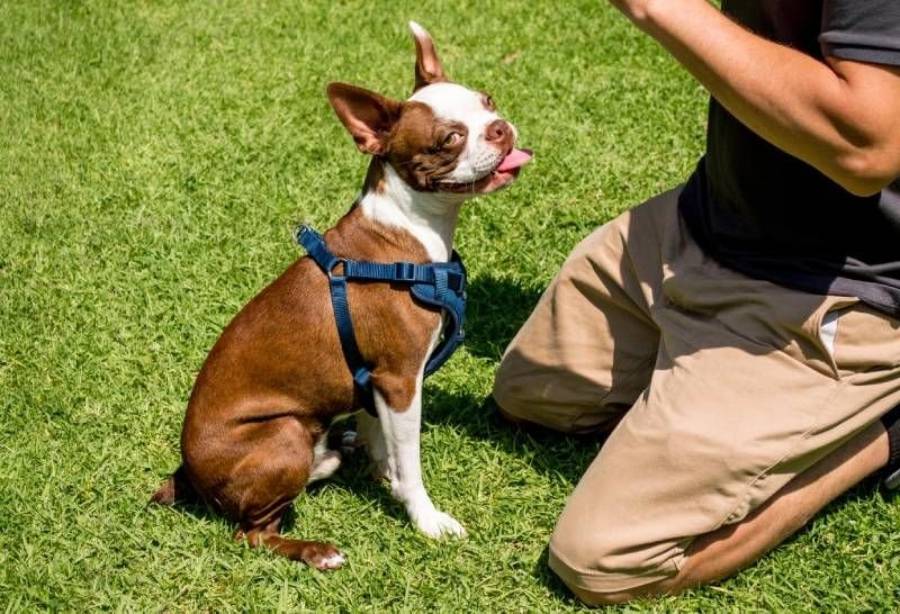
Leash training a Boston Terrier starts with teaching one simple rule: walking calmly on a loose leash allows the walk to continue. Use a properly fitted harness or collar, a fixed-length leash, small training treats, and short practice sessions in a low-distraction environment. Reward your Boston Terrier when the leash stays loose and when the dog chooses to remain attentive to you.
Boston Terriers can become excited by people, dogs, smells, and unfamiliar surroundings, so leash training should progress gradually. Start indoors, where distractions are limited, before practicing in a yard, quiet outdoor area, and eventually on regular walks. If your Boston Terrier pulls, avoid teaching that pulling is an effective way to reach an interesting person, object, or location. Instead, reinforce the walking behavior you want and increase difficulty only after your dog can perform it consistently in an easier environment.
This guide explains how to leash train a Boston Terrier step by step, including how to introduce the leash and harness, teach loose-leash walking, manage pulling and distractions, select training equipment, and solve common problems such as leash biting or refusing to walk.
How do you leash train a Boston Terrier step by step?
Leash train a Boston Terrier in 7 steps: choose properly fitted equipment, introduce the leash indoors, reward calm behavior, teach your dog to follow you, practice loose-leash walking, add outdoor distractions gradually, and increase walking distance. Complete each step consistently before making the environment more difficult.
1. Choose and fit the leash and harness. Start with equipment that allows you to control your Boston Terrier without interfering with normal movement. A fixed-length leash gives you a predictable working distance, while a properly fitted harness or collar should remain secure without restricting movement. Let your dog inspect the equipment before putting it on so the leash and harness become familiar objects rather than sudden restraints.
2. Introduce the leash indoors. Attach the leash in a quiet room and allow your Boston Terrier to become comfortable wearing it before expecting structured walking. Keep the first sessions simple and supervised. Walk a few steps, encourage your dog to move with you, and reward voluntary movement. Starting indoors removes competing stimuli such as other dogs, pedestrians, traffic, and unfamiliar smells, making it easier for your Boston Terrier to associate following you with reinforcement.
3. Reward calm behavior while wearing the leash. Give a small treat or another valued reward when your Boston Terrier stands, sits, or moves calmly with the equipment attached. Reward the behavior you want rather than using the leash primarily to physically position the dog. For example, when your Boston Terrier turns toward you instead of pulling toward another part of the room, mark and reward that choice. Consistent reinforcement teaches the dog which behaviors produce desirable outcomes.
4. Teach your Boston Terrier to follow you. Begin walking several steps in one direction and reward your dog for moving with you while the leash remains loose. Change direction occasionally so your Boston Terrier learns to monitor your movement instead of choosing the entire walking route independently. Start with only a few successful steps between rewards. Increase the number of steps gradually as your dog becomes more consistent.
5. Practice loose-leash walking. A loose leash should form some slack between you and your Boston Terrier rather than remaining continuously tight. Reward your dog while the leash is loose and continue moving forward when the desired walking behavior is maintained. If the leash becomes tight, avoid allowing pulling to become the reliable method for reaching a person, smell, dog, or destination. The practical distinction is simple: loose-leash behavior produces progress and reinforcement, while pulling does not produce the same outcome.
6. Introduce outdoor distractions gradually. Move outside after your Boston Terrier can follow you reliably in the easier indoor environment. Begin in a quiet yard, driveway, or other low-distraction location before progressing to busier walking areas. Dogs, people, vehicles, noises, and smells increase the difficulty of the same behavior your dog practiced indoors. If your Boston Terrier stops responding to familiar cues outside, increase the distance from the distraction or return temporarily to an easier environment instead of repeatedly giving a cue the dog cannot follow.
7. Increase walking distance and difficulty. Extend walks after your Boston Terrier can maintain loose-leash behavior for increasingly longer periods. Change one major difficulty at a time when possible. For example, practice a longer distance on a quiet route before expecting the same performance on a crowded street. This progression allows your Boston Terrier to practice successful repetitions instead of moving directly from an easy indoor exercise to a highly distracting walk.
The complete progression is indoors → quiet outdoor area → normal walking route → higher-distraction environment. Moving through these stages gradually makes leash training easier to repeat because your Boston Terrier learns the walking behavior first and then learns to perform the same behavior around progressively stronger distractions.
How do you teach a Boston Terrier to walk without pulling?
Teach a Boston Terrier to walk without pulling by rewarding forward movement when the leash is loose and preventing a tight leash from consistently moving the dog toward what it wants. This creates a clear consequence for both behaviors: loose-leash walking allows progress, while pulling does not become the shortcut to a destination.
Start in an environment where your Boston Terrier can still pay attention to you. Walk several steps and reward the dog while it remains within your preferred walking area and the leash has visible slack. Deliver the reward close to the position where you want the dog to walk. As your Boston Terrier becomes consistent, gradually increase the number of loose-leash steps required before the next reward.
Reward timing matters because the reward needs to correspond with the desired behavior. For example, if your Boston Terrier walks five steps with a loose leash but receives the treat only after surging forward and tightening the leash, the reinforcement becomes less precise. Mark and reward while the leash is still loose. This helps distinguish the successful behavior from the pulling behavior that follows it.
Avoid relying on continuous leash tension to keep your Boston Terrier beside you. Constant tension makes it harder to create a clear difference between a loose leash and a tight leash. Instead, use reinforcement, movement, direction changes, and appropriate distance from distractions to create opportunities for the dog to make the correct choice.
What should you do when your Boston Terrier pulls on the leash?
Stop allowing forward progress when your Boston Terrier pulls, then resume movement when the leash becomes loose again. The goal is not to punish the dog for reaching the end of the leash. The goal is to prevent pulling from repeatedly achieving the exact result the dog wants.
For example, your Boston Terrier may pull toward an interesting smell several feet ahead. Continuing directly toward that smell while the leash remains tight teaches a simple pattern: pull → reach the smell. Instead, stop forward progress when the leash tightens. Encourage or wait for your dog to reorient toward you and create slack in the leash, then reward the improved position and continue walking.
Distance also affects pulling. A Boston Terrier that walks calmly 30 feet from another dog may begin pulling when only 5 feet away. In that situation, increasing distance can make the exercise achievable again. Practice successful loose-leash repetitions at the manageable distance before gradually working closer to the distraction.
Consistency is essential because the consequence needs to remain predictable. If pulling works during some walks but stops progress during others, your Boston Terrier receives conflicting information. Everyone who regularly walks the dog should therefore follow the same basic walking rules whenever possible.
How do you stop a Boston Terrier from getting distracted on walks?
Stop a Boston Terrier from getting distracted on walks by increasing distance from distractions, rewarding attention, and gradually practicing around more challenging environments. The goal is not to eliminate your dog’s interest in people, dogs, smells, or sounds. The goal is to teach your Boston Terrier to notice those distractions without losing the ability to respond to you.
Start attention training in a quiet environment before practicing it on a busy walk. Reward your Boston Terrier when it voluntarily looks at you, turns toward you, or follows your movement. You can also teach a consistent attention cue and reward the dog immediately after it responds. Once your Boston Terrier can perform the behavior reliably indoors, repeat the exercise in a quiet outdoor area.
Distance determines how difficult many distractions become. A Boston Terrier may remain attentive when another dog is 50 feet away but start pulling or ignoring cues when that dog approaches within 10 feet. Move farther from the distraction when your dog becomes too focused on it to respond. At the greater distance, reward attention and loose-leash walking before gradually decreasing the distance over future training sessions.
Introduce distractions progressively rather than exposing your Boston Terrier to several difficult stimuli at once. A practical progression is a quiet indoor area, a yard or quiet outdoor space, a calm street, a normal walking route, and finally a busier environment. Moving directly from indoor training to a crowded park makes the task substantially harder because the dog must process people, animals, movement, sounds, and smells while simultaneously practicing a new walking skill.
Use the same principle when your Boston Terrier becomes excited around people or other dogs. Create enough distance for your dog to remain responsive, reinforce calm behavior, and approach only while the leash remains manageable. If excitement increases until your Boston Terrier begins pulling continuously, increase the distance again. This teaches the dog that calm behavior allows interaction with the environment more effectively than pulling.
Sniffing can also become part of reinforcement rather than something you constantly prevent. If your Boston Terrier wants to investigate a safe location, ask for a short period of loose-leash walking before allowing access to the smell. The environmental reward then supports the behavior you are training: walk calmly first, then explore.
What equipment do you need to leash train a Boston Terrier?
The basic equipment for Boston Terrier leash training includes a properly fitted harness or collar, a fixed-length leash, small training treats, and identification tags. A treat pouch can also make reinforcement faster because rewards need to be accessible while the desired walking behavior is happening.
Choose a fixed-length leash that provides enough room for natural movement while still allowing practical control during training. The purpose of the leash is to provide safety and maintain connection with your Boston Terrier, not to continuously pull the dog into position. During initial loose-leash exercises, a predictable leash length also makes it easier for both owner and dog to learn where the comfortable walking range ends.
Use small, easy-to-eat treats when food is the primary reinforcement. Small rewards allow multiple repetitions without interrupting the walking exercise for long periods. Reward value can also change with training difficulty. A quiet room may require only ordinary rewards, while a more distracting outdoor environment may require something your Boston Terrier values more highly to compete with surrounding stimuli.
Equipment should fit securely and allow normal movement. Check the fit before training sessions and watch for rubbing, restricted movement, or attempts to escape the equipment. A Boston Terrier that suddenly resists walking should not automatically be treated as disobedient; an uncomfortable fit can interfere with the behavior you are trying to teach.
Should a Boston Terrier wear a harness or collar for leash training?
A properly fitted harness is a practical option for Boston Terrier leash training, while a collar can still serve purposes such as carrying identification. Whichever equipment is used, fit and comfort are essential because leash training requires repeated movement and consistent control.
Boston Terriers are brachycephalic dogs, meaning they have shortened skulls and relatively flat faces. Because breathing considerations can be important in brachycephalic breeds, owners should avoid relying on excessive pressure around the neck to control pulling. Leash manners should be taught through reinforcement and training rather than by continuously applying stronger physical pressure.
A harness still needs to fit correctly. It should remain secure while allowing the shoulders and legs to move naturally. Check the fit regularly, particularly with a growing Boston Terrier puppy, because equipment that fitted correctly several weeks earlier may become too tight as the dog develops.
A collar can carry identification and may be suitable in contexts where it can be used comfortably and safely, but it should not replace training. Neither a harness nor a collar automatically teaches a Boston Terrier to stop pulling. The equipment manages the physical connection between dog and owner; reinforcement, repetition, and consistent consequences teach the walking behavior.
If your Boston Terrier coughs, struggles to breathe, shows unusual exercise intolerance, or displays other signs of physical discomfort during walks, stop treating the problem as a leash-training issue and consult a veterinarian. Changing training technique cannot address an underlying medical problem.
How long does it take to leash train a Boston Terrier?
There is no fixed number of days or weeks required to leash train every Boston Terrier because training speed depends on the dog’s age, previous leash experience, training consistency, distraction level, and the specific walking behavior being taught. A dog may learn to follow its owner on a loose leash indoors before it can perform the same behavior reliably around dogs, people, traffic, and unfamiliar smells.
There are 5 main factors that affect leash-training progress. Age affects previous learning and the dog’s stage of development. Previous leash experience determines whether you are teaching a new skill or replacing an established behavior such as pulling. Consistency affects how predictable the consequences of pulling and loose-leash walking are. Distraction level changes the difficulty of the exercise. The target behavior also matters because accepting a harness is simpler than maintaining loose-leash walking throughout a distracting outdoor route.
Measure progress by behavior rather than by the calendar. For example, a Boston Terrier is ready for a more difficult environment when it can repeatedly follow you, respond to familiar cues, and maintain a loose leash in the current environment. If the same dog begins pulling continuously after moving to a busier location, reduce the difficulty instead of assuming that the previous training has failed.
Keep individual training sessions short enough for your Boston Terrier to remain engaged. A productive session consists of successful repetitions in which the dog can still respond to reinforcement and perform the behavior being practiced. End or simplify the exercise when attention deteriorates significantly rather than continuing until both dog and owner become frustrated.
Practice consistently throughout the week and incorporate leash skills into normal walking routines. Formal training is useful for introducing a behavior, but everyday repetition helps make that behavior reliable. For example, you can practice several controlled loose-leash repetitions before allowing your Boston Terrier to sniff a safe area. This turns an ordinary walk into another opportunity to reinforce the same walking rules.
Increase only as much difficulty as your Boston Terrier can successfully handle. Longer distances, unfamiliar locations, nearby dogs, pedestrians, traffic, and exciting smells can all make the same loose-leash behavior harder. A Boston Terrier that succeeds for a longer period in a quiet environment is not automatically ready to perform equally well in a crowded location.
At what age should you start leash training a Boston Terrier puppy?
Start introducing a Boston Terrier puppy to a leash and properly fitted equipment early in its training, using short and positive sessions appropriate to the puppy’s developmental stage. Initial leash training does not require a long outdoor walk. A puppy can first learn that wearing equipment, following the owner, and keeping slack in the leash are rewarding behaviors in a controlled environment.
Begin by allowing the puppy to become comfortable with the harness or collar. Reward calm behavior while putting the equipment on and keep early experiences brief. Once the puppy is comfortable wearing it, attach the leash and practice following you for short distances indoors. These exercises establish the basic relationship between owner movement, leash pressure, walking position, and reinforcement without adding unnecessary environmental difficulty.
Progress from indoor exercises to appropriate outdoor environments gradually. A young Boston Terrier encounters several new stimuli outside, including vehicles, people, dogs, surfaces, noises, and smells. Adding all of these stimuli while simultaneously expecting perfect leash behavior makes the task harder. Keep expectations appropriate to the puppy’s current training level and reinforce successful behavior frequently when entering a new environment.
Outdoor access for puppies also involves health considerations beyond leash training. Follow your veterinarian’s guidance about vaccination status, disease exposure, exercise, and when your individual puppy can safely use public walking areas. Indoor leash practice and controlled training can continue while those health considerations are being managed.
Adult Boston Terriers can also learn leash skills. The main difference is that an adult dog may already have established walking habits that need to be replaced with new behaviors. For example, an adult Boston Terrier that has repeatedly reached interesting smells by pulling has a history of reinforcement for pulling. Training therefore needs to establish a new pattern in which loose-leash walking produces forward progress and access to desirable parts of the environment.
Do not interpret age alone as evidence that leash training will succeed or fail. Whether you are working with a puppy or an adult Boston Terrier, the essential process remains consistent: establish the desired behavior in an easy environment, reinforce it clearly, prevent unwanted behavior from repeatedly producing rewards, and increase environmental difficulty gradually.
Why does my Boston Terrier keep pulling on the leash?
A Boston Terrier keeps pulling on the leash when pulling has been rewarded, surrounding distractions are more valuable than the owner’s reinforcement, training difficulty increases too quickly, walking rules are inconsistent, or excitement exceeds the dog’s current training ability. Identifying which of these 5 causes is driving the behavior makes it easier to choose the correct response instead of simply applying more leash pressure.
1. Pulling has previously been rewarded. A behavior becomes worth repeating when it reliably produces a desirable result. For example, a Boston Terrier sees a tree, pulls toward it, and reaches the tree while the leash remains tight. Repeating this sequence teaches the dog that pulling works. Change the pattern by allowing forward progress or access to the desired location when the leash becomes loose rather than while the dog is actively pulling.
2. The environment is more rewarding than the owner. Dogs, people, food smells, grass, moving objects, and unfamiliar locations can compete with treats and attention. A Boston Terrier that follows you easily indoors may therefore appear to forget its training outside. The behavior has not necessarily disappeared; the environment has become more difficult. Increase your distance from strong distractions and reinforce attention where your dog can still respond before gradually moving closer.
3. Training difficulty increased too quickly. Loose-leash walking in a quiet room and loose-leash walking near another dog are not equally difficult tasks. Moving directly from basic indoor training to a busy walking route can produce repeated pulling because your Boston Terrier has not practiced the behavior through the intermediate stages. Return to an easier environment when performance deteriorates, establish successful repetitions, and then increase one element of difficulty at a time.
4. Walking rules are inconsistent. Your Boston Terrier receives conflicting information when pulling stops forward movement during training sessions but works during ordinary walks. The same problem occurs when different family members respond differently to a tight leash. Establish a predictable rule in which loose-leash behavior produces progress and reinforcement while pulling does not consistently provide immediate access to the desired destination.
5. Excitement or distraction exceeds the dog’s current training level. A Boston Terrier may understand loose-leash walking but become too stimulated to perform it in a specific situation. Repeated pulling toward another dog is one example. Instead of repeatedly asking for behavior the dog cannot currently perform, create more distance from the trigger. Reinforce attention and calm movement at that distance before progressing closer.
Pulling should therefore be treated as information about the training setup rather than simply as a behavior that needs stronger physical correction. Ask what the Boston Terrier is trying to reach, whether pulling has worked before, and whether the current environment exceeds the dog’s previous training experience. These answers determine whether you need to adjust reinforcement, distance, consistency, or difficulty.
Why does my Boston Terrier bite the leash while walking?
A Boston Terrier may bite the leash because the leash has become an object for play, the dog is highly excited, or leash restriction creates frustration during the walk. The appropriate response is to reduce reinforcement for leash biting and teach an alternative behavior that is incompatible with continuing to grab the leash.
First, avoid automatically turning leash biting into a game. Pulling the leash back and forth while your Boston Terrier holds it can create a tug-like interaction, making the leash itself more rewarding. Keep your response controlled, reduce unnecessary movement of the leash, and redirect your dog’s attention toward a behavior you can reinforce.
Reward an alternative behavior as soon as your Boston Terrier disengages from the leash. Depending on the situation, this may mean looking at you, walking beside you, following a familiar cue, or moving forward calmly. For example, if your Boston Terrier releases the leash and takes several calm steps beside you, reinforce those steps rather than continuing to focus on the previous leash biting.
Look at when the behavior occurs because the context can reveal its trigger. A Boston Terrier that grabs the leash immediately after leaving the house may be responding to excitement, while a dog that begins biting it after being prevented from reaching something may be displaying frustration. If leash biting appears mainly near the end of longer walks, the training session or walk may also have become too difficult to maintain productively.
Adjust the environment after identifying the pattern. Reduce stimulation when excitement triggers the behavior, create greater distance from frustrating distractions, and shorten or simplify training when your Boston Terrier repeatedly loses focus. The objective is to create more opportunities to reinforce calm walking before leash biting begins.
Persistent leash biting accompanied by intense lunging, fear, aggression, or other difficult behavior requires more than repeatedly redirecting the dog during walks. In these situations, a qualified dog-training or behavior professional can observe the context in which the behavior occurs and develop an appropriate training plan.
Read more: How to Crate Train a Boston Terrier: Step-by-Step Guide
Why does my Boston Terrier sit down or refuse to walk on a leash?
A Boston Terrier may sit down or refuse to walk because the equipment or environment is unfamiliar, a distraction has captured its attention, the dog is fearful or stressed, the walk has become tiring, or physical discomfort is making movement unpleasant. Identify the cause before trying to make the dog continue because pulling harder on the leash does not teach voluntary forward movement.
Unfamiliar equipment is a common training-related cause. A Boston Terrier that has not learned to wear a harness, collar, or leash may freeze, sit, scratch at the equipment, or resist moving when it is first attached. Return to a controlled environment and reinforce simple behaviors such as standing, following you for several steps, and moving while the leash remains loose. Gradual exposure allows the dog to learn that wearing the equipment predicts normal movement and rewards.
Environmental hesitation requires a different response. A Boston Terrier may walk normally at home but stop when encountering traffic, unfamiliar surfaces, people, dogs, loud noises, or a new location. Create more distance from the stimulus when possible and reward voluntary movement rather than dragging the dog toward it. For example, if your Boston Terrier stops when approaching a busy intersection, move back to a distance where the dog can respond to you and reinforce calm behavior there before progressing closer.
Fatigue and physical discomfort should also be considered, particularly when refusal appears suddenly in a dog that previously walked normally. Watch for limping, repeated stopping, unusual breathing difficulty, sensitivity when moving, or other changes from the dog’s normal behavior. A training technique cannot resolve an underlying physical problem. Stop the exercise and seek veterinary guidance when refusal to walk is accompanied by signs of pain, breathing difficulty, injury, or other concerning physical symptoms.
Avoid labeling every refusal as stubbornness. The same visible behavior of sitting down can have several different causes, and each cause requires a different response. A dog unfamiliar with a harness needs equipment acclimation, a dog overwhelmed by traffic needs easier environmental exposure, and a dog experiencing physical discomfort may need veterinary assessment. Identifying the context makes the training response more precise.
What are the most common Boston Terrier leash training mistakes?
There are 6 common Boston Terrier leash training mistakes: starting around too many distractions, allowing pulling to produce forward movement, rewarding too late, increasing difficulty too quickly, applying inconsistent walking rules, and continuing training after the dog has lost focus. These mistakes make the desired walking behavior less predictable and can slow progress even when individual training sessions appear successful.
1. Starting with too many distractions. A busy park or crowded sidewalk combines dogs, people, smells, noises, and movement with the new skill your Boston Terrier is trying to learn. This increases the difficulty before the basic behavior is established. Start in a quiet environment and add distractions after your dog can consistently follow you and maintain a loose leash.
2. Allowing pulling to produce forward movement. Continuing toward a desired destination while your Boston Terrier pulls can reinforce the pulling itself. For example, if the dog reaches another dog every time it pulls toward one, access to the other dog becomes the reward. Prevent this pattern by making calm, manageable leash behavior the more reliable route to forward movement and appropriate environmental rewards.
3. Rewarding too late. Reinforcement works best when your Boston Terrier can associate the reward with the behavior that earned it. Waiting until after the leash has tightened can make the training signal unclear. Mark and reward while the dog is performing the desired behavior, such as walking beside you with visible slack in the leash.
4. Increasing difficulty too quickly. Performing well indoors does not mean a Boston Terrier has mastered the same skill in every environment. Outdoor distractions change the task. Progress through increasingly challenging environments and reduce difficulty when your dog repeatedly fails to perform a behavior that was reliable under easier conditions.
5. Applying inconsistent walking rules. Your Boston Terrier cannot easily learn that pulling is ineffective when pulling works on some walks, with some family members, or whenever the owner is in a hurry. Keep the core consequence predictable. Loose-leash walking should consistently provide more opportunities for forward progress and reinforcement than pulling.
6. Continuing after the dog has lost focus. Longer training does not automatically produce better learning. When your Boston Terrier repeatedly stops responding, becomes increasingly distracted, or can no longer perform behaviors that were successful earlier in the session, simplify or end the exercise. Several productive repetitions provide a clearer learning experience than extending a session dominated by pulling and frustration.
Correcting these mistakes creates a consistent training system. Make the desired behavior easy to perform, reinforce it while it is happening, prevent pulling from repeatedly achieving the dog’s goal, and increase difficulty gradually. These principles connect indoor practice with reliable loose-leash walking in real-world environments.When should you get professional help with Boston Terrier leash training?
Get professional help with Boston Terrier leash training when pulling, lunging, fear, or other leash behaviors are persistent enough that you cannot safely manage or improve them through consistent training. A professional can observe the behavior in context, identify its triggers, and develop a training plan that addresses the specific problem rather than treating every difficult leash behavior the same way.
Persistent lunging is one reason to seek additional help. A Boston Terrier that repeatedly lunges toward dogs, people, vehicles, or other stimuli may require more structured behavior work than basic loose-leash exercises provide. The distance, intensity, and triggers associated with the behavior need to be identified so training can begin at a level the dog can successfully handle.
Strong fear responses also require careful management. Freezing, attempting to escape, repeatedly refusing to approach particular environments, or becoming highly distressed around specific stimuli indicates that simply pulling the dog forward is unlikely to solve the problem. A qualified trainer or behavior professional can help establish a gradual training process that works below the dog’s current reaction threshold.
Professional assistance is also appropriate when you cannot physically manage your Boston Terrier safely during walks. Leash training should create greater control over time, not put the dog, owner, other animals, or pedestrians at unnecessary risk. Getting help early can prevent repeated unwanted behaviors from becoming a normal part of every walk.
Training professionals and veterinarians serve different purposes. Consult a veterinarian when leash problems are accompanied by possible physical symptoms, including pain, limping, coughing, unusual breathing difficulty, sudden exercise intolerance, or an abrupt refusal to walk. These signs can have causes that behavior training alone cannot address.
For behavior-based problems, look for a qualified professional who uses clear, humane training methods and can explain how reinforcement, environmental management, and progression will be applied. The training plan should also teach you how to respond consistently between sessions because long-term leash behavior depends on what happens during everyday walks, not only during professional training.
A Boston Terrier does not need perfect leash behavior before taking normal walks. The practical goal is a dog that can walk safely on a manageable, mostly loose leash, respond to its owner, and recover from everyday distractions. Build that behavior progressively from quiet environments to real-world walks, reinforce successful repetitions, and reduce difficulty whenever the environment exceeds your dog’s current training ability.