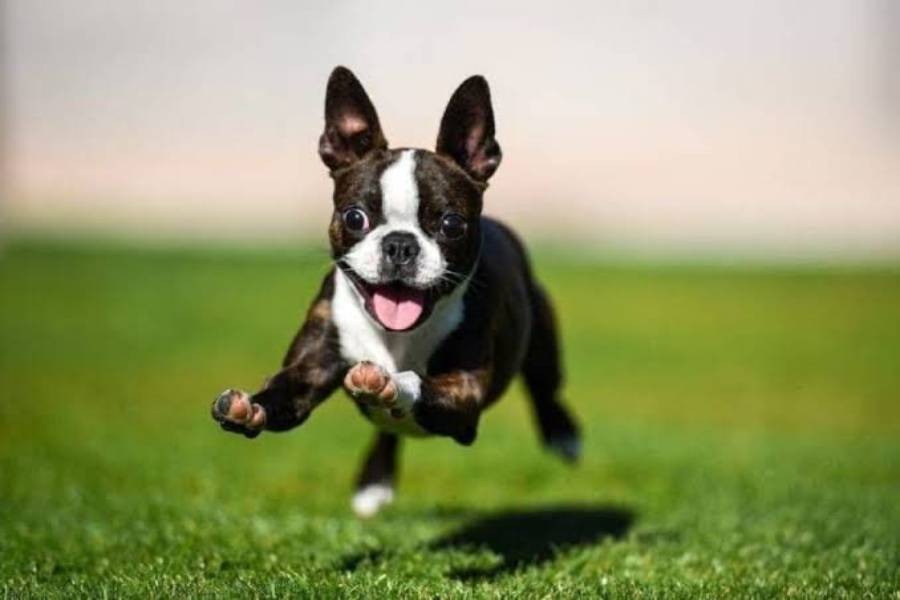
You can stop a Boston Terrier from jumping by removing the attention that rewards jumping and consistently rewarding calm behaviors, such as keeping all four paws on the floor or sitting during greetings. The goal is not simply to prevent the jump. Your Boston Terrier needs to learn which behavior earns attention, treats, play, and access to people instead.
Boston Terriers may jump when greeting their owners, meeting visitors, asking for attention, or becoming excited during play. Jumping can persist when it produces a rewarding response. Talking to your dog, touching it, or pushing it away may still provide attention, so the behavior can continue even when you intend to discourage it.
Effective training therefore requires a consistent response from everyone who interacts with your dog. You will need to stop rewarding the jump, reinforce the desired alternative at the correct moment, and gradually practice that behavior around more exciting people and situations. This guide explains why Boston Terriers jump, how to respond when jumping occurs, how to train calm greetings step by step, and what to change if your Boston Terrier continues jumping despite regular training.
Why Does Your Boston Terrier Keep Jumping on People?
A Boston Terrier keeps jumping on people mainly because jumping produces a rewarding result, such as attention, physical contact, play, or access to the person. Excitement can trigger the behavior, but reinforcement is what can turn repeated jumping into an established habit. If jumping reliably gets a response, the dog has a reason to repeat it.
Greeting situations are a common trigger. A Boston Terrier may become highly excited when an owner returns home, a visitor enters the house, or someone approaches during a walk. The dog wants interaction and tries to reach the person’s hands or face. If the person responds by talking, touching, petting, or playing with the dog, jumping has successfully produced social interaction.
Negative reactions can also provide attention. Pushing a Boston Terrier away, repeatedly saying “no,” making eye contact, or grabbing its front paws still creates interaction immediately after the jump. From the dog’s perspective, jumping caused the person to respond. This is why simply reacting more strongly to jumping does not necessarily teach the dog to keep its paws on the floor.
Young Boston Terriers may also jump because they have not yet learned an appropriate greeting behavior. A puppy does not automatically know that people expect four paws on the floor during greetings. Training becomes clearer when the owner teaches an alternative behavior rather than relying only on stopping the unwanted one. For example, sitting before receiving attention gives the dog a specific action it can repeat whenever it wants to greet someone.
Consistency determines whether this new behavior becomes reliable. Jumping can persist when one family member ignores it while another pets the dog or when visitors reward jumping because they find it friendly. The Boston Terrier receives conflicting information about which behavior works. Everyone who regularly interacts with the dog should therefore follow the same greeting rules.
How Do You Stop a Boston Terrier From Jumping?
Stop a Boston Terrier from jumping by making jumping unrewarding and immediately rewarding an appropriate alternative, such as standing with four paws on the floor or sitting. Repeat this response during every greeting so the dog learns a predictable rule: jumping does not produce attention, while calm behavior does.
The training process has 3 essential parts. First, prevent jumping from producing the reward your Boston Terrier wants. Second, identify one clear replacement behavior. Third, deliver the reward immediately when the dog performs that behavior. Repetition creates a direct association between calm greetings and desirable consequences.
What Should You Do When Your Boston Terrier Jumps?
Remove attention when your Boston Terrier jumps, then restore attention as soon as all four paws return to the floor. Keep the response calm and consistent rather than turning the situation into another exciting interaction.
For example, your Boston Terrier approaches and jumps while you are greeting it. Avoid rewarding the jump with petting or enthusiastic interaction. When the dog returns its front paws to the floor, mark that correct behavior with calm praise and provide attention or another planned reward. The timing matters because the consequence needs to correspond with the behavior you want repeated.
If the dog immediately jumps again, remove the reward again. This creates a simple pattern: jump and interaction stops; remain on the floor and interaction continues. The dog receives information from the consequence of its behavior rather than from repeated verbal correction.
Avoid creating an accidental sequence in which jumping becomes the first step toward earning a treat. If the pattern repeatedly becomes jump → owner gives a command → dog sits → treat, the Boston Terrier may learn to start the sequence by jumping. Practice the replacement behavior separately and reward calm greetings that occur without an initial jump.
How Do You Reward Your Boston Terrier for Keeping Four Paws on the Floor?
Reward your Boston Terrier while all four paws are still on the floor so the reward is clearly associated with the desired greeting behavior. Rewards can include treats, petting, praise, play, or permission to approach someone, depending on what motivates the dog in that situation.
Reward timing should be immediate. If your Boston Terrier approaches a person without jumping, reinforce that choice before excitement escalates. Waiting until the dog has already jumped several times makes it harder to communicate which behavior earned the reward.
Sitting can also serve as a replacement behavior because it is physically incompatible with jumping at the same moment. Ask for a sit during controlled training sessions, reward it promptly, and gradually practice around increasingly exciting greetings. Over time, the goal is for the Boston Terrier to offer the calm behavior without needing repeated commands.
The reward should also match the context. Food can be useful when teaching a new behavior because it can be delivered quickly and precisely. During everyday greetings, access to the person can become the reward: four paws remain on the floor and the person pets the dog; jumping starts and the interaction stops. This makes the same behavioral rule applicable even when treats are not available.
How Do You Train a Boston Terrier Not to Jump Step by Step?
Train a Boston Terrier not to jump by teaching calm greetings in a low-distraction environment first, then gradually practicing around movement, different people, and real visitors. A practical training sequence has 5 steps: establish the replacement behavior, practice approaches, introduce another person, increase distractions, and reinforce the behavior in everyday situations.
Start by choosing one replacement behavior. Keeping four paws on the floor is the simplest option because the dog can still approach and interact naturally. Sitting provides a more structured greeting and can be useful for a Boston Terrier that becomes highly excited when people approach. Whichever behavior you choose, use the same standard consistently instead of changing the requirement from one greeting to another.
Next, practice when your Boston Terrier is relatively calm. Approach the dog and provide attention while its paws remain on the floor. Stop approaching or remove attention if it jumps. Resume the interaction when the dog returns to the desired position. This teaches the dog that its own behavior controls whether the greeting continues.
Add movement once your Boston Terrier succeeds during calm practice. Walk toward the dog, step away and return, enter through a doorway, or recreate other situations that normally trigger jumping. Increase difficulty gradually. If the dog repeatedly jumps at a particular level, reduce the excitement or distance rather than repeating the same unsuccessful interaction.
Introduce another person after your Boston Terrier can greet you more reliably. Explain the training rule before the person approaches: attention is available while the dog remains on the floor or sits, and attention stops when jumping begins. Starting with one cooperative person makes the consequence predictable and prevents mixed responses.
Finally, practice the same behavior in everyday situations. Training should eventually include family members, familiar visitors, unfamiliar visitors, and other appropriate greeting situations. A Boston Terrier that sits successfully in the living room has learned the behavior in that environment but may not automatically perform it when an exciting guest enters. Practicing across different situations teaches the dog that the same greeting rule applies regardless of who arrives.
How Do You Stop a Boston Terrier From Jumping on You?
Stop your Boston Terrier from jumping on you by withholding the attention it is seeking during the jump and consistently giving that attention when it offers the desired greeting behavior. This rule should apply when you return home, initiate play, prepare food, or interact with a dog that is demanding attention.
Coming home is an important training opportunity because owner arrivals can produce intense excitement. Keep the greeting controlled rather than immediately encouraging energetic interaction. Give your Boston Terrier attention when its paws remain on the floor or when it performs the replacement behavior you have taught. Remove that attention if jumping begins.
Apply the same rule when your Boston Terrier jumps to initiate play. Starting a game immediately after the dog jumps can reinforce the behavior because jumping has successfully produced access to play. Instead, begin the game after the dog is calm or performs the expected behavior. Play itself then becomes the reward.
Food-related situations require the same consistency. If your Boston Terrier jumps while you prepare its meal, avoid allowing jumping to become the behavior that moves the process forward. Ask for the established calm behavior before putting the food down. The dog learns that self-control, rather than jumping, provides access to the resource it wants.
Daily attention should follow the same pattern. A Boston Terrier that jumps onto its owner for petting can learn that four paws on the floor produces faster and more reliable attention. The important distinction is not whether the reward is food, petting, play, or access to something desirable. The reward should consistently follow the behavior you want the dog to repeat.
How Do You Stop a Boston Terrier From Jumping on Guests?
Stop a Boston Terrier from jumping on guests by controlling the greeting, preventing jumping from earning attention, and allowing interaction only when the dog keeps four paws on the floor or performs its trained replacement behavior. Guests need to follow the same rules as household members because inconsistent responses can keep the jumping behavior rewarding.
Prepare your Boston Terrier before the guest enters rather than waiting until the dog is already highly excited. Have treats available if you use food rewards, position the dog at a manageable distance from the entrance, and ask for a familiar calm behavior. The objective is to create a situation in which the dog can make the correct choice and receive reinforcement for it.
Tell the guest how to respond before the greeting begins. The guest should provide attention when your Boston Terrier remains on the floor or sits as trained. If the dog jumps, attention should stop. Once the dog returns to the desired position, the greeting can resume. This makes access to the visitor a direct reward for calm behavior.
Distance can make the exercise easier when your Boston Terrier becomes too excited to respond. Start farther from the guest and reward calm behavior before gradually decreasing the distance. Moving closer becomes another reward. If jumping starts repeatedly, increase the distance again and return to a difficulty level at which the dog can succeed.
Practice with cooperative people before expecting reliable behavior with every visitor. A family member or familiar friend can enter several times during a controlled training session, allowing your Boston Terrier to practice the same greeting sequence repeatedly. Real visitors are less predictable, so rehearsing the behavior first gives the dog a clearer pattern to follow.
Do not expect guests to do all of the training. The owner should manage the environment and explain the greeting rules. A visitor who enthusiastically pets the dog while it jumps can reinforce the exact behavior you are trying to eliminate, even if your Boston Terrier behaves correctly during training sessions with you.
Should You Use a Leash to Stop a Boston Terrier From Jumping?
A leash can help stop a Boston Terrier from reaching people while jumping, but it should be used as a management tool rather than as the primary method for teaching calm greetings. The leash controls access to the trigger while reinforcement teaches the dog which behavior should replace jumping.
During visitor training, a leash allows you to maintain enough distance for your Boston Terrier to remain responsive. For example, you can begin several feet from a guest, reward four paws on the floor, and gradually allow the dog to move closer while it stays calm. If excitement increases and jumping begins, create more distance and try again at an easier level.
Avoid relying on leash corrections to communicate the desired behavior. Physically preventing a jump can stop the movement at that moment, but prevention alone does not explain what the dog should do instead. Pair leash management with a clear replacement behavior such as standing calmly or sitting.
The leash is especially useful while a Boston Terrier is still learning because it prevents repeated practice of the unwanted behavior. Every successful jump onto a willing visitor creates another opportunity for jumping to be rewarded with attention. Managing access reduces those opportunities while the desired greeting pattern becomes stronger.
Reduce your dependence on the leash as your Boston Terrier becomes more reliable. Practice first in controlled situations and then gradually test the behavior under greater distractions. The long-term goal is not a dog that avoids jumping only because a leash prevents it. The goal is a Boston Terrier that chooses an appropriate greeting because calm behavior has become the more consistently rewarded option.
What Should You Avoid When Your Boston Terrier Jumps?
Avoid rewarding jumping with attention, using physical reactions that increase interaction, responding inconsistently, or relying on punishment instead of teaching an alternative behavior. These responses can make training less clear because they either reinforce the jump or fail to show your Boston Terrier what to do instead.
Do not automatically push your Boston Terrier down when it jumps. Although pushing may remove the dog temporarily, it also creates physical interaction. A dog seeking attention may find touching, movement, and verbal reactions rewarding enough to repeat the behavior. Removing attention and rewarding four paws on the floor provides a clearer consequence.
Avoid giving attention immediately after a jump unless your Boston Terrier has first returned to the desired behavior. Petting, talking, making eye contact, or beginning a game can become rewards when they consistently follow jumping. Instead, deliver attention while the dog is standing calmly or sitting so the timing identifies the behavior that earns interaction.
Do not allow different people to use contradictory greeting rules. Training becomes difficult when one person ignores jumping, another pushes the dog away, and another allows the dog to jump up for petting. Your Boston Terrier is receiving 3 different consequences for the same action. Establish one household rule and ask regular visitors to follow it whenever practical.
Avoid depending on punishment to solve the problem. Punishment may interrupt jumping without establishing a reliable replacement behavior. A clearer training strategy teaches the Boston Terrier exactly what produces the desired outcome: four paws on the floor earns attention, sitting allows a greeting to continue, and jumping temporarily removes access to the reward.
Do not increase training difficulty too quickly. A Boston Terrier that can greet its owner calmly in a quiet room may still jump when several visitors arrive at the door. This does not necessarily mean the dog has failed to learn the behavior. It means the distraction level has changed. Reduce the difficulty, reinforce successful responses, and increase the challenge gradually.
How Much Exercise Does a Boston Terrier Need to Reduce Overexcitement?
Regular physical activity and mental stimulation can make an excitable Boston Terrier easier to train, but exercise alone will not teach the dog to stop jumping. Exercise manages energy and arousal, while behavioral training establishes the greeting behavior you want the dog to perform.
The appropriate amount of activity depends on factors such as age, health, physical condition, and environmental temperature. Instead of using exercise as a way to exhaust the dog before every greeting, build a consistent routine that combines suitable physical activity with mental engagement. Walks, controlled play, scent-based activities, and short training sessions can all provide structured outlets.
Mental stimulation is particularly useful because jumping is not simply a matter of unused physical energy. A Boston Terrier also needs opportunities to practice attention and impulse control. Short sessions involving sit, stay, waiting at doors, or responding to cues around mild distractions can reinforce the same self-control required during greetings.
Exercise should take place under conditions appropriate for the individual dog. Boston Terriers are brachycephalic dogs, meaning they have shortened skulls and muzzles. This physical structure can make strenuous activity and hot conditions more challenging for some dogs. Exercise intensity should therefore be adjusted to the dog’s condition rather than increased simply because jumping continues.
Most importantly, do not treat a tired dog as a trained dog. A Boston Terrier may jump less immediately after activity because its arousal or energy level is lower, but the behavior can return when the dog is rested and excited again. Lasting improvement comes from combining appropriate activity with repeated practice of calm greetings and consistent reinforcement.
How Long Does It Take to Train a Boston Terrier to Stop Jumping?
There is no fixed number of days required to train every Boston Terrier to stop jumping because progress depends on the dog’s learning history, training frequency, household consistency, and level of distraction. A dog that has received attention for jumping for months has a different training history from a puppy that is learning greeting manners for the first time.
Consistency is one of the main factors affecting progress. A Boston Terrier receives a clear behavioral pattern when every household member rewards four paws on the floor and removes attention when jumping occurs. Progress can be slower when jumping occasionally succeeds because the dog still has a reason to try the behavior.
Training frequency also matters. Several short opportunities to practice calm greetings throughout normal daily interactions can provide more useful repetition than relying on occasional formal sessions. Entering a room, returning home, beginning play, and greeting a familiar person can all become opportunities to reinforce the same rule.
Measure progress by behavior rather than by expecting jumping to disappear on a specific date. Useful signs include fewer jumps during familiar greetings, faster recovery after becoming excited, more spontaneous sits, and the ability to keep four paws on the floor around increasingly distracting people. These changes show that the replacement behavior is becoming more reliable.
Expect performance to vary as the environment changes. Your Boston Terrier may greet family members calmly but still jump when an unfamiliar visitor arrives. Training is not complete simply because the behavior works in one room with one person. Continue practicing until the dog can apply the greeting behavior across the situations it encounters regularly.
Read more: How to Leash Train a Boston Terrier: 7 Easy Steps
What Should You Do If Your Boston Terrier Still Will Not Stop Jumping?
Review the consequences of the jumping behavior first if your Boston Terrier continues to jump despite regular training. Persistent jumping often means the behavior is still being rewarded somewhere, the training situation is too difficult, or the replacement behavior is not yet reliable enough under distraction.
Reduce the difficulty when your Boston Terrier repeatedly fails during a particular situation. For example, a dog that can sit when one familiar person approaches may become too excited when several guests enter simultaneously. Increase the distance, reduce the number of distractions, or return to practice with one person before attempting the more difficult greeting again.
Check whether your Boston Terrier clearly understands the replacement behavior outside greeting situations. A sit that works only when you are holding a treat may not be reliable enough to use when an exciting visitor arrives. Practice the behavior in several locations and around gradually increasing distractions before expecting it to compete with a highly rewarding social interaction.
Also examine whether jumping is being prevented only through management. Leashes, gates, and distance can reduce opportunities to jump, but the dog still needs opportunities to practice the desired behavior successfully. Management prevents rehearsal of the problem; reinforcement training builds the behavior that eventually replaces it.
Is Someone Still Rewarding Your Boston Terrier for Jumping?
Jumping can continue when even one person regularly rewards it with petting, talking, play, or access to social interaction. Review how family members, friends, and frequent visitors respond rather than evaluating only your own training sessions.
For example, your Boston Terrier may receive no attention for jumping on you but receive enthusiastic petting whenever it jumps on another family member. The dog then learns that jumping works with certain people. This can make the behavior appear inconsistent even though the consequence is predictable from the dog’s perspective.
Create one greeting rule for the household. Decide whether the required behavior is four paws on the floor or sitting, and make attention contingent on that behavior. The simpler and more consistent the rule is, the easier it becomes for both the dog and the people interacting with it to follow.
When Should You Work With a Professional Dog Trainer?
Consider working with a qualified professional trainer when jumping remains difficult to manage despite consistent training or when the behavior occurs alongside other concerning behaviors. Direct observation can help identify reinforcement patterns, environmental triggers, and handling problems that are difficult to recognize during everyday interactions.
Professional guidance is especially useful when the Boston Terrier’s size, intensity, or behavior makes greetings difficult to control safely. A trainer can observe the dog in context and develop a training setup that matches its current ability rather than repeatedly exposing it to situations in which it cannot succeed.
Jumping accompanied by behaviors such as growling, snapping, guarding, intense fear, or other signs of distress should not be treated as a simple greeting problem without further assessment. These behaviors can involve a different underlying issue and require an approach based on the dog’s complete behavioral context.
Choose a professional who uses clear, structured training methods and can explain both the behavior being reinforced and the replacement behavior being taught. The objective remains the same: identify what maintains the unwanted behavior and establish a safer, repeatable behavior that earns the outcomes your Boston Terrier values.
What Other Boston Terrier Behaviors Can You Train With the Same Method?
The same reinforcement-based method used to stop jumping can help teach alternative behaviors for attention barking, rushing toward doors, overexcited greetings, and other unwanted behaviors maintained by attention or access to something the dog wants. The principle is to identify what the Boston Terrier gains from the behavior, prevent the unwanted behavior from consistently producing that outcome, and reinforce a specific alternative instead.
Attention barking is one example. If a Boston Terrier barks and immediately receives petting, play, or conversation, barking can become an effective way to initiate interaction. Teaching a quiet alternative, such as sitting near the owner, gives the dog another way to request attention. Rewarding the alternative consistently makes the expected behavior clearer than repeatedly telling the dog to stop barking.
Door rushing can be approached in a similar way. Instead of allowing forward movement to open access to the doorway, teach the Boston Terrier to wait in a designated position. Opening the door then becomes conditional on calm behavior. If the dog rushes forward, access pauses; if it waits, the door opens. The environment itself provides a meaningful reward for impulse control.
Overexcited greetings can also improve through the skills developed during jumping training. Waiting, sitting, keeping four paws on the floor, and remaining responsive around people all require the Boston Terrier to control its immediate response to excitement. Practicing these behaviors in gradually more distracting situations helps make calm interaction more reliable outside formal training sessions.
The important principle is to teach what the dog should do rather than focusing exclusively on what it should stop doing. A clear replacement behavior gives the Boston Terrier an action that can be reinforced repeatedly. When owners apply the same rules consistently across greetings, attention, play, and access to desired resources, impulse-control training becomes part of everyday interaction rather than a skill practiced only during dedicated sessions.