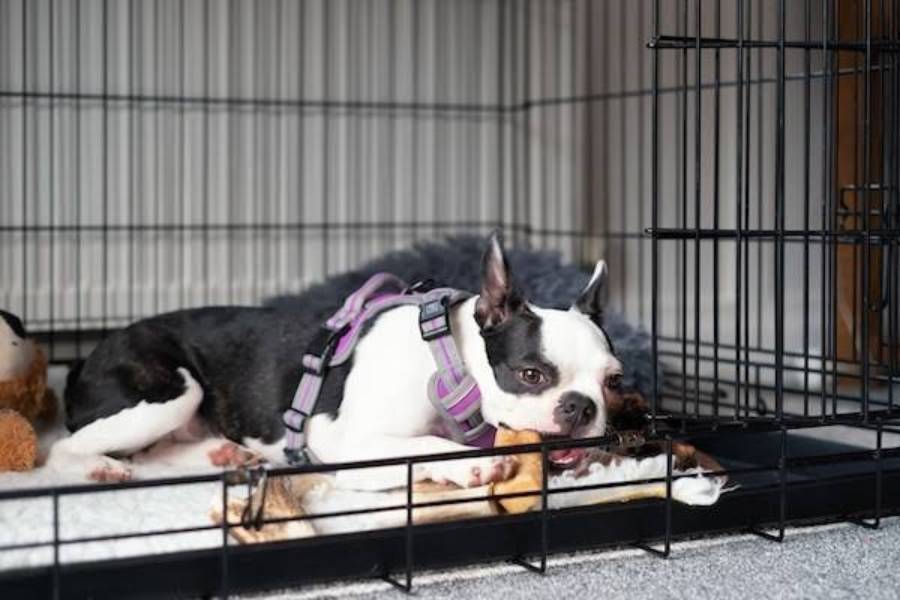
Crate training a Boston Terrier starts with creating a positive association with the crate and gradually teaching your dog to stay inside with the door closed. Begin by choosing a crate that gives your Boston Terrier enough room to stand, turn around, and lie down comfortably. Place it in an area where your dog can remain close to the household, then use treats, meals, toys, and praise to encourage voluntary entry.
Once your Boston Terrier enters the crate comfortably, close the door for a few seconds and reward calm behavior. Increase the time gradually before adding another challenge, such as moving farther away, leaving the room, or taking a short trip outside the home. Progressing one step at a time helps prevent the crate from becoming associated with isolation or punishment.
Crate training can also support nighttime routines and potty training because it gives your Boston Terrier a predictable place to rest between bathroom trips, play, exercise, and supervised time. However, crying, barking, crate accidents, or persistent attempts to escape can indicate that the training is progressing too quickly or that another need has not been met. This guide explains how to crate train a Boston Terrier step by step, including nighttime training, crate duration, potty training, common mistakes, and problems that can occur during the process.
How Do You Crate Train a Boston Terrier Step by Step?
Crate train a Boston Terrier by introducing the crate gradually, rewarding voluntary entry, closing the door for short periods, and increasing both duration and distance only after your dog remains calm. The process should move from easy interactions with an open crate to short periods alone rather than immediately confining the dog for extended periods.
Consistency is important throughout the process. Use the same crate cue, reward calm behavior, and schedule short training sessions throughout the day. The crate should function as a predictable resting area rather than a place your Boston Terrier enters only when you leave the house. Using the crate as punishment can create a negative association that makes voluntary entry and calm confinement more difficult.
Progress should be based on behavior rather than a fixed training schedule. Move to the next stage when your Boston Terrier willingly enters the crate and remains relaxed at the current stage. If your dog begins barking continuously, scratching at the door, refusing to enter, or showing persistent distress, reduce the difficulty and return to a stage where the dog can remain calm.
How Do You Choose and Set Up the Right Crate for a Boston Terrier?
Choose a crate large enough for your Boston Terrier to stand upright, turn around, and lie down comfortably. A crate should provide enough space for normal resting positions without being unnecessarily oversized, particularly when it is also being used as part of house training.
A crate with a divider is useful for a growing Boston Terrier puppy because the usable space can be increased as the puppy grows. This avoids buying several crates while allowing the interior to remain appropriately sized during different growth stages. Wire crates also provide airflow and visibility, while enclosed plastic crates provide a more sheltered environment. The appropriate option depends on the dog and how the crate will be used.
Place the crate in a comfortable area where your Boston Terrier can remain connected to normal household activity. Avoid locations exposed to direct sunlight, excessive heat, cold drafts, or constant disturbance. Boston Terriers are brachycephalic dogs, so preventing overheating and maintaining adequate ventilation are especially important when selecting and positioning an enclosed resting space.
Keep the initial setup simple. Comfortable bedding can make the crate inviting for a dog that does not chew or destroy fabric, while an appropriate crate-safe toy can provide enrichment. Remove collars, harnesses, or other equipment that could become caught on parts of the crate when the dog is left unattended.
How Do You Introduce Your Boston Terrier to the Crate?
Introduce your Boston Terrier to the crate with the door open and allow the dog to enter voluntarily. Start by placing treats near the entrance, then progressively place them farther inside. Reward approaching, investigating, and entering the crate instead of physically pushing or pulling the dog into it.
Once your Boston Terrier willingly enters, begin creating positive experiences inside the crate. Give treats, an appropriate toy, or regular meals there while keeping the door open at first. Feeding inside the crate is particularly useful because repeated positive experiences can make entering the space part of the dog’s normal routine.
Add a consistent verbal cue after your Boston Terrier begins entering willingly. Say a short cue such as “crate” immediately before encouraging the dog inside, then reward the completed behavior. The cue should predict the action rather than be repeated while the dog is confused or reluctant.
Do not rush to close the door simply because your Boston Terrier has entered once or twice. The first objective is voluntary entry and comfort inside the crate. Repeating several successful, low-pressure sessions establishes a stronger foundation for confinement than immediately testing how long the dog will tolerate a closed door.
How Do You Start Closing the Crate Door?
Start closing the crate door only after your Boston Terrier can enter voluntarily and remain comfortable inside. Close the door for a few seconds while staying next to the crate, reward calm behavior, and open it again before the dog becomes anxious or frustrated.
Increase the duration gradually across successful sessions. For example, progress from a few seconds to slightly longer intervals instead of making a sudden jump from a short exercise to several minutes of confinement. The purpose is to teach your Boston Terrier that a closed door is temporary and does not predict punishment or prolonged isolation.
Reward calm behavior rather than excitement at the moment of release. When possible, wait for a calm moment before opening the door so barking, pawing, or jumping does not consistently become the behavior that ends the session. However, persistent distress should not be treated as a simple obedience problem. Repeated distress indicates that the exercise may need to become easier or that another need should be addressed.
Change one major difficulty at a time. If you are increasing how long the door remains closed, stay nearby. Once your Boston Terrier handles that duration comfortably, begin changing your distance from the crate. Separating duration and distance makes it easier to identify which part of the exercise is causing difficulty.
How Do You Train Your Boston Terrier to Stay in the Crate When You Leave?
Teach your Boston Terrier to remain in the crate alone by increasing your distance gradually before practicing actual departures from home. Begin by sitting beside the crate, then stand farther away, walk around the room, briefly leave the room, and return while the dog is still calm.
Keep the first absences short. Leaving the room for a few seconds and returning calmly gives your Boston Terrier repeated opportunities to learn that your departure is temporary. Increase the duration only after the dog can handle the previous interval without persistent barking, escape attempts, or other signs of distress.
After your Boston Terrier can remain relaxed while you move around the home, practice normal departure cues. Pick up your keys, put on your shoes, walk out briefly, and return without turning departures or arrivals into highly stimulating events. These exercises connect crate training with the routine the dog will experience when you genuinely need to leave.
Exercise, toilet needs, and timing also affect success. Give your Boston Terrier an opportunity to eliminate before a planned crate period and provide appropriate physical activity and interaction during the day. A crate can provide a structured resting space, but it should not replace exercise, social contact, mental stimulation, or regular bathroom opportunities.
How Should You Crate Train a Boston Terrier Puppy at Night?
Crate train a Boston Terrier puppy at night by placing the crate near you initially, establishing a consistent bedtime routine, providing a final potty break, and keeping nighttime interactions brief and calm. The objective is to teach the puppy that nighttime crate time means resting while still providing bathroom breaks when necessary.
Place the crate close enough to your sleeping area that you can hear the puppy during the early stages of training. A young puppy may vocalize because it needs to eliminate rather than because it wants attention. Keeping the crate nearby makes it easier to respond to legitimate bathroom needs without giving the puppy unrestricted access to the house overnight. Once the puppy consistently sleeps comfortably, the crate can be moved gradually if you want its permanent location elsewhere.
Create the same sequence before bed each night. Give your Boston Terrier appropriate activity earlier in the evening, allow time to settle down, and take the puppy outside for a final potty trip immediately before placing it in the crate. Keep the period before sleep calm rather than using intense play to tire the puppy out at the last minute. A predictable routine helps the puppy associate the sequence of potty trip, crate entry, and reduced household activity with sleep.
Keep nighttime potty trips functional rather than entertaining. Take the puppy directly to its designated bathroom area, give it an opportunity to eliminate, and return it to the crate afterward. Avoid turning the trip into playtime, feeding, or prolonged attention because these activities can encourage the puppy to treat waking during the night as an opportunity for interaction.
Expect nighttime routines to change as the puppy develops. A young Boston Terrier may need more frequent bathroom opportunities than an adult dog because bladder control is still developing. Instead of expecting the puppy to remain crated for an arbitrary number of hours, adjust the schedule according to age, established elimination patterns, and whether the puppy is consistently remaining clean and comfortable overnight.
What Should You Do If Your Boston Terrier Cries in the Crate?
Identify why your Boston Terrier is crying before deciding whether to wait, provide a potty break, or change the training session. Crate crying can result from a bathroom need, frustration, insufficient crate conditioning, physical discomfort, attention-seeking behavior, or genuine distress. Treating every type of crying in the same way can either reinforce unwanted vocalization or leave an important need unresolved.
First consider the circumstances surrounding the crying. A puppy that wakes after sleeping for a period may need to eliminate. A Boston Terrier that starts vocalizing immediately after the training difficulty has been increased may not yet be ready for that duration or distance. A dog that has already eliminated, exercised, and demonstrated comfort at the current training level may instead be testing whether vocalization causes the crate door to open.
Use the dog’s overall behavior as additional information rather than focusing only on sound. Brief whining that settles as the dog relaxes differs from persistent vocalization accompanied by frantic scratching, repeated escape attempts, heavy panting unrelated to heat, or an inability to settle. The second pattern indicates that simply extending the session is unlikely to teach calm crate behavior.
Adjust the training difficulty when crying repeatedly appears at the same stage. For example, if your Boston Terrier remains calm for two minutes but consistently becomes distressed after a substantially longer interval, return to a duration the dog can complete successfully and increase it in smaller increments. Successful repetition builds the behavior you want more effectively than repeatedly pushing the dog beyond its current tolerance.
Should You Ignore a Boston Terrier Crying in the Crate?
Do not automatically ignore all crate crying, because the correct response depends on why your Boston Terrier is vocalizing. Check predictable needs such as toileting, temperature, physical comfort, and whether the current crate session represents a sudden increase in difficulty. Puppies in particular may vocalize at night because they genuinely need a bathroom break.
Avoid immediately opening the crate every time your Boston Terrier makes a brief attention-seeking sound when its needs have already been met. If barking or whining consistently causes immediate release, the dog can learn that vocalization is an effective way to open the door. When the dog is comfortable and not distressed, wait for a brief calm moment before opening the crate and reinforce that calm behavior.
The response should change when vocalization is accompanied by sustained signs of distress. Frantic escape attempts, self-injurious behavior, persistent inability to settle, or an abrupt change from previously comfortable crate behavior requires more attention than ordinary protest whining. Reduce the training difficulty and determine what changed instead of repeatedly extending the confinement period.
Repeated severe reactions also warrant professional evaluation. A veterinarian can help rule out physical problems when behavior changes suddenly or is accompanied by other symptoms, while a qualified dog trainer or behavior professional can evaluate the training process and the dog’s response to confinement. The goal of crate training is a Boston Terrier that can rest calmly in the crate, not a dog that has simply stopped vocalizing while remaining distressed.
How Long Can a Boston Terrier Stay in a Crate?
How long a Boston Terrier can stay in a crate depends on age, bladder control, previous crate training, health, and whether the dog is crated during the day or sleeping overnight. A puppy requires more frequent bathroom breaks and supervision than a healthy adult dog, so one maximum crate duration should not be applied to every Boston Terrier.
Crate duration should also be separated from physical bladder capacity. An adult Boston Terrier may be physically capable of waiting several hours to eliminate, but that does not mean spending the same amount of time confined in a crate should become the dog’s daily routine. Boston Terriers still need opportunities to walk, exercise, interact with people, explore their environment, eliminate, and receive mental stimulation throughout the day.
Watch the dog’s behavior and elimination pattern when determining whether the current schedule is appropriate. Repeated crate accidents, restlessness near the end of each session, reluctance to enter the crate, or consistently urgent elimination immediately after release can indicate that the intervals are too long. Shortening the interval and providing more frequent potty opportunities is more productive than expecting the dog to adapt to an unsuitable schedule.
Long crate periods should not compensate for an owner’s schedule. If your Boston Terrier regularly needs to remain alone longer than its established crate routine allows, arrange an appropriate break through a household member, pet sitter, or dog walker. The crate is a management and training tool, not a replacement for the dog’s daily physical, social, and toileting needs.
How Long Can a Boston Terrier Puppy Stay in a Crate?
A Boston Terrier puppy should stay in a crate for shorter periods than an adult because bladder control and familiarity with confinement are still developing. Younger puppies generally need more frequent opportunities to eliminate, particularly after waking, eating, drinking, playing, and spending time in the crate.
Age-based rules can provide a rough planning framework, but they should not be treated as an exact timer for every puppy. Development, water intake, activity, sleep, health, and individual elimination patterns affect how frequently a Boston Terrier puppy needs to go outside. A schedule that works for one puppy may result in repeated accidents for another of the same age.
Daytime and nighttime crate periods also function differently. A sleeping puppy may remain settled for longer than an awake puppy during the day, but young puppies can still require nighttime potty trips. Monitor when your puppy naturally eliminates and build the crate schedule around that pattern instead of deliberately making the puppy hold its bladder for progressively longer periods.
Frequent accidents indicate that the routine needs adjustment. Shorten the interval between potty trips, confirm that the crate is appropriately sized, and take the puppy outside at predictable high-probability times. Consult a veterinarian when a previously house-trained puppy suddenly begins having frequent accidents or when elimination changes occur alongside other physical symptoms.
How Does Crate Training Help Potty Train a Boston Terrier?
Crate training can support potty training by creating a predictable cycle of resting, supervised activity, and outdoor bathroom opportunities. The crate does not teach a Boston Terrier where to eliminate by itself. Its value comes from helping the owner manage when the puppy is resting and when it should be taken directly to an appropriate potty area.
Build the routine around predictable transitions. Take your Boston Terrier puppy outside after waking, after leaving the crate, after meals, after drinking a substantial amount, after active play, and before bedtime. Puppies should also receive additional potty opportunities according to their individual elimination pattern. These repeated trips increase the chance that elimination occurs in the correct location where it can immediately be reinforced.
Take the puppy directly to the designated potty area after opening the crate rather than allowing unsupervised exploration of the house first. Give the puppy time to eliminate and reward successful toileting immediately afterward. The sequence of crate, outdoor potty area, elimination, and reward creates a clearer behavioral pattern than correcting accidents after they have already happened.
Supervision remains important when the puppy is outside the crate. Watch for behaviors associated with an upcoming bathroom need, such as suddenly stopping play, sniffing the floor repeatedly, circling, or moving toward a previously used elimination area. Take the puppy outside when these signals appear rather than waiting for an accident.
Do not punish a Boston Terrier for an accident in the crate or house. Punishment after elimination does not teach the puppy the correct bathroom location and can make elimination around the owner stressful. Clean the area thoroughly and determine what part of the management routine failed, such as an interval that was too long, a missed post-meal trip, insufficient supervision, or a crate that provides substantially more space than the puppy needs.
Repeated crate accidents require more than additional cleaning. Review crate size, potty frequency, feeding and drinking patterns, and the timing of previous accidents to identify a pattern. A crate divider can reduce unnecessary space for a growing puppy, while more frequent outdoor trips can address a schedule that exceeds the puppy’s current bladder control.
A sudden or persistent change in elimination can also have a physical cause rather than a training cause. Seek veterinary guidance when a Boston Terrier that was previously progressing well begins having unexplained frequent accidents, strains to urinate or defecate, shows unusual changes in thirst or urination, or displays other signs of illness. Crate training should organize potty training, but it should not be used to force a dog to suppress an unresolved elimination need.
How Long Does It Take to Crate Train a Boston Terrier?
There is no fixed number of days required to crate train every Boston Terrier because progress depends on age, previous crate experience, training consistency, and the dog’s response to confinement. A Boston Terrier that already feels comfortable in enclosed resting spaces may progress faster than a puppy experiencing a crate for the first time or a dog with a previous negative association with confinement.
Measure progress through behavior rather than the calendar. The first milestone is voluntary entry into the crate. The next milestones are remaining relaxed with the door closed, staying calm while the owner moves farther away, tolerating brief periods alone, and eventually resting or sleeping comfortably during normal crate periods. Each milestone demonstrates a specific skill that should be established before substantially increasing difficulty.
Training frequency also affects progress. Several short, successful sessions provide repeated opportunities to reinforce calm crate behavior without requiring the dog to tolerate a difficult session for an extended period. Consistency matters across household members as well. Using the same crate cue, reward pattern, release routine, and expectations makes the behavior easier for a Boston Terrier to predict.
Progress does not always occur at the same rate. A Boston Terrier may handle a closed crate comfortably while the owner is nearby but begin vocalizing as soon as the owner leaves the room. In that situation, the problem is distance or absence rather than the crate itself. Reduce that specific difficulty instead of restarting every part of the training process.
Consider crate training successful when your Boston Terrier can enter willingly, settle with the door closed, and remain relaxed for an appropriate period without persistent attempts to escape. The objective is not to reach the longest possible confinement time. It is to establish the crate as a safe and predictable resting space that can be used when appropriate.
Read more: How to Potty Train a Boston Terrier: Step-by-Step Guide
What Are the Most Common Boston Terrier Crate Training Mistakes?
The most common crate training mistakes involve creating negative associations, progressing faster than the dog can handle, reinforcing unwanted behavior, or using the crate for excessive confinement. Correcting these mistakes early makes it easier for a Boston Terrier to develop calm and predictable crate behavior.
There are 9 key mistakes to avoid when crate training a Boston Terrier.
1. Using the crate as punishment. Sending your Boston Terrier to the crate after unwanted behavior can connect the crate with isolation or correction. Use the crate for planned rest, sleep, training sessions, and appropriate management instead.
2. Forcing your Boston Terrier into the crate. Pushing or dragging a reluctant dog inside removes voluntary choice during the introduction stage and can increase resistance. Use food, toys, praise, and gradual training to encourage the dog to enter independently.
3. Closing the door too early. A Boston Terrier that has only begun investigating the crate may not be ready for confinement. Establish voluntary entry and comfort inside before making a closed door part of the exercise.
4. Increasing difficulty too quickly. Moving directly from a few seconds in the crate to a long absence changes duration, distance, and isolation at the same time. Increase one major challenge at a time so your Boston Terrier can build on successful repetitions.
5. Leaving the dog in the crate for too long. Extended confinement can interfere with bathroom opportunities, exercise, social interaction, and mental stimulation. Plan crate periods around the dog’s needs rather than using the crate to make an inconvenient schedule manageable.
6. Opening the door immediately after every bark or whine. Consistently releasing a comfortable dog as soon as it vocalizes can teach it that barking opens the door. When basic needs have been met and the dog is not distressed, reinforce a calm moment before release.
7. Ignoring genuine distress. Not every vocalization is attention-seeking behavior. Persistent escape attempts, an inability to settle, or other intense behavioral changes indicate that the session requires reassessment rather than simply more time in the crate.
8. Using an inappropriate crate setup. A poorly sized crate, uncomfortable location, excessive heat, or unsafe objects can interfere with training. The crate should allow normal resting positions and provide a safe, well-ventilated environment.
9. Training inconsistently. Changing cues, rules, release routines, or expectations from one session to another makes the process less predictable. Household members should follow the same basic routine so entering and resting in the crate consistently produces similar outcomes.
These mistakes share one underlying problem: they make the crate unpredictable or unpleasant. Effective crate training does the opposite. Your Boston Terrier should learn what happens before entering, what is expected while inside, and how calm behavior fits into the release routine.
When Should You Get Professional Help With Crate Training?
Get professional help when your Boston Terrier repeatedly shows severe distress, risks injuring itself while trying to escape, develops unexplained crate accidents, or suddenly stops tolerating a crate it previously used comfortably. These situations can involve factors that cannot be resolved simply by increasing training time.
A veterinarian is the appropriate first contact when crate behavior changes suddenly or occurs alongside physical symptoms. Repeated changes in urination, defecation, appetite, thirst, breathing, mobility, or general behavior can require medical evaluation. Training adjustments should not be used as a substitute for investigating a possible physical problem.
A qualified dog trainer or behavior professional can help when the primary problem occurs during the training process. For example, professional guidance may be useful when your Boston Terrier remains comfortable until you leave, repeatedly becomes distressed at a specific stage, refuses to approach the crate despite gradual positive introductions, or shows no meaningful improvement after the training difficulty has been reduced.
Seek help promptly when escape behavior creates an injury risk. Repeatedly allowing a distressed dog to bite, bend, scratch, or force its way through crate components does not teach calm confinement and can result in physical harm. Stop increasing the difficulty and address the cause of the response before resuming the same type of crate session.
Crate training should ultimately produce a Boston Terrier that enters willingly and can rest comfortably for an appropriate period. The crate is successful when it supports safe management, sleep, travel, or house training without replacing exercise, human interaction, bathroom breaks, and the other activities your Boston Terrier needs each day.
1 thought on “How to Crate Train a Boston Terrier: Step-by-Step Guide”