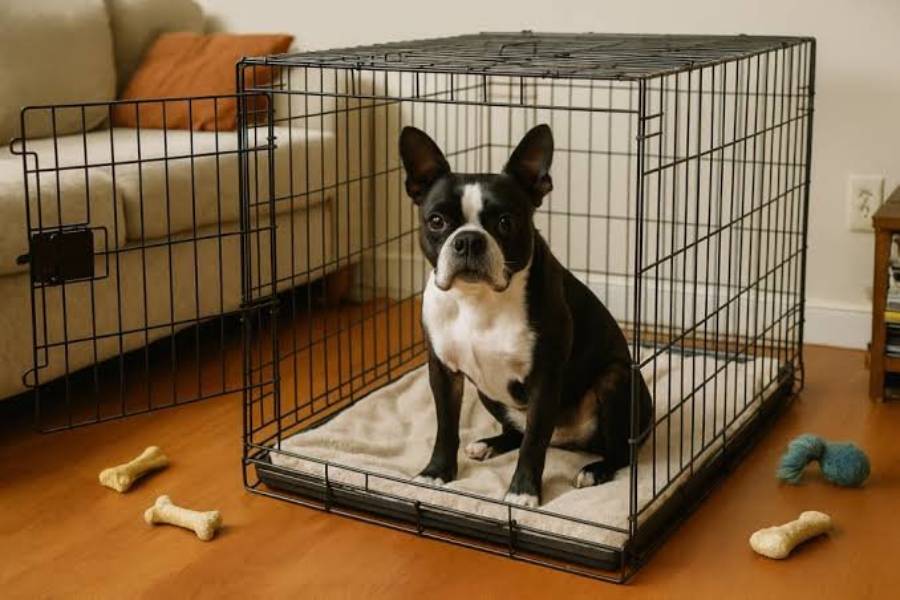
Potty training a Boston Terrier requires a consistent bathroom schedule, one designated potty spot, close supervision, and immediate positive reinforcement. Start training as soon as your Boston Terrier comes home, whether you have a young puppy or an adult dog that has not been reliably house-trained. The goal is to create a predictable routine that teaches your dog where and when to eliminate.
Take your Boston Terrier to the same potty area after waking up, eating, drinking, playing, and before bedtime. Use the same verbal cue each time, then reward successful elimination immediately with praise or a small treat. Consistency matters because repeating the same location, cue, and reward helps the dog associate a specific place and behavior with a positive outcome. Indoor supervision and appropriate crate use can also reduce opportunities for accidents while this habit develops.
This guide explains how to potty train a Boston Terrier step by step, including how often to schedule potty breaks, recognize signs that your dog needs to go outside, use crate training, handle nighttime potty trips, respond to accidents, and troubleshoot a Boston Terrier that continues peeing or pooping indoors.
How Do You Potty Train a Boston Terrier?
To potty train a Boston Terrier, establish one designated potty spot, follow a consistent bathroom schedule, supervise the dog indoors, use the same verbal cue, and reward successful elimination immediately. The training works through repetition: the Boston Terrier experiences the same location, routine, cue, and positive consequence until going potty in the correct place becomes a predictable habit.
Start by choosing one outdoor potty area that is easy to reach every time your Boston Terrier needs to eliminate. Take the dog directly to this location rather than allowing it to explore the entire yard first. Keep the dog on a leash when necessary, limit distractions, and give it enough time to sniff and eliminate. Using the same area also preserves familiar scent cues that can help the dog recognize the location as its bathroom spot.
Next, create a consistent potty schedule around events that commonly precede urination or defecation. Take your Boston Terrier outside after waking up, after meals, after drinking a substantial amount of water, after active play, after naps, and before bedtime. Young puppies require more frequent opportunities because their bladder control is still developing. A predictable schedule also makes accidents easier to troubleshoot: repeated accidents at a similar time can indicate that the next scheduled potty break needs to happen earlier.
Introduce a short verbal cue such as “go potty” when your Boston Terrier reaches the designated area and is preparing to eliminate. Use the same words each time rather than switching between several commands. Avoid repeating the cue continuously. The objective is to associate one consistent verbal signal with the elimination behavior so that the cue becomes useful during future potty trips.
Reward your Boston Terrier immediately after it finishes eliminating in the correct place. Give verbal praise and, during the early stages of training, a small high-value treat. Timing is critical. A reward delivered after the dog has returned indoors may become associated with entering the house rather than with going potty outside. Immediate reinforcement makes the relationship between the desired behavior and its consequence clearer.
Supervise your Boston Terrier closely whenever it has free access to the house. Keep the puppy in the same room, use a leash indoors when closer management is necessary, or place it in an appropriately sized crate or confined puppy-safe area when direct supervision is not possible. Indoor freedom should increase gradually after the dog demonstrates reliable potty habits. Giving unrestricted access to several rooms too early increases the number of places where an unnoticed accident can occur.
Consistency between household members is equally important. Everyone responsible for the Boston Terrier should use the same potty location, schedule, verbal cue, and reward system. For example, one person taking the puppy outside while another regularly allows it to use an indoor area creates two different rules. A single, repeatable routine makes the expected behavior easier for the dog to learn.
How Often Should You Take a Boston Terrier Puppy Outside to Potty?
Take a Boston Terrier puppy outside frequently throughout the day and always after predictable triggers such as waking, eating, drinking, playing, and sleeping. Younger puppies need more potty opportunities than older puppies because bladder and bowel control develop with age. Potty frequency should therefore be adjusted as the puppy matures rather than following one fixed interval throughout the entire training period.
Age provides a useful starting point, but it should not be treated as the only predictor of bladder control. Activity level, water intake, meal timing, sleep, excitement, and individual development can change how soon a puppy needs to eliminate. A puppy that drinks water and then spends time playing, for example, may need another potty trip sooner than a puppy of the same age that is sleeping.
Daily events provide more reliable training cues than relying only on the clock. Take your Boston Terrier outside immediately after it wakes in the morning and after naps. Schedule another opportunity after meals and active play sessions, and always provide a final potty trip shortly before bedtime. During the early training stage, taking the puppy outside more frequently is preferable to waiting for it to have an accident and then trying to correct the routine afterward.
Track when your Boston Terrier eats, drinks, eliminates, sleeps, and has accidents for several days. This simple record can reveal an individual pattern. For example, if the puppy repeatedly needs to defecate shortly after breakfast, schedule an outdoor potty opportunity before the time when those accidents normally occur. As the puppy develops better bladder control and remains consistently accident-free, increase the interval between scheduled potty trips gradually rather than making a sudden change.
How Can You Tell When a Boston Terrier Needs to Go Potty?
A Boston Terrier that needs to go potty may start sniffing the floor, circling, pacing, becoming restless, moving toward the door, or suddenly stopping an activity to search for another location. Recognizing these signals allows you to take the dog outside before an accident occurs. The signs may be subtle during early potty training, so close supervision is especially important for puppies.
Sniffing and circling are useful signals because dogs commonly investigate a location before eliminating. A Boston Terrier may repeatedly sniff one section of the floor, walk in small circles, or leave its resting area without an obvious reason. Take the dog directly to its designated potty spot when these behaviors appear instead of waiting to confirm whether it will urinate or defecate indoors.
Changes in normal activity can also indicate an immediate potty need. A Boston Terrier that suddenly stops playing, walks away from family members, becomes restless, approaches an exit, or tries to enter another room should be supervised closely. Individual dogs can develop their own signals over time. For example, one Boston Terrier may stand near the back door, while another may pace between its owner and the exit.
Respond to a potty signal by taking your Boston Terrier to the designated bathroom area immediately. Use the established potty cue and wait for the dog to eliminate. Reward successful elimination as soon as it finishes. This sequence reinforces both parts of the desired behavior: communicating or showing a potty need and eliminating in the correct location.
Learning your Boston Terrier’s individual pattern becomes easier when you combine behavioral signals with its daily schedule. A puppy that begins sniffing shortly after waking, eating, or playing has both a behavioral signal and a routine-based reason to need a potty break. Acting on these combined signals can prevent accidents more effectively than relying on a fixed schedule alone.
How Can Crate Training Help Potty Train a Boston Terrier?
Crate training can support Boston Terrier potty training by limiting unsupervised indoor freedom and helping owners create predictable periods for sleeping, supervision, and outdoor potty breaks. A crate is a management tool rather than a punishment or a substitute for regular bathroom opportunities.
The crate should provide enough room for your Boston Terrier to stand, turn around, and lie down comfortably. An unnecessarily large crate can be less useful for house training because the dog may have enough space to use one area for resting and another for elimination. For a growing Boston Terrier puppy, an adjustable crate with a divider can help maintain appropriate usable space as the puppy gets larger.
Create a predictable sequence around crate use. Take your Boston Terrier outside before placing it in the crate when appropriate, then provide another potty opportunity promptly after releasing it. For example, a puppy waking from a crate nap should normally go to the designated potty location before receiving unrestricted indoor playtime. The sequence becomes wake up → potty area → successful elimination → reward → supervised freedom.
Never use the crate to punish a Boston Terrier for an indoor accident. The dog should learn that the crate is a safe resting space, not a place it is sent after doing something undesirable. Punishment can also interfere with potty training when the dog begins associating elimination in front of its owner with a negative response rather than learning where elimination should occur.
How Long Can a Boston Terrier Stay in a Crate During Potty Training?
The appropriate crate period depends on the Boston Terrier’s age, bladder control, activity, sleep schedule, and individual potty pattern. Young puppies require more frequent bathroom opportunities and should not be expected to remain crated for the same periods as reliably house-trained adult dogs.
Use your puppy’s actual elimination pattern to determine when a potty break is needed instead of using the crate to force longer intervals. A Boston Terrier that repeatedly urinates in its crate is providing evidence that the current routine needs adjustment. Possible training-related factors include waiting too long between potty opportunities, using excessive crate space, or failing to provide a successful potty trip before confinement.
Crate duration should also be considered differently during sleep and active daytime periods. A sleeping puppy may behave differently from an awake puppy that has recently eaten, consumed water, or played. Take the Boston Terrier outside promptly after it wakes rather than assuming that a previous crate interval predicts how long it can wait during the next part of the day.
As potty training progresses, extend the routine gradually based on successful behavior. Consistent success without crate accidents and reliable elimination after release indicate that the current schedule is working. Repeated accidents indicate that the interval or management strategy should be reassessed rather than simply increasing crate time.
What Should You Do When Your Boston Terrier Has a Potty Accident?
When your Boston Terrier has a potty accident, respond calmly, take the dog to its designated potty area if you catch the accident in progress, clean the indoor location thoroughly, and adjust the training routine to reduce the chance of another accident. An accident is useful information about the current schedule and level of supervision. It can indicate that the potty break came too late, the dog had too much unsupervised freedom, or the owner missed a signal that the dog needed to eliminate.
If you catch your Boston Terrier beginning to urinate or defecate indoors, calmly interrupt the behavior without frightening the dog and take it directly to the established potty spot. Give the usual potty cue and allow the dog an opportunity to finish there. Reward the dog immediately if it eliminates outside. This response redirects the behavior toward the correct location while maintaining the same cue-and-reward system used during regular training.
Do not punish your Boston Terrier after discovering an accident that has already happened. The dog cannot use delayed punishment to learn the intended sequence of going to a specific outdoor location and receiving reinforcement there. Instead, identify why the accident was possible. For example, an accident shortly after a meal may indicate that the post-meal potty trip needs to happen sooner, while an accident during unsupervised play may indicate that the dog was given too much indoor freedom at that stage of training.
Clean urine and feces thoroughly after every indoor accident. An enzymatic cleaner designed for pet messes can help break down odor-producing material rather than simply masking the smell. Residual odor can make an indoor location more recognizable as a previous elimination site, so cleaning is part of environmental management as well as household hygiene. Follow the cleaner’s instructions and keep your Boston Terrier away from the area while the product is being used when required.
Repeated accidents should trigger a change in the training system rather than a stronger punishment. Increase supervision, shorten the interval between potty opportunities, return temporarily to a smaller supervised area, and record when accidents occur. If accidents repeatedly happen at 3 p.m., for example, schedule a potty trip before that time. The objective is to create more opportunities to reward correct elimination and fewer opportunities to practice eliminating indoors.
How Can You Potty Train a Boston Terrier at Night?
Potty train a Boston Terrier at night by establishing a consistent bedtime routine, providing a final potty opportunity before sleep, using an appropriate sleeping or crate area, and taking a young puppy outside during the night when its individual bladder control requires it. Nighttime training should follow the same basic rule as daytime training: create predictable opportunities for the correct behavior instead of expecting the dog to avoid accidents without an established routine.
Begin the nighttime routine with a final trip to the designated potty area shortly before your Boston Terrier settles for sleep. Keep this trip focused on elimination rather than turning it into an extended play session. Use the normal potty cue, wait for the dog to finish, reward successful elimination, and then return indoors. Repeating the same sequence each night helps distinguish the final bathroom trip from daytime outdoor activities.
Young Boston Terrier puppies may still need a nighttime potty break because their bladder control is developing. Pay attention to the puppy’s age, previous overnight accidents, waking behavior, and established elimination pattern rather than assuming every puppy can remain dry for the entire night. Whining, restlessness, waking suddenly, or moving around the crate after sleeping can indicate a potty need, although these behaviors can also occur for other reasons.
Keep necessary nighttime potty trips calm and brief. Take the puppy directly to the designated area, use the established cue, reward successful elimination, and return it to its sleeping area. Avoid adding prolonged play or exciting interaction. The purpose is to reinforce a simple sequence: waking for a genuine potty need leads to elimination outside and then a return to sleep.
Adjust nighttime potty breaks gradually as your Boston Terrier develops reliable bladder control. If the puppy consistently remains dry and no longer needs a scheduled break at the previous time, the interval can be extended progressively. Avoid making a sudden large change simply because the puppy stayed dry for one night. A pattern of successful nights provides more useful information than a single result.
Morning behavior is also part of nighttime potty training. Take your Boston Terrier to its potty area promptly after waking rather than allowing extended indoor play first. The morning trip completes the overnight routine and creates another opportunity to reinforce elimination in the correct place. As the dog matures and develops a reliable pattern, nighttime management becomes less intensive while the final-before-bed and first-thing-in-the-morning potty habits can remain part of the daily routine.
Can You Use Puppy Pads to Potty Train a Boston Terrier?
You can use puppy pads to potty train a Boston Terrier when consistent outdoor access is difficult, but the pad should have a clearly defined purpose and location. Puppy pads can provide an indoor elimination area for very young puppies, dogs living in apartments with limited outdoor access, or households that temporarily cannot take a puppy outside whenever it needs to eliminate. However, owners who ultimately want outdoor-only potty habits should treat pads as a transitional training tool rather than automatically maintaining two permanent bathroom locations.
Place the puppy pad in one consistent, easily accessible area rather than moving it between rooms. Take your Boston Terrier to the pad after waking, eating, drinking, playing, and other predictable potty triggers. Use the same verbal potty cue that you would use outdoors and reward successful elimination immediately. The underlying training mechanism remains consistent: the dog learns to associate a designated location and cue with elimination and a positive consequence.
Avoid placing several pads throughout the house simply to catch accidents. Multiple elimination locations can make the desired potty boundary less specific, particularly when the eventual goal is outdoor-only house training. Supervision remains necessary even when pads are available. A puppy pad should teach the Boston Terrier where to eliminate rather than replace the process of establishing a predictable potty routine.
How Do You Transition a Boston Terrier From Puppy Pads to Going Outside?
Transition a Boston Terrier from puppy pads to outdoor potty training by gradually shifting the designated bathroom location toward the exit and then to a consistent outdoor spot. Keep the verbal cue and reward system unchanged while changing the location. Maintaining these familiar parts of the routine gives the dog a consistent behavioral pattern while the physical potty area moves.
Begin by keeping the pad in one established location. Once your Boston Terrier reliably uses it, move the pad progressively closer to the door used for outdoor potty trips. The transition should be gradual enough that the dog continues finding the designated area instead of returning to the pad’s original location.
Next, establish the outdoor potty spot and take your Boston Terrier there during its normal bathroom times. Reward outdoor elimination immediately and consistently. As outdoor success becomes reliable, reduce dependence on the indoor pad rather than offering both options indefinitely when your training goal is outdoor-only elimination.
Pay close attention to accidents during this transition. An increase in indoor accidents can indicate that the location changed faster than the dog understood the new routine. Temporarily increase supervision and outdoor potty opportunities instead of punishing mistakes. The transition is complete when your Boston Terrier consistently seeks or uses the outdoor potty location without depending on the indoor pad.
How Long Does It Take to Potty Train a Boston Terrier?
The time required to potty train a Boston Terrier depends on age, previous house-training experience, bladder control, schedule consistency, supervision, and how reliably correct elimination is reinforced. There is no single training duration that accurately applies to every Boston Terrier. A young puppy learning bladder control and an adult dog that already understands basic house rules begin training from different developmental and behavioral starting points.
Consistency strongly affects progress. A Boston Terrier that receives predictable potty opportunities and immediate reinforcement receives repeated opportunities to practice the desired behavior. An inconsistent routine creates fewer reliable associations. For example, taking the dog to one potty location in the morning but allowing random indoor or outdoor elimination later in the day makes the household rule less consistent.
Progress should therefore be measured through behavior rather than the number of days since training started. Useful indicators include fewer indoor accidents, elimination soon after reaching the designated potty area, increasingly predictable bathroom times, clearer potty signals, and the ability to remain accident-free with gradually increased indoor freedom. These behaviors show that the routine is becoming established.
Training progress is not always linear. A Boston Terrier may have several successful days and then experience another accident after a schedule change, excessive indoor freedom, an unusually active period, or a missed potty opportunity. One accident does not necessarily mean the training process has restarted. Review what happened immediately before the accident and correct the relevant part of the routine.
Avoid increasing freedom simply because your Boston Terrier has remained accident-free for a short period. Expand access to the home gradually while continuing scheduled potty opportunities and supervision. For example, allow access to an additional room while monitoring behavior before progressing to unrestricted access. If accidents return after freedom increases, reduce the accessible area temporarily and reinforce the established potty routine again.
Reliable potty training is achieved when correct elimination becomes a consistent habit rather than an occasional successful response. The Boston Terrier should understand where to eliminate, follow its established routine, show recognizable signals when it needs an additional potty opportunity, and maintain these behaviors as supervision is gradually reduced.
Why Is My Boston Terrier Still Having Accidents in the House?
A Boston Terrier may continue having accidents because the potty schedule is inconsistent, indoor freedom has increased too quickly, the designated potty location is unclear, reinforcement is poorly timed, marking is being mistaken for a potty-training problem, or a health issue has changed the dog’s elimination habits. Identify the cause by examining when, where, and under what circumstances each accident occurs instead of treating every accident as the same training failure.
An inconsistent potty schedule is one of the first training factors to examine. Boston Terriers learn more effectively when bathroom opportunities follow predictable daily events such as waking, eating, drinking, playing, and sleeping. If a puppy repeatedly urinates before its next scheduled trip, shorten the interval and provide an earlier opportunity. Recording meals, water intake, potty trips, and accidents for several days can reveal patterns that are difficult to notice from memory alone.
Too much unsupervised freedom can also increase accidents. A Boston Terrier that behaves reliably in one supervised room is not automatically ready to roam throughout the house. Additional rooms create more locations where the dog can move away from its owner and eliminate unnoticed. Reduce the accessible area when accidents increase, restore close supervision, and expand freedom again only after the dog demonstrates consistent potty habits.
Conflicting bathroom rules can slow training as well. For example, allowing elimination on a puppy pad in one room, occasionally using another indoor location, and expecting outdoor elimination at other times creates several acceptable options from the dog’s perspective. Establish one clear system whenever possible. If puppy pads are being phased out, follow a deliberate transition toward the outdoor potty spot rather than repeatedly switching between locations.
Reward timing should also be reviewed. Give the reward immediately after your Boston Terrier finishes eliminating in the correct place. Waiting until the dog walks back into the house weakens the connection between outdoor elimination and the reward. The same principle applies to verbal praise: mark the desired behavior while the event is still clear rather than several minutes later.
Urine marking can look like failed potty training but represents a different behavioral pattern. Marking often involves relatively small amounts of urine deposited in specific locations rather than emptying a full bladder during a normal bathroom event. The circumstances surrounding the behavior matter, so persistent marking may require a management approach different from simply increasing routine potty breaks.
A sudden change deserves additional attention when a Boston Terrier was previously reliably house-trained. Increased urination, difficulty urinating, unusual stool, excessive thirst, apparent discomfort, or an abrupt increase in accidents should not automatically be treated as disobedience or failed training. Contact a veterinarian when accidents are accompanied by concerning physical or behavioral changes so that potential health-related causes can be assessed.
Read more: Why Do Boston Terriers Sleep So Much? 5 Main Reasons
What Are the Most Common Boston Terrier Potty Training Mistakes?
There are 8 common potty training mistakes that can interfere with a Boston Terrier’s progress: changing the potty location, following an inconsistent schedule, rewarding too late, allowing too much freedom too soon, using the crate incorrectly, punishing accidents, leaving accident odors behind, and overlooking sudden changes in elimination behavior. Correcting these mistakes makes the training system more predictable for both the dog and the owner.
The first mistake is changing the designated potty location repeatedly. A consistent location gives your Boston Terrier a clear destination and allows environmental and scent cues to become part of the routine. Choose an accessible area and continue using it unless there is a practical reason to change locations.
The second mistake is using an inconsistent schedule. Potty training becomes harder to predict when bathroom opportunities vary substantially from day to day. Build trips around repeatable events such as waking, meals, play sessions, naps, and bedtime. Adjust the schedule when the dog’s actual elimination pattern shows that a potty opportunity needs to occur earlier.
The third mistake is rewarding too late. Positive reinforcement is most useful when the consequence closely follows the desired behavior. Praise and reward your Boston Terrier immediately after successful elimination in the correct place rather than waiting until you return indoors.
The fourth mistake is giving too much indoor freedom too early. Expand access gradually as reliability improves. A puppy that remains accident-free under direct supervision may still have accidents when allowed to disappear into another room. Return to closer supervision when increasing freedom causes setbacks.
The fifth mistake is using the crate incorrectly. A crate should help manage unsupervised periods and create a predictable routine around potty opportunities. It should not be used to punish accidents or to make a young puppy wait beyond its current bladder control. Take the Boston Terrier to its potty area promptly after appropriate crate periods and after waking.
The sixth mistake is punishing accidents. Punishment after an accident does not show the dog the correct bathroom location. When you discover an old accident, clean it and review the training routine. When you catch an accident in progress, calmly redirect the Boston Terrier to the designated potty area and reinforce successful elimination there.
The seventh mistake is failing to clean accident locations thoroughly. Remaining urine or fecal odor can preserve cues associated with previous elimination. Clean the area appropriately and use a pet-safe enzymatic cleaner when suitable for the affected surface. Prevent access to repeatedly used accident locations while rebuilding the correct routine.
The eighth mistake is assuming every accident is behavioral. A Boston Terrier that suddenly begins having accidents after being reliably house-trained may have experienced a change that requires more than additional training. Monitor associated changes in urination, defecation, drinking, appetite, discomfort, and behavior, and consult a veterinarian when the pattern suggests a possible health problem.
The most effective correction is not to add more punishment or more commands. Return to a simpler and more consistent system: supervise closely, provide predictable potty opportunities, use one designated location, reward correct elimination immediately, and increase freedom only after reliable success. This gives the Boston Terrier repeated opportunities to practice the behavior you want instead of repeatedly practicing indoor elimination.
How Do You Know When a Boston Terrier Is Fully Potty Trained?
A Boston Terrier is reliably potty trained when it consistently eliminates in the designated location, remains accident-free during normal household routines, shows recognizable signals when it needs to go, and maintains these habits as indoor freedom gradually increases. Potty training should be evaluated through repeated behavior rather than a single accident-free day or week.
One important sign is predictability. A house-trained Boston Terrier should regularly eliminate during established potty opportunities, such as after waking, after meals, following periods of activity, and before bedtime. The dog should also understand where elimination is expected. When taken to the designated potty spot, it should be able to follow the established routine without needing extensive prompting or redirection.
Communication is another useful indicator. Your Boston Terrier may stand near the door, pace, become restless, approach you, or display another behavior that has consistently preceded a potty trip. The exact signal can differ between dogs. What matters is that you can recognize the pattern and respond before an indoor accident occurs.
Test reliability by increasing indoor freedom gradually. Allow your Boston Terrier access to an additional room while maintaining the existing potty schedule and monitoring its behavior. If the dog continues using the correct potty location without accidents, access can be expanded progressively. If accidents return after freedom increases, reduce the accessible area and return to closer supervision before trying again.
Crate dependence should also decrease as house-training reliability improves. The crate can remain a safe resting place, but it should not be the only reason the Boston Terrier avoids indoor accidents. A reliably trained dog should maintain appropriate elimination habits during supervised periods outside the crate and eventually during normal household activity.
An occasional accident does not automatically erase previous training. Consider what changed before the accident, including the potty schedule, feeding or drinking pattern, supervision, environment, and access to the usual potty location. Correct the specific disruption and reinforce the established routine rather than restarting every training step unnecessarily.
Pay particular attention to a sudden loss of previously reliable potty habits. A Boston Terrier that begins urinating or defecating indoors unexpectedly, especially alongside changes in thirst, urination frequency, stool, discomfort, appetite, or general behavior, may need veterinary assessment rather than stricter house training.
Ultimately, successful potty training means your Boston Terrier understands a stable household rule: eliminate in the designated potty location and communicate the need for an additional bathroom opportunity when necessary. Maintain the same basic schedule, cues, and reinforcement as supervision decreases. Consistency after training helps preserve the habit that consistency created during training.
1 thought on “How to Potty Train a Boston Terrier: Step-by-Step Guide”