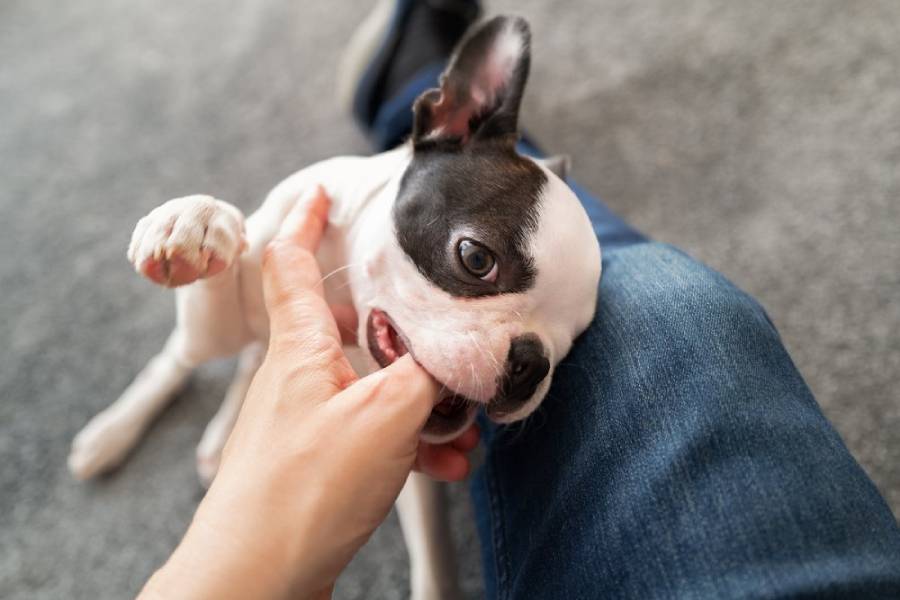
Boston Terriers do not have one scientifically established bite-force rating in PSI, despite specific numbers frequently published online. Bite strength varies between individual dogs and is influenced by factors such as body size, jaw structure, muscle force, skull anatomy, and the circumstances in which the dog bites. Boston Terriers are small, brachycephalic dogs with compact heads and short muzzles, but these physical traits alone do not establish a specific bite-force measurement.
The practical risk of a Boston Terrier bite also cannot be determined from PSI alone. The location and duration of a bite, the depth of penetration, the dog’s behavior, and the age and size of the person bitten all affect the potential severity of an injury. Bite force and biting tendency are also separate characteristics: a dog’s physical ability to bite does not indicate how likely that dog is to bite.
This article examines the Boston Terrier bite force, the reliability of commonly reported PSI estimates, and the physical factors that influence bite strength. It also explains how Boston Terriers compare with other dogs, whether their bites can cause serious injuries, why puppies and adults bite, and how owners can reduce unwanted biting behavior.
What Is the Bite Force of a Boston Terrier?
There is no scientifically established PSI measurement for the bite force of a Boston Terrier. Specific Boston Terrier bite-force figures published online should therefore be treated as estimates unless they can be traced to a controlled study that directly measured the breed.
Bite force is commonly expressed in pounds per square inch (PSI), which describes pressure applied over a specific area. However, a dog’s bite cannot be represented accurately by assigning every member of a breed one fixed PSI value. The pressure generated during a bite changes according to the individual dog’s jaw muscles, body size, skull dimensions, tooth contact area, motivation, and position of the jaw when biting.
This distinction matters because Boston Terriers are sometimes assigned a precise PSI figure without an explanation of how that number was obtained. A precise-looking number does not automatically represent a measured biological characteristic. For a PSI figure to serve as reliable evidence of Boston Terrier bite force, researchers would need to measure Boston Terriers under defined conditions and explain the measurement method, sample size, equipment, and results.
The Boston Terrier’s physical characteristics still provide useful context. The breed has a compact body and a brachycephalic, or short-muzzled, skull. These characteristics affect the geometry of the jaw, but they do not provide enough information to calculate a universal bite force. Two Boston Terriers can also produce different levels of force because bite strength varies between individual dogs.
For owners, the more useful conclusion is that a Boston Terrier is physically capable of causing a painful bite and tissue injury even though the breed does not have a verified PSI figure. Bite severity should therefore be evaluated through the circumstances and resulting injury rather than an unsupported breed-specific number.
Is the Boston Terrier Bite Force PSI Scientifically Proven?
No specific Boston Terrier bite-force PSI should be described as scientifically proven without a study that directly supports that measurement. A figure repeated across pet websites is not equivalent to experimental evidence, especially when those websites do not identify an original measurement study.
There are 3 important categories of bite-force figures to distinguish: direct measurements, biomechanical estimates, and unsourced estimates. Direct measurements record force produced during an actual bite using measurement equipment. Biomechanical estimates calculate potential force from variables such as skull dimensions, jaw mechanics, and muscle characteristics. Unsourced estimates provide a number without enough information to determine how it was produced. These 3 categories should not be presented as interchangeable evidence.
The distinction also explains why dog bite-force comparisons can be misleading. One breed may have a figure derived from a biomechanical model, while another may have a number recorded under different experimental conditions. A third breed may have a figure that has simply been repeated between websites. Ranking these values from highest to lowest creates an apparently precise comparison even though the underlying evidence is not equivalent.
A Boston Terrier’s actual bite strength can also change according to the bite itself. A defensive snap, playful mouthing, and a sustained bite do not involve the same behavior or necessarily produce the maximum force the dog is physically capable of generating. Jaw position and tooth contact further influence how force is transferred to the object or tissue being bitten.
For this reason, Boston Terrier bite force is better described through available evidence and physical context than through an unverified PSI claim. A specific number should only be presented as measured fact when its original research supports that conclusion. This approach avoids turning an estimate into certainty simply because the same figure appears repeatedly online.
What Determines How Hard a Boston Terrier Can Bite?
A Boston Terrier’s bite strength is determined by several interacting factors, including jaw structure, muscle force, body size, skull anatomy, tooth position, and the intensity of the bite. These variables explain why individual Boston Terriers do not produce an identical amount of force and why assigning one fixed PSI value to the entire breed is problematic.
Jaw structure affects how muscular force is transferred through the lower jaw to the teeth. The location of the bite also changes the mechanical advantage available to the dog. A bite made with teeth farther toward the back of the mouth can transfer force differently from a bite made primarily with the front teeth. As a result, bite pressure can vary even when the same dog bites on two different occasions.
Body size and muscle development provide additional context. Boston Terriers are compact dogs rather than large, heavy breeds, which limits the amount of muscle mass available to generate force compared with substantially larger dogs. Individual variation remains important, however. Two Boston Terriers of different sizes, ages, physical conditions, and muscle development should not be expected to produce exactly the same bite strength.
Skull anatomy is another relevant factor. Boston Terriers are brachycephalic dogs, meaning their skulls are relatively broad and their muzzles are shortened compared with longer-muzzled breeds. This changes the geometry of the jaws and the spatial relationship between the skull, jaw muscles, and teeth. A short muzzle alone does not prove that Boston Terriers have an unusually powerful bite, because bite strength depends on the complete biomechanical system rather than a single skull characteristic.
The dog’s behavior at the moment of contact also affects the force delivered. Playful mouthing, a quick warning snap, a defensive bite, and a sustained bite represent different actions. A dog does not necessarily use its maximum physical biting capacity every time its teeth make contact with a person, another animal, or an object.
These factors make bite force an individual and context-dependent characteristic. Breed anatomy helps explain the physical mechanisms involved, but it does not provide enough evidence to assign every Boston Terrier the same precise PSI value.
How Strong Is a Boston Terrier Bite Compared With Other Dogs?
A Boston Terrier should not be given a precise position in a dog bite-force ranking without comparable scientific measurements across the breeds being ranked. Differences in body size and anatomy make it reasonable to expect substantial variation in bite strength between dogs, but exact PSI rankings require standardized evidence.
Size provides one useful comparison point. Boston Terriers are smaller than breeds with substantially greater body mass and larger jaw musculature. This physical difference matters when evaluating their potential bite strength, but body weight alone cannot determine the pressure produced at the teeth. Skull shape, muscle architecture, jaw dimensions, tooth position, and individual characteristics also contribute to the result.
Comparisons with other compact brachycephalic dogs, such as French Bulldogs and Pugs, require the same caution. These breeds share certain anatomical characteristics, including shortened muzzles, but similar skull classifications do not mean they have identical bite forces. Differences in body dimensions, jaw geometry, muscle development, and individual variation prevent skull type alone from establishing which breed produces the stronger bite.
Comparisons become even less reliable when online PSI tables combine figures obtained through different methods. For example, a biomechanical estimate for one breed cannot be treated as directly equivalent to a measured value for another breed or an unsourced figure for a third. Placing all three values in the same ranking removes the methodological differences that determine what those numbers actually mean.
For pet owners, the practical comparison is more useful than an unsupported PSI ranking. Boston Terriers have enough jaw strength and functional teeth to cause injury, but their bite risk should be evaluated alongside their size, individual behavior, training, socialization, and the circumstances that trigger a bite. The next question is therefore not simply how their bite ranks against another breed, but how much harm a Boston Terrier bite can actually cause.
Can a Boston Terrier Bite Cause a Serious Injury?
A Boston Terrier bite can cause a serious injury, although the severity depends on more than the dog’s bite force. The location of the bite, depth of penetration, duration of contact, number of bites, and characteristics of the person bitten all influence the resulting damage. This is why an estimated PSI figure cannot reliably predict the medical consequences of an individual bite.
A minor bite may leave superficial scratches, bruising, or small breaks in the skin. A more forceful bite can produce puncture wounds or lacerations when the teeth penetrate and tear tissue. The injury becomes more concerning when a bite affects the face, hands, joints, or other areas containing vulnerable structures. Repeated or sustained biting can also cause more tissue damage than a quick warning snap.
The person being bitten changes the level of risk as well. Children have smaller bodies and may place their faces closer to a dog’s head during interaction, making facial injuries a particular concern. Older adults and people with conditions that affect healing can also experience greater complications from wounds that initially appear limited.
Infection is another concern once a bite breaks the skin. A dog’s mouth contains bacteria that can enter damaged tissue through puncture wounds. Deep punctures are especially important to assess because the visible opening can appear small while the teeth have carried bacteria farther beneath the skin. Cleaning a minor wound promptly is therefore important, while deep wounds, uncontrolled bleeding, severe pain, signs of infection, or bites involving vulnerable areas warrant medical assessment.
The seriousness of a Boston Terrier bite should therefore be judged by the actual injury rather than an assumed breed PSI. Even a small dog can cause meaningful tissue damage under the right circumstances, while many contacts with teeth never involve the dog’s maximum possible bite force.
Do Boston Terriers Bite Often?
Bite force does not indicate how often a Boston Terrier will bite. Bite strength describes a physical capability, while biting frequency is primarily a behavioral issue influenced by the individual dog’s experiences, emotional state, health, socialization, environment, and training.
It is also important to distinguish biting from normal puppy mouthing. Boston Terrier puppies can use their mouths during play and exploration, particularly while they are learning how much pressure is acceptable during interactions. Puppy mouthing does not automatically indicate aggression. Bite inhibition develops as the puppy learns to control the pressure applied with its mouth when interacting with people and other dogs.
Adult biting requires more attention to context. A Boston Terrier may use a snap or bite when frightened, cornered, injured, protecting a valued resource, or attempting to increase distance from something it perceives as threatening. Warning behaviors can occur before a bite, including body stiffening, attempts to move away, growling, or other changes in body language. Recognizing these signals allows an owner to address the trigger before an interaction escalates.
Individual history also matters more than a theoretical breed bite-force figure when evaluating bite risk. A Boston Terrier that has received appropriate socialization, consistent training, and careful management of stressful situations can behave differently from a dog that repeatedly experiences fear-provoking interactions or has learned that biting successfully ends unwanted contact.
For this reason, a strong bite and a tendency to bite should never be treated as the same characteristic. Knowing how much physical force a Boston Terrier might generate provides limited information about whether an individual dog is likely to use its teeth aggressively. Understanding why Boston Terriers bite provides more practical information for preventing the behavior.
Why Do Boston Terriers Bite?
Boston Terriers can bite because of puppy development, fear, stress, pain, resource guarding, overstimulation, or defensive behavior. The trigger matters because biting is an action rather than a single personality trait. Identifying what happens immediately before the bite is therefore more useful for correcting the behavior than focusing on the dog’s theoretical bite force.
A Boston Terrier may also learn that snapping or biting successfully stops an unwanted interaction. For example, a dog that bites when someone attempts to take a toy may discover that the person immediately moves away. Repetition can reinforce the behavior because biting has achieved the dog’s immediate goal. Owners should therefore examine the context, body language, and consequences surrounding repeated biting rather than treating every incident as the same behavioral problem.
Why Do Boston Terrier Puppies Bite?
Boston Terrier puppies commonly use their mouths during play, exploration, and teething, so puppy biting does not automatically indicate aggression. Young dogs investigate objects and interactions with their mouths while simultaneously learning bite inhibition, which is the ability to control how much pressure they apply with their teeth.
Play can make mouthing more intense. A puppy that becomes highly excited while chasing hands, wrestling, or playing tug may apply progressively more pressure because arousal has increased. Consistent responses help establish boundaries: owners can redirect the puppy toward an appropriate toy and reinforce calm interaction instead of encouraging games in which hands become the target.
Teething can also increase chewing and mouthing because puppies seek objects to chew while their adult teeth develop. Providing suitable chew items gives the puppy an acceptable outlet while reducing opportunities to practice biting hands, clothing, or household objects. The goal is not to prevent a puppy from using its mouth entirely but to teach which objects are appropriate and how much pressure is acceptable during interaction.
Persistent puppy biting should still be evaluated in context. A puppy that mouths during excited play presents a different behavioral pattern from one that repeatedly stiffens, guards objects, attempts to escape contact, or bites when approached. These surrounding signals help distinguish developmentally normal mouthing from behavior that requires closer attention.
Why Do Adult Boston Terriers Bite?
Adult Boston Terriers may bite when they experience fear, stress, pain, resource conflict, or a situation they perceive as threatening. Unlike routine puppy mouthing, adult biting requires attention to the trigger and the sequence of behaviors leading to the incident.
Fear-related biting can occur when a dog believes retreat is difficult or unsuccessful. An unfamiliar person reaching toward the dog, unwanted handling, or being physically cornered can increase defensive behavior. The Boston Terrier may first attempt to avoid the interaction or display warning signals before escalating to a snap or bite when those signals do not create sufficient distance.
Pain can produce a similar defensive response. A normally tolerant dog may suddenly resist being touched when an injury or painful medical condition makes contact uncomfortable. A sudden, unexplained change in biting behavior can justify veterinary assessment, particularly when it occurs alongside sensitivity to touch, reduced activity, changes in appetite, or other physical symptoms.
Resource guarding occurs when a dog attempts to retain access to something it values, such as food, toys, chews, or a resting location. Taking the resource by force can intensify conflict because the dog learns that human approach predicts loss. Management and behavior modification should instead focus on reducing conflict and teaching the dog that a person’s approach does not require defensive action.
Overstimulation can also contribute to biting. Extended high-intensity play or repeated handling can push an interaction beyond what an individual dog tolerates comfortably. Recognizing changes in body language and ending or modifying the interaction before escalation reduces opportunities for the dog to practice biting as a way of stopping contact.
These causes demonstrate why the reason a Boston Terrier bites is more useful for prevention than its estimated PSI. Bite force describes what the jaws may physically do, whereas identifying the trigger explains what owners need to change to reduce the chance of another bite.
Read more: Boston Terrier Intelligence: How Smart Are They?
How Can You Stop a Boston Terrier From Biting?
You can reduce Boston Terrier biting by identifying the trigger, teaching bite inhibition, redirecting inappropriate mouthing, reinforcing calm behavior, providing appropriate socialization, and preventing situations that repeatedly cause defensive biting. The correct approach depends on why the dog bites because puppy mouthing, fear-based biting, pain-related biting, and resource guarding do not have the same underlying cause.
Start by identifying what happens immediately before each biting incident. Record the situation, people or animals involved, objects present, the dog’s body language, and what happened after the bite. For example, a Boston Terrier that mouths hands during energetic play requires a different response from a dog that growls and bites when someone approaches its food. Identifying this pattern helps owners address the cause instead of reacting only after the bite occurs.
Teach bite inhibition and appropriate alternatives when dealing with puppy mouthing. Redirect the puppy from hands or clothing to toys and suitable chew items, then reinforce interaction that does not involve painful contact. Consistency is important because allowing rough hand play during one interaction and discouraging it during another gives the puppy conflicting information about acceptable behavior.
Positive reinforcement can strengthen alternative behaviors in both puppies and adults. Rewarding behaviors such as releasing an object, moving away from a trigger, settling calmly, or responding to a cue gives the dog another way to handle the situation. Training should focus on teaching the desired response rather than relying on physical punishment after an unwanted bite has already occurred.
Socialization can also reduce biting associated with unfamiliar situations. Appropriate exposure to different people, environments, sounds, handling, and other animals helps a young Boston Terrier develop experience with situations it may encounter later. Socialization should remain controlled and appropriate for the individual dog rather than forcing interaction when the dog is already displaying fear or significant stress.
Management is necessary when a predictable trigger creates a bite risk. Owners can use physical distance, barriers, leashes, separate feeding areas, or changes in routine to prevent repeated incidents while the underlying behavior is being addressed. Preventing rehearsal matters because repeatedly allowing a dog to solve a stressful situation through biting can strengthen that behavioral pattern.
Punishment should not replace identification of the trigger. Punishing growling or other warning behavior may suppress a visible warning without resolving the fear, pain, or conflict that produced it. A dog that stops displaying an obvious warning can still retain the motivation to defend itself, making its future behavior harder to anticipate.
Professional help is appropriate when a Boston Terrier repeatedly bites, causes injuries, shows escalating aggression, guards resources intensely, or behaves unpredictably around people or other animals. A veterinarian can first investigate pain or medical problems when behavior changes suddenly. A qualified canine behavior professional can then assess environmental and behavioral triggers and develop an appropriate modification plan.
Are Boston Terriers Dangerous Dogs?
Bite force alone does not establish whether a Boston Terrier is dangerous. Practical bite risk depends on the individual dog’s behavior, history, health, socialization, training, environment, and circumstances surrounding human or animal interactions.
The distinction between physical capability and behavior is important. Boston Terriers have teeth and jaws capable of causing injury, as other dogs do, but that fact does not show that an individual Boston Terrier is likely to bite. A PSI estimate describes an assumed physical characteristic; it does not measure temperament, fear responses, impulse control, or the frequency of aggressive behavior.
Individual circumstances provide more useful information about risk. A Boston Terrier that repeatedly guards food, reacts defensively to handling, or has a documented history of serious bites requires different management from a dog without those behavioral patterns. Similarly, a sudden increase in defensive behavior can indicate pain or another problem that needs investigation rather than an inherent change in breed-level bite force.
Responsible management reduces preventable bite incidents. Owners should supervise interactions where appropriate, teach children how to interact safely with dogs, recognize signs that a dog wants distance, provide consistent training, and address recurring behavioral problems before they escalate. These measures target the conditions that lead to biting instead of relying on a breed’s supposed PSI rating to predict behavior.
The most accurate way to understand Boston Terrier bite risk is therefore to separate 3 questions: how much force the dog can physically generate, why the individual dog might bite, and how severe a particular bite could be. Current breed-specific PSI claims do not answer all three questions. Evaluating anatomy, behavior, circumstances, and actual injury provides a more useful picture than assigning every Boston Terrier a single bite-force number.
1 thought on “Boston Terrier Bite Force: How Strong Is Their Bite?”