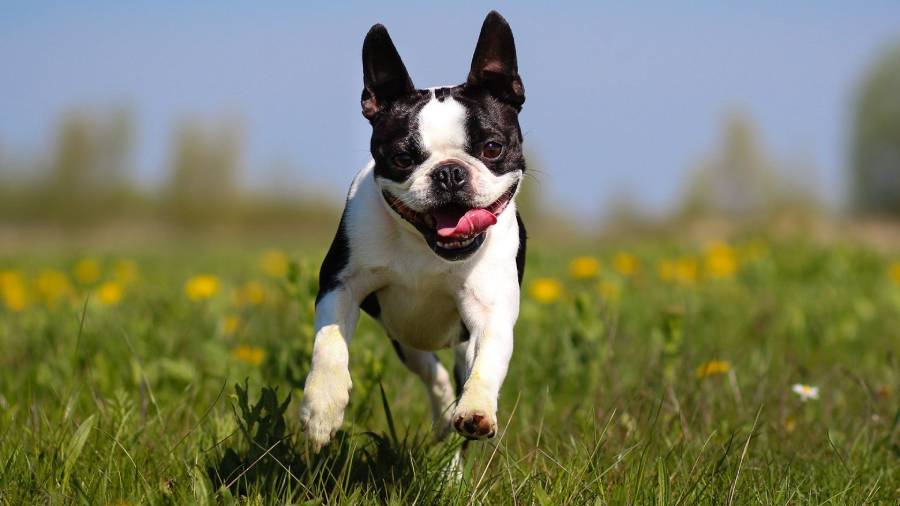
A Boston Terrier can run at roughly 15–20 mph (24–32 km/h) during a short sprint, but individual running speed varies with age, fitness, body condition, health, and weather. This makes the Boston Terrier reasonably quick over short distances, although the breed is not built to maintain its top speed for extended periods.
Running speed and running endurance are different abilities. A healthy adult Boston Terrier may accelerate quickly when playing, chasing a toy, or running across a yard, but maintaining a fast pace places greater demands on breathing and temperature regulation. Boston Terriers are brachycephalic dogs, meaning they have short skulls and relatively flat faces. This anatomy can make strenuous exercise and heat management more challenging, particularly during warm or humid conditions.
For owners, the practical question is therefore not only how fast a Boston Terrier can run, but also how long and how far the dog can exercise safely. This guide explains Boston Terrier running speed, the factors that influence it, how the breed compares with other dogs, its running endurance and distance, and the precautions owners should take when running with a Boston Terrier.
How Fast Can a Boston Terrier Run?
A Boston Terrier can run at an estimated top speed of about 15–20 mph (24–32 km/h) over a short distance. This range describes sprinting rather than a pace the dog can maintain continuously. A Boston Terrier may approach its faster speeds while chasing a ball, playing with another dog, or running across an open yard, but its sustainable running pace is lower.
The breed’s physical build helps explain its short-distance speed. Boston Terriers are compact, muscular dogs with relatively strong hindquarters for their size, allowing them to accelerate quickly during brief bursts of activity. However, acceleration and endurance are separate abilities. A dog that reaches a high speed for several seconds does not necessarily have the respiratory or cardiovascular capacity to maintain that pace over a long run.
The 15–20 mph figure should also be treated as an approximate range rather than a guaranteed speed for every Boston Terrier. There is no single scientifically established maximum running speed that applies to the entire breed. Individual dogs differ in body size, muscle development, age, health, motivation, and physical conditioning. A fit adult running after a favorite toy, for example, will generally demonstrate greater speed than an older or poorly conditioned dog.
For owners, top speed is therefore less useful than understanding the dog’s complete running ability. Boston Terriers are better suited to short bursts of energetic activity and controlled recreational exercise than sustained high-speed running. Their brachycephalic anatomy also becomes increasingly important as exercise intensity and duration increase.
What Affects a Boston Terrier’s Running Speed?
Five main factors affect a Boston Terrier’s running speed: age, body condition, fitness, health, and environmental conditions. These factors influence not only how quickly the dog can accelerate but also how long it can continue running before fatigue, breathing difficulty, or heat accumulation reduces its pace.
Age changes running performance throughout a Boston Terrier’s life. Puppies are energetic but are still developing their muscles, coordination, bones, and joints, so their enthusiasm for running should not be interpreted as adult-level physical capacity. Healthy adults generally have the strongest combination of muscle development, coordination, and stamina. Senior Boston Terriers tend to slow as muscle mass, joint mobility, cardiovascular capacity, or general activity levels decline.
Body condition also affects speed because excess weight increases the amount of mass the dog must move with every stride. A Boston Terrier at a healthy body condition can move more efficiently than an overweight dog carrying additional weight. Extra body fat also increases the physical workload of exercise and can make heat management more difficult, which may shorten the period during which the dog can maintain a faster pace.
Fitness determines how effectively a Boston Terrier handles repeated physical activity. Regular walking, play, and appropriately controlled exercise can improve muscular conditioning and stamina. A sedentary Boston Terrier may still sprint quickly for a few seconds when excited, but it is less likely to sustain running comfortably. Conditioning should develop gradually rather than through sudden increases in running distance or intensity.
Health can impose a more direct limitation. Respiratory problems, joint pain, injuries, cardiovascular conditions, and other medical issues can reduce both running speed and exercise tolerance. Boston Terriers are brachycephalic dogs, so respiratory function deserves particular attention during strenuous activity. A dog showing noisy or difficult breathing during exercise should not be pushed to maintain a predetermined speed or distance.
Temperature and humidity can further reduce running performance. Dogs primarily release excess heat through panting rather than sweating across the body as humans do. Because Boston Terriers have shortened facial anatomy, strenuous exercise in hot or humid conditions can place additional demands on breathing and heat dissipation. A Boston Terrier that runs comfortably in cool weather may therefore slow down much sooner under hotter conditions, even when its age, weight, and fitness have not changed.
Are Boston Terriers Fast Compared With Other Dogs?
Boston Terriers are moderately fast dogs, but they are slower than breeds developed for sprinting, hunting, or sustained athletic work. Their estimated top speed of 15–20 mph (24–32 km/h) is sufficient for quick bursts during play and recreational exercise, but speed alone does not make the Boston Terrier a high-performance running breed.
Greyhounds provide a useful comparison because their bodies are specialized for sprinting. They have long legs, flexible spines, deep chests, and a lean build that allows them to cover considerably more ground with each stride. Labrador Retrievers also have a physical advantage during sustained activity because they are larger sporting dogs developed for active field work. Boston Terriers have a shorter stride and a more compact body, making their running characteristics substantially different from those of these athletic breeds.
A more relevant comparison can be made with other brachycephalic companion dogs, such as French Bulldogs and Pugs. These breeds share shortened facial structures that can limit airflow and exercise tolerance, although the degree varies between breeds and individual dogs. Boston Terriers generally have a lighter, more athletic build than many French Bulldogs and Pugs, which helps explain why a healthy Boston Terrier can appear surprisingly quick during short periods of activity.
The practical distinction is therefore not whether a Boston Terrier is simply “fast” or “slow.” Its running ability is characterized by quick acceleration and moderate short-distance speed combined with more limited endurance. This combination makes sprinting during play fundamentally different from accompanying an owner on a prolonged run.
How Long Can a Boston Terrier Run?
A Boston Terrier is better suited to short periods of running than prolonged continuous running. There is no universal number of minutes that every Boston Terrier can run safely because exercise tolerance depends on pace, fitness, age, body condition, respiratory function, and environmental temperature.
A short sprint places different demands on the body than continuous running. During a brief chase or game, a Boston Terrier can accelerate, run quickly, and then recover by slowing down or stopping. Continuous running removes much of this recovery time. As the exercise continues, muscles require sustained oxygen delivery while metabolic activity generates additional body heat. The dog must therefore maintain both respiration and temperature regulation while continuing to move.
Brachycephalic anatomy is particularly relevant to this process. Boston Terriers have shortened skulls and muzzles, and some individuals have narrower or otherwise compromised upper airways. Dogs also rely heavily on panting to dissipate heat. A Boston Terrier that has difficulty moving air efficiently may consequently reach its exercise limit sooner as running intensity, duration, temperature, or humidity increases.
Physical conditioning changes how long an individual dog can remain active. A healthy adult accustomed to regular exercise will generally tolerate activity better than a sedentary dog suddenly taken on a continuous run. Conditioning should be progressive: exercise duration and intensity are increased gradually while the owner monitors breathing, movement, recovery, and willingness to continue. A dog’s ability to complete one run comfortably does not justify a large increase in distance on the next session.
Running duration should therefore be determined by the individual dog’s response rather than by forcing it to reach a fixed time target. Slowing down, repeatedly falling behind, seeking shade, refusing to continue, or developing unusually heavy or difficult breathing indicates that the exercise demands are exceeding the dog’s comfortable capacity. Stopping at these signals is more useful than attempting to make every Boston Terrier run for the same number of minutes.
How Far Can a Boston Terrier Run?
There is no single safe running distance that applies to every Boston Terrier. Running distance depends on pace, age, physical conditioning, body condition, respiratory function, terrain, temperature, and humidity. For this breed, the dog’s response to exercise is more useful than choosing a fixed mileage target.
Distance also needs to be separated from speed. A Boston Terrier may cover a short distance rapidly while chasing a toy but be unable to sustain anything close to that speed over a longer route. Sprinting relies on brief, intense effort followed by recovery, whereas continuous running requires the respiratory and cardiovascular systems to support muscular activity while the dog simultaneously regulates its body temperature.
Walking distance should not be treated as equivalent to running distance either. Walking creates a lower physical workload and allows more opportunities for a Boston Terrier to regulate its pace, sniff, stop, and recover. Running increases oxygen demand and heat production, so a dog that comfortably completes a long walk does not automatically have the conditioning required to run the same distance.
A Boston Terrier that has not been conditioned for running should begin with short periods of activity rather than a predetermined long-distance goal. Run-walk sessions provide one way to control the workload because periods of jogging can alternate with slower walking and recovery. Duration or distance can then be increased gradually when the dog consistently completes the activity without abnormal breathing, excessive fatigue, or prolonged recovery.
Long-distance running is generally a poor match for the breed’s physical characteristics. Boston Terriers were not developed as endurance-running dogs, and their brachycephalic anatomy can place additional limits on sustained strenuous exercise. Individual capability still varies, so owners should judge distance according to the specific dog’s conditioning and physical response rather than assuming that every healthy Boston Terrier should reach the same mileage.
Can Boston Terriers Go Running With Their Owners?
Healthy Boston Terriers can run with their owners, but they are generally better suited to short, controlled runs or run-walk sessions than prolonged endurance running. The appropriate pace should be determined by the dog rather than by the owner’s normal human running speed.
Jogging at a controlled pace is more practical than expecting a Boston Terrier to maintain its sprinting speed. An owner can begin with walking, introduce short jogging intervals, and observe how the dog responds before increasing the workload. This progression gives the dog time to develop conditioning while allowing the owner to identify breathing or mobility limitations before attempting longer sessions.
The dog should also be allowed to slow down or stop instead of being pulled along to maintain a target pace. Falling behind, repeatedly stopping, seeking shade, refusing to continue, or showing increasingly labored breathing indicates that the current workload should be reduced. These behavioral signals provide immediate information about exercise tolerance that a mileage target cannot provide.
Running conditions matter as much as running pace. Cooler conditions reduce the additional heat load placed on a Boston Terrier during exercise, while hot and humid environments make heat dissipation more difficult. Route characteristics also change the workload: hills, prolonged exposure to direct sunlight, and demanding surfaces can make a run harder than the same distance on a flat, shaded route.
Long-distance running should not be treated as a standard exercise goal for a Boston Terrier. Owners seeking a canine partner for sustained high-mileage running should recognize that the breed’s compact build and brachycephalic anatomy differ from those of dogs developed for endurance work. Boston Terriers are better matched to exercise that allows regular changes in pace, recovery periods, and opportunities to stop.
The goal of running with a Boston Terrier is therefore appropriate physical activity rather than maximum speed or distance. A controlled session that ends while the dog remains comfortable provides more value than extending a run until the dog becomes exhausted. Exercise intensity should always be adjusted to the individual dog’s health, conditioning, breathing, and environmental conditions.
Is Running Safe for Boston Terriers?
Running can be safe for a healthy Boston Terrier when the intensity, duration, and environmental conditions match the individual dog’s exercise tolerance. The main concern is not running itself but the combination of strenuous activity, restricted airflow, and heat accumulation. Boston Terriers are brachycephalic dogs, so owners need to monitor breathing and body temperature more closely than they would with many longer-muzzled breeds.
Brachycephalic dogs have shortened skulls and muzzles, and individual Boston Terriers can differ considerably in airway structure. Dogs with more restricted airflow have to work harder to move air during strenuous exercise. Running increases oxygen demand, which increases respiratory effort. A Boston Terrier that breathes comfortably while walking may therefore experience greater difficulty when the pace becomes faster or the exercise continues for longer.
Heat adds another physiological demand. Dogs depend heavily on panting to release excess body heat, and exercise simultaneously generates additional metabolic heat. Hot or humid weather makes this cooling process less effective. For a Boston Terrier, combining vigorous running with unfavorable environmental conditions can therefore reduce exercise tolerance and increase the risk of overheating.
Running safety should consequently be evaluated continuously rather than decided before the exercise begins. A Boston Terrier may tolerate one running session comfortably but struggle with the same distance on a hotter day, after gaining weight, following a period of inactivity, or when experiencing a health problem.
Why Can Boston Terriers Overheat While Running?
Boston Terriers can overheat while running because exercise generates body heat while their brachycephalic anatomy can make respiratory cooling less efficient. The risk increases when strenuous activity is combined with high temperature, humidity, direct sunlight, or inadequate recovery periods.
Panting moves air across moist respiratory surfaces and helps the dog dissipate heat through evaporation. As running intensity rises, the body simultaneously requires more oxygen and produces more heat. The respiratory system therefore contributes to both exercise performance and temperature regulation. A Boston Terrier with restricted airflow has less physiological margin when these demands increase together.
Humidity creates an additional problem because evaporative cooling becomes less effective as environmental moisture increases. This means a warm, humid run can place a greater thermal load on the dog than a similar run in cool conditions. Owners should therefore adjust exercise according to weather rather than maintaining the same speed and distance throughout the year.
Exercise should be stopped before the dog reaches severe heat distress. Moving a run to a cooler part of the day, reducing its intensity, providing recovery periods, and choosing shaded routes can reduce heat exposure. On particularly hot or humid days, lower-intensity activity may be more appropriate than running.
What Signs Show That a Boston Terrier Should Stop Running?
A Boston Terrier should stop running when it develops unusually heavy or difficult breathing, repeatedly slows or stops, becomes weak or uncoordinated, or shows signs that it cannot recover normally from the exercise. Continuing to push the dog toward a speed or distance goal after these signs appear can increase physical stress.
Changes in behavior are often among the easiest warning signs for an owner to notice. A dog that begins falling behind, repeatedly sits or lies down, seeks shade, refuses to move forward, or loses interest in continuing is communicating that the current workload may be too high. These signals should not be treated as stubbornness during strenuous exercise.
Breathing also needs to be assessed relative to the individual dog’s normal response. Panting is expected during exercise, but progressively labored breathing, obvious difficulty drawing air, or respiratory distress requires the activity to stop. Because Boston Terriers vary in airway anatomy, owners should learn what normal post-exercise breathing looks like for their own dog instead of relying solely on a universal running time.
Weakness, disorientation, abnormal movement, vomiting, collapse, or severe breathing difficulty are more serious warning signs. These symptoms require immediate cessation of exercise, and severe or persistent signs warrant prompt veterinary attention. The objective is to recognize exercise intolerance early rather than waiting until a Boston Terrier is physically exhausted before ending the run.
Read more: Boston Terrier Bite Force: How Strong Is Their Bite?
When Should a Boston Terrier Avoid Running?
A Boston Terrier should avoid strenuous running during hot or humid weather, when experiencing breathing difficulty, while injured or ill, or when its physical condition does not support the planned exercise. Running should also be limited when an individual dog has a health condition for which a veterinarian has recommended exercise restrictions.
Hot and humid conditions create one of the clearest reasons to reduce running intensity. Exercise generates metabolic heat, while dogs rely heavily on panting for cooling. High humidity reduces the efficiency of evaporative cooling, and Boston Terriers can face an additional challenge because of their brachycephalic anatomy. Moving exercise to cooler conditions or replacing a run with a lower-intensity walk reduces this combined respiratory and thermal workload.
A Boston Terrier should not continue running when it already shows breathing difficulty at rest or during light activity. Strenuous exercise increases oxygen demand and respiratory effort, so an existing breathing problem can become more pronounced as running intensity rises. Owners who notice persistent noisy breathing, unusual respiratory effort, or reduced exercise tolerance should seek veterinary guidance before introducing or resuming strenuous running.
Injury and illness also require changes to normal exercise. Limping, stiffness, pain, weakness, gastrointestinal illness, fever, or recovery from a medical procedure can make running inappropriate even when the dog remains eager to move. Excitement is not evidence that the body is ready for strenuous activity. Exercise should follow veterinary restrictions when a Boston Terrier is recovering from an injury, illness, or surgery.
Poor conditioning is another reason to avoid demanding runs. A Boston Terrier that has been sedentary cannot safely acquire endurance by immediately completing a long or fast session. Muscles, joints, cardiovascular function, and exercise tolerance need time to adapt to increasing workloads. Starting with manageable activity and progressing gradually provides a safer route to improved fitness.
Individual limitations ultimately take priority over general breed recommendations. Two Boston Terriers of the same age and weight can have different respiratory function, fitness levels, joint health, and exercise tolerance. Owners should therefore base running decisions on the condition and response of the individual dog rather than attempting to reach a breed-wide speed, duration, or distance target.
How Can You Exercise a Boston Terrier Safely?
Exercise a Boston Terrier safely by controlling intensity, building fitness gradually, choosing suitable weather, providing recovery opportunities, and monitoring the dog’s breathing and behavior throughout the activity. The objective is consistent physical activity that the dog tolerates comfortably, not achieving maximum running speed or distance.
Start with an exercise level that matches the dog’s current conditioning. A Boston Terrier with little running experience can begin with regular walks before short jogging intervals are introduced. Alternating walking and jogging gives the dog recovery periods while allowing the owner to observe how breathing and movement change as intensity increases.
Increase exercise gradually after the dog demonstrates that the existing workload is comfortable. Changing one variable at a time, such as adding a small amount of duration before increasing pace, makes the dog’s response easier to evaluate. Sudden increases in both speed and distance create a larger workload and make it harder to identify what caused excessive fatigue.
Choose cooler conditions for higher-intensity activity. Early morning or cooler periods of the day can reduce environmental heat exposure compared with running under direct sun during hotter periods. Shade, terrain, humidity, and access to rest areas should also influence route selection. On hot or humid days, a controlled walk or indoor activity may provide exercise without the thermal demands of outdoor running.
Provide access to fresh water and opportunities to recover, particularly around longer periods of activity. Hydration supports normal physiological function, but water does not make strenuous exercise in unsafe heat conditions acceptable. Environmental conditions and exercise intensity still need to be adjusted appropriately.
Monitor the Boston Terrier throughout the session instead of evaluating it only after the run is finished. Observe pace, willingness to continue, coordination, breathing effort, and recovery. Reduce the workload or stop when the dog repeatedly falls behind, seeks rest, refuses to continue, or develops unusual breathing.
A safe exercise routine can also include activities other than running. Walking, controlled play, short games, and mentally engaging activities can contribute to daily stimulation without requiring sustained high-speed exercise. This variety is particularly useful for Boston Terriers because their exercise needs do not have to be met through long-distance running.
For owners who want to develop a regular running routine, the individual Boston Terrier should set the practical limit. Speed, mileage, and duration are secondary to comfortable breathing, normal movement, appropriate recovery, and willingness to exercise. Dogs with known respiratory, orthopedic, cardiovascular, or other medical conditions should have their exercise plan discussed with a veterinarian before participating in strenuous running.
1 thought on “Boston Terrier Running Speed: How Fast Can They Run?”