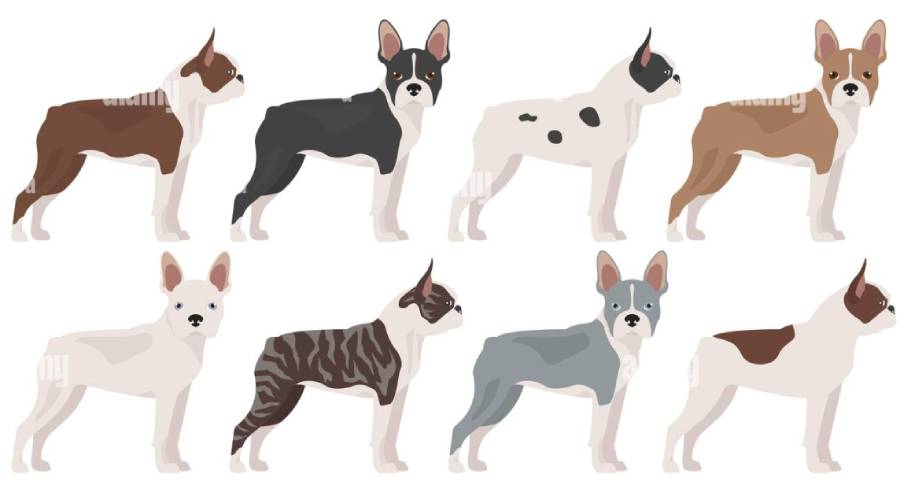
Boston Terriers come in three primary breed-standard color categories: brindle, seal, and black, each paired with distinctive white markings. Black and white is one of the easiest combinations to recognize, while brindle creates darker coats with visible striping. Seal can appear black indoors but develops a reddish cast in bright light or direct sunlight. The placement and extent of white markings also affect how each Boston Terrier looks, even when two dogs share the same base coat color.
Boston Terriers can also appear in colors described as red, blue, lilac, and fawn, while merle may be advertised as another variation. These colors and patterns should be distinguished from breed-standard colors rather than grouped together simply because they occur or are marketed as rare. Coat color terminology is especially important when comparing puppies because breeder descriptions, genetic color names, and official breed-standard terminology do not always mean the same thing.
This guide explains the standard and non-standard Boston Terrier coat colors, how to distinguish black, brindle, and seal coats, and how white markings affect appearance. It also covers coat color genetics, changes from puppyhood to adulthood, potential health considerations associated with specific genetic traits, and what prospective owners should prioritize when choosing a Boston Terrier puppy.
What Colors Do Boston Terriers Come In?
Boston Terriers come in three primary breed-standard color categories: brindle, seal, and black, combined with white markings. These base colors create the classic high-contrast appearance associated with the breed. Boston Terriers may also be described as red, blue, lilac, fawn, or merle, but these colors and patterns need to be separated from the standard colors when identifying a dog’s coat.
Coat color describes the pigmentation covering most of the dog’s body, while markings describe contrasting areas that appear over or alongside that base color. For example, a black Boston Terrier may have a white muzzle, a white blaze between the eyes, a white chest, and white on the legs. Two black Boston Terriers can therefore have the same base color but look noticeably different because their white markings cover different areas.
Boston Terrier colors can be organized into three practical groups: standard colors, white markings, and non-standard color variations. Standard colors include brindle, seal, and black in combination with white. White markings determine much of the breed’s recognizable pattern. Non-standard colors include terms such as red, blue, lilac, and fawn, while merle describes a pattern rather than a single solid coat color.
This distinction matters when comparing Boston Terrier puppies. A color name used in a breeder listing may describe the dog’s visible appearance or genetics without indicating that the color belongs to the breed standard. Terms such as “rare,” “exotic,” or “unique” describe how a puppy is marketed and should not be treated as synonyms for an officially recognized breed-standard color.
What Are the Standard Boston Terrier Coat Colors?
The standard Boston Terrier coat colors are brindle, seal, or black with white markings. Although these coats share the breed’s characteristic white pattern, their underlying pigmentation differs enough that owners can distinguish them by examining the coat in appropriate lighting.
A black and white Boston Terrier has a predominantly black coat contrasted by white markings. The black areas retain their dark appearance under both normal and bright lighting rather than developing the reddish tone associated with seal. White commonly appears around the muzzle, between the eyes, across the chest, and on portions of the neck and legs. The exact distribution of white can vary between individual dogs.
A brindle and white Boston Terrier has dark coat hairs arranged in a striped or streaked pattern rather than a completely uniform base color. Brindling varies in visibility. A dog with pronounced brindling can show obvious lighter streaks across its darker coat, while a heavily dark brindle Boston Terrier may initially appear almost black. Looking at the coat under natural light makes subtle brindle patterning easier to identify.
A seal and white Boston Terrier can look black under ordinary indoor lighting, which is why seal is frequently confused with black. The defining visual difference becomes clearer when the coat is exposed to bright light, where seal develops a reddish or warm cast. This light-dependent appearance provides a practical way to distinguish seal from a genuinely black coat.
White is an important component of the Boston Terrier’s appearance, but white should be understood alongside the dog’s base coat rather than as an isolated standard color in this context. A Boston Terrier described as black and white, for example, has black as its dark base color with white markings creating the contrasting pattern. The same principle applies to brindle and white and seal and white dogs.
The distinction among black, brindle, and seal is therefore based on the appearance of the darker portion of the coat. Black remains consistently dark, brindle contains visible striping or streaking, and seal reveals a reddish cast under suitable light. Examining these characteristics is more reliable than identifying a Boston Terrier solely from a general impression of whether its coat looks “black and white.”
How Can You Tell Black, Brindle, and Seal Boston Terriers Apart?
You can tell black, brindle, and seal Boston Terriers apart by examining the dark portion of the coat for solid pigmentation, visible striping, or a reddish cast in bright light. Black remains consistently black, brindle contains lighter or differently colored streaks within a darker coat, and seal can look black in normal conditions but shows a reddish tone under bright light. Natural daylight provides the clearest conditions for comparing these three colors.
A black Boston Terrier has a dark coat without the striping associated with brindle or the reddish cast that distinguishes seal. The color should be evaluated on areas with substantial dark pigmentation rather than around the edges of white markings. Looking at the back, sides, and other larger dark areas makes it easier to determine whether the coat is genuinely black.
A brindle Boston Terrier is identified by striping or streaking within the darker coat. The intensity of this pattern varies between dogs. Some Boston Terriers have obvious brindle stripes that can be recognized immediately, while others have such dark brindling that they appear black from a distance. Examining the sides and back in natural light can reveal streaks that are difficult to see indoors.
A seal Boston Terrier requires a different identification method because the coat can closely resemble black. Seal appears black under normal conditions but develops a reddish cast when viewed in the sun or sufficiently bright light. The change in appearance under light is therefore more useful for identification than simply comparing how dark a seal and black Boston Terrier look indoors.
The three colors can be distinguished using the following visual characteristics:
| Coat color | Typical appearance | Appearance in bright light | Main identifying feature |
|---|---|---|---|
| Black | Solid black | Remains black | Consistent dark pigmentation |
| Brindle | Dark with streaks or stripes | Pattern becomes easier to see | Visible brindle striping |
| Seal | Often appears black | Shows a reddish cast | Red tone under bright light |
White markings should not be used as the primary method for distinguishing these colors. A black, brindle, or seal Boston Terrier can have similar white areas on the face, chest, neck, and legs. The identification should instead focus on the pigmentation and pattern within the darker portions of the coat.
What White Markings Do Boston Terriers Have?
Boston Terriers can have white markings on the muzzle, between the eyes, chest, neck, forelegs, and hind legs. The distribution and size of these markings vary between individual dogs, creating noticeable differences in appearance even among Boston Terriers with the same base coat color.
Facial markings are among the breed’s most recognizable features. White can form a band around the muzzle and extend upward as a blaze between the eyes. The width and shape of this blaze can differ from one Boston Terrier to another. A narrow blaze produces less white coverage on the face, while a broader blaze creates stronger contrast against a black, brindle, or seal coat.
White can also appear around the neck and across the chest. A Boston Terrier may have a white forechest that contrasts sharply with the darker body coat, while white around the neck can create the appearance of a partial or more extensive collar. These markings contribute to the breed’s characteristic formal appearance but do not change the underlying coat color.
The legs provide another area where white markings vary. White may extend across part of the forelegs and appear on the feet or portions of the hind legs. The amount of white is not identical across every Boston Terrier, so two dogs described as black and white can have substantially different visual patterns despite sharing the same base color.
Coat color and white markings should therefore be identified separately. A Boston Terrier’s base coat tells you whether the darker pigmentation is black, brindle, or seal, while the markings describe where white appears across the body. For example, two seal Boston Terriers remain the same base color even if one has a broad facial blaze and extensive white chest markings while the other has less white coverage.
This distinction also prevents a common identification mistake. Terms such as black and white or brindle and white describe a combination of base pigmentation and contrasting markings rather than two equivalent base coat colors. Identifying the darker coat first and the distribution of white second provides a clearer description of a Boston Terrier’s appearance.
What Are the Non-Standard Boston Terrier Coat Colors?
Non-standard Boston Terrier coat colors commonly described by breeders and owners include red, blue, lilac, and fawn, while merle is a coat pattern rather than a single color. These variations differ from the black, brindle, and seal colors associated with the breed standard. Terms such as “rare” or “exotic” may also appear in puppy listings, but rarity and breed-standard recognition describe different characteristics.
Non-standard colors occur because inherited genetic variants affect the production, distribution, or intensity of pigment in the coat. A Boston Terrier can therefore display pigmentation that looks substantially different from the familiar dark coat and white markings. The visible color alone, however, does not explain the dog’s complete genetic background, pedigree, or health.
What Is a Red Boston Terrier?
A red Boston Terrier has a reddish, copper, liver, or brown-toned coat instead of the black pigmentation associated with a standard black and white Boston Terrier. The intensity of the color can vary, so individual dogs may range from lighter reddish brown to deeper liver-like shades. White markings can still occur on the muzzle, face, chest, neck, and legs.
Red should be identified according to the pigmentation of the coat rather than simply because a Boston Terrier looks warmer or lighter in photographs. Lighting, camera settings, and surrounding colors can alter how a coat appears. Examining the dog in natural light provides a more reliable indication of its actual pigmentation.
What Is a Blue Boston Terrier?
A blue Boston Terrier has a diluted gray or blue-gray appearance where darker pigmentation would otherwise be expected. In dog coat terminology, “blue” does not mean that the coat is literally bright blue. The term describes a cool gray appearance produced by reduced intensity of dark pigment.
Blue Boston Terriers can retain the characteristic white areas associated with the breed, producing a blue-gray and white combination. The dilution that produces this appearance is genetically different from ordinary black pigmentation, which is why blue should not be treated as another name for a lighter black coat.
The genetic mechanism behind dilute pigmentation is also relevant to health discussions. Coat appearance alone should not be used to diagnose a skin or coat disorder, but owners considering a dilute-colored puppy should evaluate health screening and breeding practices rather than treating unusual color as the primary measure of the puppy’s value.
What Is a Lilac Boston Terrier?
A lilac Boston Terrier has a pale, diluted brown or gray-brown coat created by pigment traits that produce a lighter appearance than typical dark Boston Terrier colors. Depending on the individual dog and lighting conditions, the coat may be described as dusty brown, muted gray-brown, or a light taupe-like shade.
Lilac is especially important to distinguish between visual terminology and breed-standard terminology. A breeder may use “lilac” to describe a particular genetic or visible color combination, but that description does not automatically make lilac a standard Boston Terrier coat color.
Because several dilute shades can look similar in photographs, visual identification alone can also be unreliable. Genetic information can provide additional context when an owner needs to determine the inherited basis of a specific coat rather than simply describe what the dog looks like.
What Is a Fawn Boston Terrier?
A fawn Boston Terrier has a lighter tan, beige, or yellowish-brown base appearance rather than the darker black, seal, or heavily brindled appearance commonly associated with the breed. The shade can vary between individual dogs, and white markings may create additional contrast on the face, chest, neck, and legs.
Fawn should not automatically be grouped with red or lilac simply because all three can look lighter than standard dark coats. Red generally emphasizes reddish or liver-like pigmentation, while lilac describes a diluted brown-gray appearance. Fawn is typically identified by its lighter tan or yellow-brown appearance.
This distinction illustrates why color names should be treated carefully. Similar-looking Boston Terriers may receive different color labels depending on visible pigmentation, genetics, or breeder terminology. A precise description should therefore separate what can be observed in the coat from claims about the genes responsible for it.
What Is a Merle Boston Terrier?
A merle Boston Terrier has a mottled coat pattern containing irregular areas of lighter and darker pigmentation. Merle differs fundamentally from terms such as black, red, or blue because it describes how pigmentation is distributed across the coat rather than simply identifying one base color.
The pattern can produce patches, marbling, or irregular pigmentation across different parts of the body. Its appearance can therefore vary substantially between dogs. A merle-patterned dog may also have white areas, making it important to distinguish merle patterning from the ordinary white markings associated with Boston Terriers.
Merle also requires more context than visual identification alone because the genetics associated with the pattern can have breeding and health implications. The presence of an unusual or visually distinctive pattern should not by itself be treated as evidence that a puppy is healthier, higher quality, or more valuable.
For prospective owners, non-standard and rare-looking colors should primarily be treated as appearance traits rather than reasons to choose one Boston Terrier over another. Health testing, parentage, responsible breeding practices, temperament, and the puppy’s overall condition provide more useful information when evaluating a dog. The next distinction is therefore whether these rare or non-standard colors are officially recognized within the Boston Terrier breed standard.
Are Rare Boston Terrier Colors Officially Recognized?
Rare Boston Terrier colors are not automatically recognized as breed-standard colors simply because they occur naturally or are advertised by breeders. Terms such as red, blue, lilac, fawn, and merle may describe a dog’s visible appearance or genetic traits, but they should be distinguished from the black, brindle, and seal colors associated with the Boston Terrier breed standard.
The word “rare” describes frequency or marketing positioning rather than official recognition. A breeder may describe a puppy as a rare blue Boston Terrier because its gray-blue coat is less commonly seen than a black and white coat. That description does not mean blue has the same status as a standard coat color. The same distinction applies to puppies advertised as lilac, red, fawn, or other unusual colors.
“Recognized,” “registered,” and “breed standard” also have different meanings. Registration generally concerns whether a dog can be recorded by a particular registry under its rules, while a breed standard describes the characteristics used to define the ideal appearance and other traits of the breed. A dog being registered therefore should not be interpreted as proof that every aspect of its coat conforms to the breed standard.
Merle requires an additional distinction because it is a pattern rather than a single base color. A merle dog has irregular areas of pigmentation distributed across its coat. Describing merle alongside red, blue, or lilac can be convenient when discussing non-standard appearances, but doing so should not imply that all of these terms represent the same type of coat trait.
Prospective owners should therefore evaluate color terminology according to its context. A Boston Terrier can have an unusual coat appearance without that appearance becoming a standard breed color. Marketing terms such as “rare,” “exotic,” or “unique” provide little information about health, temperament, pedigree, or breeding quality on their own. These factors need to be assessed separately.
What Genetics Determine a Boston Terrier’s Coat Color?
A Boston Terrier’s coat color is determined by inherited genetic variants that influence pigment production, pigment type, pigment intensity, and the distribution of color across the coat. A puppy inherits genetic material from both parents, and the resulting combination contributes to whether its visible coat appears black, brindle, seal, brown-toned, dilute, or patterned.
Coat appearance is a phenotype, meaning the physical trait that can be observed. The underlying genetic combination is the genotype. These concepts are related but are not interchangeable. Two Boston Terriers that look similar can carry different inherited variants, while genetic differences can also produce visibly different coats among puppies from related bloodlines.
Pigmentation in dogs is largely produced through forms of melanin. Eumelanin contributes to dark pigmentation, while pheomelanin contributes to red and yellow pigmentation. Genetic variants can influence which pigment is produced, where it appears, and how strongly it is expressed. The final coat therefore results from interactions among multiple inherited factors rather than from a single “Boston Terrier color gene.”
Dilution provides one example of how genetics can change visible coat appearance. A genetic variant affecting pigment distribution can reduce the visual intensity of darker pigmentation, creating a gray or blue-gray appearance rather than a conventional black appearance. Related pigment combinations can contribute to other diluted shades that breeders may describe using terms such as lilac.
Brindle illustrates a different mechanism because it involves the distribution of pigmentation in a striped pattern. Instead of producing a uniformly colored surface, the coat shows contrasting streaks or stripes. The visibility of brindling varies, which explains why one Boston Terrier may have obvious striping while another appears almost black until its coat is examined closely in daylight.
White markings add another layer to the phenotype. The white muzzle, blaze, chest, neck, and leg areas associated with Boston Terriers result from pigmentation patterns that differ from the genes controlling the appearance of the darker portions of the coat. This is why identifying a Boston Terrier accurately requires considering both its base pigmentation and the distribution of its white markings.
Inheritance also explains why predicting puppy colors solely from the visible appearance of the parents can be unreliable. A parent’s visible coat does not necessarily reveal every genetic variant it carries. Certain inherited traits may not be visually expressed in a parent but can contribute to a puppy’s phenotype when combined with genetic material inherited from the other parent.
Genetic testing can provide information that visual inspection cannot. It may help identify variants associated with specific coat traits and clarify whether a dog carries particular pigmentation genes even when those traits are not obvious from appearance. However, a coat-color test serves a different purpose from comprehensive health screening. Knowing which color variants a Boston Terrier carries does not by itself establish that the dog is healthy or responsibly bred.
For pet owners, coat genetics are most useful for explaining why Boston Terriers can have different colors and patterns, not for ranking one appearance above another. The visible coat is only one inherited characteristic. Health history, breed-specific screening, physical condition, and temperament provide separate information that should be considered when evaluating an individual Boston Terrier.
Can a Boston Terrier’s Coat Color Change as It Grows?
A Boston Terrier’s genetically determined coat color does not normally change into a different genetic color as the dog grows, but its visible coat appearance can change from puppyhood to adulthood. Changes in hair texture, brindle visibility, pigmentation intensity, lighting, and age can make the same dog appear lighter, darker, or differently patterned over time.
Brindle is one coat pattern in which these visual differences can be especially noticeable. A dark brindle Boston Terrier puppy may initially look almost black because the lighter streaks are subtle or difficult to see. As the adult coat develops, the brindle pattern may become easier to identify, particularly when the dog is viewed in natural daylight. This represents a change in how clearly the pattern can be seen rather than a transformation from black to brindle.
Lighting can also create an apparent color change without altering pigmentation. Seal Boston Terriers provide a clear example because their coats can appear black under ordinary indoor lighting but show a reddish cast in bright light. Photographs of the same seal Boston Terrier can therefore look different depending on sunlight, indoor lighting, camera exposure, and surrounding colors.
Aging can alter coat appearance as well. Older dogs may develop gray or white hairs, particularly around the muzzle and face. These age-related changes do not mean that the Boston Terrier’s inherited base color has changed. A genetically black Boston Terrier remains a black Boston Terrier even if gray hairs become increasingly visible as the dog ages.
Owners should therefore distinguish genetic coat color from visible coat appearance. Genetics establishes the inherited pigmentation and pattern, while age, coat development, lighting, and environmental conditions influence how those characteristics look at a particular moment. A dramatic or unexpected coat change accompanied by hair loss, thinning, itching, inflammation, or skin lesions should be considered separately from normal color development because those signs may indicate a coat or skin problem rather than a normal change in pigmentation.
Are Some Boston Terrier Coat Colors Linked to Health Problems?
Coat color alone does not determine whether a Boston Terrier will be healthy, but some genes that influence pigmentation or coat patterns can also be associated with specific health concerns. The relevant factor is the underlying genetic variant and breeding combination rather than whether a color is visually unusual, attractive, or described as rare.
Dilute pigmentation is one area where coat genetics and health can overlap. Dogs with certain dilute coat genetics may be susceptible to coat and skin conditions associated with diluted pigmentation. These problems can involve hair thinning, hair loss, or changes in coat quality. A blue or other dilute-looking coat does not by itself diagnose a disorder, so an individual dog should be assessed according to its clinical condition and genetic background rather than appearance alone.
Merle genetics require particular attention because health risk depends on how the pattern-associated genetic variants are inherited. Certain merle breeding combinations can increase the risk of sensory abnormalities, including hearing and vision problems. This is why the appearance of a merle-patterned puppy should not be evaluated separately from information about its parents, genetic background, and breeding practices.
Pigmentation and hearing also have a more complex relationship than the simple claim that a white or unusually colored dog will become deaf. Genes involved in pigmentation can be associated with congenital hearing problems in some dogs, but visible coat color alone is not sufficient to predict hearing ability in an individual Boston Terrier. Health evaluation and appropriate testing provide stronger evidence than assumptions based on appearance.
Prospective owners should also avoid the opposite assumption that a standard-colored Boston Terrier is automatically healthy. Black, brindle, or seal coloring does not replace breed-specific health screening. Coat color represents only one group of inherited traits, while other health conditions can be transmitted independently of the genes responsible for visible pigmentation.
Responsible puppy selection therefore requires evaluating several factors together. Owners should ask about the health history of the parents, relevant health testing, the puppy’s veterinary records, breeding practices, and any genetic testing appropriate to the breeding pair. When an unusual color or pattern is involved, understanding how that trait was inherited provides more useful information than relying on labels such as “rare” or “exotic.”
The practical distinction is that a coat color can act as a reason to investigate particular genetics, but it should not be treated as a diagnosis. A Boston Terrier should be evaluated as an individual dog, with health decisions based on veterinary findings, appropriate testing, pedigree information where available, and documented breeding practices rather than coat color alone.
Read more: Boston Terrier Running Speed: How Fast Can They Run?
Does Coat Color Affect a Boston Terrier’s Temperament?
Coat color is not a reliable predictor of a Boston Terrier’s temperament. A black, brindle, seal, red, blue, lilac, fawn, or differently patterned Boston Terrier should not be expected to have a particular personality simply because of its coat. Color describes pigmentation and pattern, while temperament develops through a broader combination of inherited behavioral traits, early development, socialization, training, environment, and individual experience.
Genetics still influence temperament, but genes associated with visible coat characteristics should not automatically be treated as genes for behavioral traits. For example, two black and white Boston Terriers can differ considerably in confidence, sociability, activity level, and response to unfamiliar situations. Conversely, Boston Terriers with different coat colors can display similar behavioral characteristics when they have comparable genetics, upbringing, and socialization.
Early socialization has a more practical connection to behavior than coat color. Exposure to different people, dogs, environments, sounds, handling, and everyday experiences during development helps shape how a puppy responds to its surroundings. Consistent training also teaches behaviors and boundaries that cannot be inferred from whether the dog is brindle, seal, black, or another color.
The puppy’s parents and breeding environment can provide more useful behavioral context. Prospective owners can observe the temperament of the parent dogs when possible and ask the breeder or rescue organization how an individual puppy interacts with people, littermates, handling, and unfamiliar situations. These observations provide information about the actual dog rather than assigning personality traits according to appearance.
Claims that a specific Boston Terrier color is inherently calmer, smarter, more aggressive, or friendlier should therefore be treated cautiously unless supported by evidence that separates coat color from other genetic and environmental factors. Choose temperament based on the individual Boston Terrier, not its pigmentation.
Should You Choose a Boston Terrier Puppy Based on Coat Color?
Coat color can be a personal preference when choosing a Boston Terrier puppy, but health, responsible breeding, temperament, and compatibility should take priority. A visually distinctive coat does not establish the puppy’s health or quality, and an unusual color should not replace the information needed to evaluate the dog itself.
Health screening is one of the first factors to consider. Prospective owners should ask for relevant information about the puppy and its parents rather than focusing only on photographs or color descriptions. Veterinary records, parental health information, appropriate screening, and transparent answers about known health issues provide substantially more useful information than labels such as “rare color.”
Breeding practices also matter. A responsible breeder should be able to explain the puppy’s parentage, health screening, living conditions, socialization, and care. When a puppy has a non-standard color or unusual pattern, prospective owners can also ask how the trait was inherited and whether genetic testing was performed when relevant. Color should not be the only feature discussed when evaluating a litter.
Temperament should be considered according to the individual puppy. A household looking for a companion should evaluate how the puppy responds to handling, people, other animals, and new situations. The needs of the household also matter because time available for training, exercise, veterinary care, and daily companionship will affect whether a particular dog is a suitable match.
The puppy’s current physical condition provides another source of information. Eyes, ears, skin, coat condition, movement, breathing, energy level, and general veterinary health deserve attention regardless of coat color. An unusual coat should never distract from signs that require veterinary evaluation.
Price should also be separated from health and quality. A breeder may charge more for a Boston Terrier described as rare, exotic, blue, lilac, red, or another unusual color, but a higher price based on color does not by itself indicate better health, temperament, or breeding quality. Prospective owners should understand what they are paying for rather than treating rarity as an independent measure of quality.
Coat preference can become a final consideration once the important factors have been evaluated. Someone may genuinely prefer the appearance of a brindle Boston Terrier, a classic black and white dog, or another coat variation. There is nothing unusual about having an aesthetic preference, but that preference should come after assessing whether the individual dog is healthy and appropriate for the household.
A practical order for evaluating a Boston Terrier puppy is health screening, breeding practices and parentage, individual temperament, physical condition, household compatibility, and then coat color preference. Following this order keeps the visually obvious trait of coat color in perspective while prioritizing characteristics that have a greater effect on the dog’s long-term welfare and the owner’s experience.
1 thought on “Boston Terrier Coat Colors: Complete Color Guide”