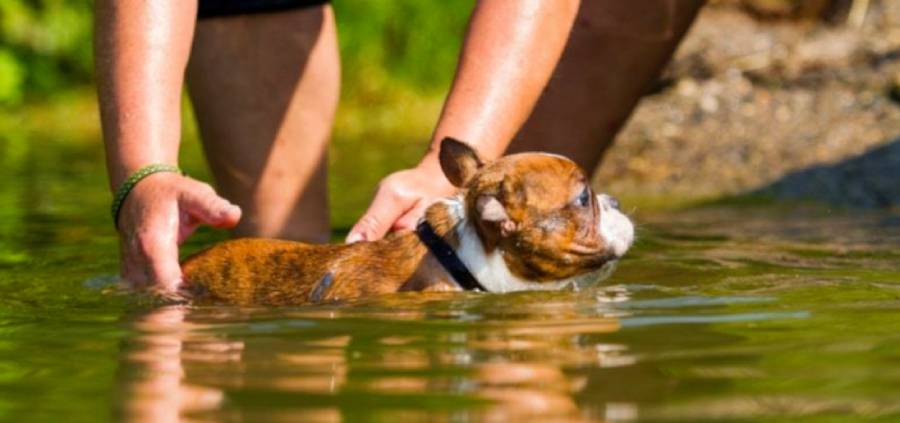
Boston Terriers can enjoy water, but their preference varies from one dog to another. Some Boston Terriers happily splash in shallow water, play with sprinklers, or enter a pool, while others hesitate around water or avoid it entirely. A dog that enjoys getting wet also does not necessarily enjoy swimming.
Boston Terriers are not naturally strong swimmers compared with breeds developed for retrieving or working in water. Their compact body and brachycephalic, or short-muzzled, facial structure can make swimming more physically demanding. As a result, a Boston Terrier that willingly enters the water can still become tired or struggle to keep a comfortable position while swimming.
Owners should therefore consider water preference and swimming ability separately. A Boston Terrier can enjoy supervised water activities without needing to swim in deep water, while dogs that do swim need appropriate supervision and an easy way to leave the water. This article explains whether Boston Terriers like water, how well they can swim, what affects their swimming ability, and how to keep them safe in pools, lakes, oceans, and other water environments.
Do Boston Terriers Like Water?
Boston Terriers can like water, but their preference depends more on the individual dog than on the breed as a whole. Some Boston Terriers willingly walk into shallow water, chase water from a sprinkler, or play around a pool, while others avoid getting wet. This variation means owners should judge their dog by its behavior rather than assume every Boston Terrier will react to water in the same way.
A Boston Terrier’s previous experience with water can influence how comfortable it feels around it. Positive, controlled exposure gives the dog an opportunity to investigate water without being forced into an unfamiliar situation. In contrast, an unpleasant experience, such as unexpectedly falling into deep water, being sprayed forcefully, or losing footing on a slippery surface, can create hesitation during later encounters. Individual temperament also matters because confident dogs may investigate unfamiliar environments more readily than cautious dogs.
Liking water can also mean different things. A Boston Terrier may enjoy standing in shallow water without wanting to swim, while another may enjoy chasing a hose but dislike being placed in a bathtub. Owners can identify a positive response by observing voluntary behaviors such as approaching the water, returning to it after moving away, playing near it, or entering shallow water without encouragement. Repeated attempts to escape, freezing, backing away, or refusing to approach indicate that the dog is uncomfortable rather than enjoying the experience.
For this reason, water preference should be evaluated by voluntary behavior rather than by whether a Boston Terrier tolerates being wet. A dog that remains in a pool after being placed there is not necessarily enjoying it. Allowing the dog to choose whether to approach the water provides a clearer indication of its actual preference.
Do Boston Terriers Like to Swim?
Some Boston Terriers enjoy swimming, but liking water does not automatically mean they like swimming. Swimming requires a dog to support its body in deeper water and paddle continuously, making it different from walking through shallow water or playing with a sprinkler. A Boston Terrier may therefore show enthusiasm around water while avoiding situations where its feet cannot touch the ground.
The distinction is important because enjoyment and swimming ability are separate characteristics. A Boston Terrier may voluntarily enter deeper water because it wants to follow its owner or retrieve a toy, yet still have difficulty maintaining an efficient swimming position. Conversely, a dog that is physically capable of paddling may simply prefer staying on dry land. Owners should not interpret either behavior as unusual because individual preference remains an important factor.
A Boston Terrier that enjoys swimming will generally enter suitable water voluntarily and continue moving without obvious panic or repeated attempts to escape. The dog may also return to the water after leaving it. These behaviors provide stronger evidence of enjoyment than simply paddling after being placed in water, since paddling is also an instinctive response a dog may use to reach safety.
Owners should therefore let a Boston Terrier determine whether swimming is an activity it enjoys rather than forcing repeated exposure. Even when a dog actively seeks out water, enthusiasm alone does not establish that it is a strong swimmer. Boston Terriers have physical characteristics that can make swimming more demanding, so swimming ability and water safety need to be considered separately from preference.
Are Boston Terriers Good Swimmers?
Boston Terriers can swim, but they should not be considered naturally strong swimmers. Their ability varies by individual dog, and being able to paddle does not mean a Boston Terrier can swim efficiently or remain safe in deep water for extended periods. Owners should distinguish between three different abilities: entering water willingly, staying afloat and paddling, and swimming comfortably without becoming exhausted.
A Boston Terrier’s body structure can make swimming more demanding. Swimming requires a dog to keep its nose and mouth above the surface while its legs generate enough movement to support and propel the body. Boston Terriers have compact, muscular bodies rather than the physical characteristics associated with breeds traditionally developed for prolonged water work. An individual Boston Terrier may still swim effectively, but owners should not assume that its breed provides a natural advantage in the water.
The Boston Terrier is also a brachycephalic breed, meaning it has a relatively short muzzle and shortened skull shape. This characteristic matters during swimming because the dog needs to maintain access to air while simultaneously paddling. Exercise also increases respiratory demand. A Boston Terrier that is already working harder to breathe during physical activity may therefore find continuous swimming more demanding than simply walking or playing in shallow water.
Fatigue creates an additional concern because a dog cannot stop paddling and stand normally when it is in water deeper than its legs. A Boston Terrier that swims comfortably at first can become less coordinated as it gets tired. Water temperature, depth, waves, currents, physical condition, age, and the distance to an exit can further change how demanding a swimming session becomes. This is why there is no single safe swimming duration that applies to every Boston Terrier.
Owners should evaluate the dog continuously rather than rely on a fixed number of minutes. A Boston Terrier should be removed from the water before fatigue begins to interfere with its breathing, body position, or ability to reach an exit. Short swimming sessions with rest periods provide more control than allowing the dog to remain in deep water until it decides to stop.
Swimming ability can also change throughout a Boston Terrier’s life. A young, physically fit adult may handle controlled swimming differently from a puppy, senior dog, overweight dog, or dog with an existing respiratory or mobility problem. Previous swimming experience can improve confidence and coordination, but experience does not remove the physical demands of staying afloat.
For these reasons, a Boston Terrier that can swim should not automatically be treated as a good or independent swimmer. The safest approach is to match the activity to the individual dog, keep swimming sessions controlled, provide an accessible way out of the water, and remain close enough to intervene immediately. These precautions become especially important in deep water and environments where the dog cannot simply stand up when it becomes tired.
Is Swimming Safe for Boston Terriers?
Swimming can be safe for Boston Terriers when the activity is supervised, controlled, and matched to the individual dog’s swimming ability. The main concern is not whether a Boston Terrier can paddle, but whether it can maintain a stable position, breathe comfortably, and reach an exit before becoming tired. Deep water, long swimming sessions, difficult exits, and unsupervised access increase the consequences if the dog begins to struggle.
Direct supervision is important because a Boston Terrier’s condition can change while it is swimming. A dog may enter the water enthusiastically and initially paddle without difficulty, then become tired as continuous movement increases physical and respiratory demand. Owners should remain close enough to remove the dog immediately rather than supervise from a distance. Pools should also have an obvious exit, such as accessible steps or a dog-friendly ramp, so the dog does not have to continue swimming while searching for a way out.
Changes in breathing, movement, and body position are key signs that a Boston Terrier is struggling in water. Warning signs include increasingly frantic paddling, difficulty keeping the face above the surface, repeated attempts to reach an exit, loss of coordinated movement, visible exhaustion, or panic. A dog showing these signs should be removed from the water immediately. Owners should not wait to see whether the dog can recover while continuing to swim.
Water conditions also determine how safe an activity is. Shallow, calm water with an easy exit provides a more controlled environment than deep water with waves or currents. Cold water can increase physical stress, while rough water requires the dog to work harder to maintain its position. Even a Boston Terrier that swims comfortably in a backyard pool should not automatically be expected to perform equally well in a lake or ocean.
The safest approach is therefore to keep swimming sessions short, provide regular opportunities to rest, and end the activity before the dog becomes exhausted. A Boston Terrier should never be forced to remain in the water to improve its swimming ability. Controlled exposure allows owners to observe the dog’s limits without creating unnecessary risk.
Should Boston Terriers Wear Life Jackets?
Boston Terriers should wear a properly fitted dog life jacket when swimming in deep water or environments where reaching safety may be difficult. A life jacket adds buoyancy and can help the dog maintain a more stable position in the water. It is particularly useful around boats, lakes, beaches, deep pools, and other locations where the dog cannot immediately place its feet on the bottom.
A suitable life jacket should fit securely without restricting normal movement or breathing. The flotation material should support the dog’s body, while a sturdy handle on the back allows an owner to lift or assist the dog when necessary. A brightly colored jacket can also make a Boston Terrier easier to locate in open water.
A life jacket does not make swimming risk-free. Flotation equipment supports a Boston Terrier in the water but does not replace direct supervision. A dog can still become tired, frightened, caught in a current, or unable to find an exit while wearing one. Owners should therefore treat the jacket as an additional safety measure rather than permission to leave the dog unattended.
Boston Terriers that only play in very shallow water where they can comfortably stand may not require flotation equipment for every interaction. The need increases as water becomes deeper, exits become less accessible, or environmental conditions become less predictable. The decision should be based on the individual dog and the water environment rather than on swimming confidence alone.
Can Boston Terriers Swim in Pools?
Boston Terriers can swim in pools, but they need direct supervision, an accessible exit, and swimming conditions appropriate for their ability. A pool provides a more controlled environment than most natural bodies of water because owners can manage access, depth, and swimming duration. However, the smooth sides and deep water of a pool can become dangerous when a dog cannot locate or reach the exit.
Teaching a Boston Terrier where to leave the pool is one of the most important safety measures. Dogs do not automatically understand that pool steps or a ramp provide the only practical exit, especially after entering from another side. Owners can introduce the exit from the water at close range and repeat the process until the dog consistently moves toward it. A dog-friendly ramp can provide an easier exit when conventional pool steps are difficult for the dog to use.
Pool access should also be controlled when nobody is supervising the dog. A Boston Terrier that voluntarily enters a pool may be unable to climb out after becoming tired. Physical barriers around the pool can prevent unsupervised entry, while a life jacket provides additional buoyancy during planned swimming sessions. Neither measure replaces the need for an owner to remain close while the dog is in the water.
Pool water introduces additional considerations beyond swimming ability. A Boston Terrier may swallow small amounts of water while swimming or retrieving toys, but owners should discourage deliberate drinking from the pool. Fresh drinking water should be available nearby so the dog does not rely on pool water when thirsty. After swimming, rinsing the coat and skin with fresh water can also remove residual pool chemicals.
Owners should keep initial pool sessions short and use shallow or easily accessible areas whenever possible. A Boston Terrier should learn how to enter and exit a pool before being allowed to swim farther from the edge. This approach allows the dog to build familiarity with the environment while giving the owner a clearer picture of its swimming ability and endurance.
Can Boston Terriers Swim in Lakes and the Ocean?
Boston Terriers can enter lakes and the ocean, but natural bodies of water present more unpredictable risks than a controlled swimming pool. Currents, waves, changing depth, water temperature, underwater obstacles, and distance from shore can increase the amount of effort required to stay afloat. A Boston Terrier that handles a pool comfortably may therefore struggle under different outdoor conditions.
Lake conditions can change within a short distance. A Boston Terrier may begin walking through shallow water and suddenly reach an area where the bottom drops away, forcing it to swim. Rocks, branches, vegetation, mud, and other submerged obstacles can also interfere with movement. Owners should select calm, accessible areas and keep the dog close rather than allowing it to swim far from shore.
Ocean swimming adds waves and currents to these risks. A Boston Terrier should not be allowed to swim into rough surf or strong currents. Waves can make it harder for a small dog to keep its face clear of the water, while a current can increase the distance and effort required to return to shore. Even a dog that appears confident may become exhausted when it has to paddle continuously against moving water.
Water temperature also affects the suitability of lakes and oceans for swimming. Cold water can make an outdoor swimming session more physically demanding, while hot weather can encourage a dog to remain active longer than it should. Owners should monitor both environmental conditions and the individual Boston Terrier instead of assuming that visible enthusiasm means the dog can continue safely.
Natural water can also contain environmental hazards that are absent from a maintained pool. Water quality can vary by location and season, and dogs may encounter wildlife, sharp objects, contaminated water, or other hazards along the shoreline. Owners should follow local warnings and prevent their Boston Terrier from drinking large quantities of lake or seawater.
For lakes and ocean environments, a properly fitted dog life jacket and close supervision provide an additional safety margin for Boston Terriers. The dog should remain close enough for the owner to intervene immediately, and every swimming session should include a clear, easily accessible route back to land. The objective is not to determine how far the dog can swim, but to let it enjoy the water without exceeding its physical ability.
Why Is My Boston Terrier Afraid of Water?
A Boston Terrier may be afraid of water because of limited exposure, a previous negative experience, unstable footing, unexpected water depth, or individual temperament. Fear does not necessarily mean something is wrong with the dog. Water introduces unfamiliar sensations, including changes in footing, temperature, sound, movement, and body support, so a cautious Boston Terrier may need time to determine whether the environment is safe.
Limited exposure is one possible reason for hesitation. A Boston Terrier that has spent little time around pools, lakes, baths, or other water environments may react cautiously during its first encounters. Entering water also changes how the ground feels beneath the dog’s feet. A slippery pool step, moving sand, muddy lake bottom, or sudden drop in depth can make an unfamiliar environment more difficult to navigate.
A negative experience can create a stronger avoidance response. Falling unexpectedly into a pool, being forced into deep water, being sprayed directly with a hose, or struggling to find an exit can associate water with discomfort or panic. Repeatedly forcing the dog back into the same situation can reinforce that response instead of teaching it to enjoy water.
Owners can recognize discomfort through behavior rather than assuming that every refusal is stubbornness. Backing away, freezing, repeatedly attempting to leave, resisting an approach to the water, or showing panic after entering are signs that the Boston Terrier is not comfortable with the situation. The appropriate response is to reduce the difficulty of the interaction rather than push the dog farther into the water.
Fear of water should also be distinguished from a simple lack of interest in swimming. A Boston Terrier may comfortably walk beside a pool or stand in shallow water but choose not to swim. That dog is not necessarily afraid of water; swimming may simply not be an activity it enjoys. Owners do not need to teach every Boston Terrier to love swimming when other forms of exercise and water play suit the dog better.
How Do You Introduce a Boston Terrier to Water?
Introduce a Boston Terrier to water gradually by starting in a controlled, shallow environment and allowing the dog to approach voluntarily. The objective is to create a positive association with water before increasing depth or introducing swimming. A Boston Terrier should never begin its water experience by being thrown, dropped, or pushed into deep water.
Start with water shallow enough for the dog to stand comfortably. Allow the Boston Terrier to investigate the edge, walk through the water, or step away without restraint. Toys, treats, praise, or interaction with the owner can reinforce calm voluntary approaches. Rewarding the dog after it chooses to approach the water helps connect the experience with a positive outcome without requiring it to enter farther than it wants.
Increase exposure only after the Boston Terrier remains relaxed at the previous level. For example, a dog can progress from approaching the water to getting its paws wet, standing in shallow water, moving through slightly deeper water, and eventually paddling for a short distance. Progress should depend on the dog’s behavior rather than on completing every stage during a single session. A Boston Terrier that becomes hesitant should return to a depth or activity where it remains comfortable.
The same gradual process applies to puppies. Early exposure can help a Boston Terrier puppy become familiar with water, but the goal should be confidence rather than immediate swimming performance. Shallow water, secure footing, short sessions, and positive reinforcement provide a controlled introduction. A puppy should be able to leave the water whenever it chooses.
Owners should also avoid pulling a reluctant Boston Terrier into water with a leash. A leash can help maintain control around a water environment, but it should not be used to overcome the dog’s resistance by force. If the dog refuses to enter, reduce the challenge by increasing its distance from the water, using a shallower area, or ending the session and trying again later.
Once a Boston Terrier voluntarily enters deeper water, supervision becomes more important. Stay close enough to provide immediate assistance and make the exit easy to identify. A properly fitted life jacket can provide additional buoyancy when the dog progresses to swimming, particularly in water where its feet cannot reach the bottom.
Successful water introduction does not require a Boston Terrier to become an enthusiastic swimmer. The practical goal is for the dog to remain calm and manageable around water while owners understand its individual limits. Some Boston Terriers may eventually enjoy swimming, while others may continue to prefer shallow-water play, and both responses can be accommodated safely.
Read more: Do Boston Terriers Like to Cuddle?
Do Boston Terriers Like Baths?
Some Boston Terriers tolerate or enjoy baths, while others dislike bathing even when they are comfortable playing in water. Swimming, water play, and bathing are different experiences for a dog. A Boston Terrier that voluntarily enters a shallow pool may still resist a bath because bathing involves handling, running water, confined space, and less control over when it can leave.
The bathing environment can influence a Boston Terrier’s response. A slippery bathtub or shower floor can make the dog feel unstable, while water sprayed directly toward the face can cause discomfort. Water temperature, unfamiliar sounds, restraint, and previous bathing experiences can also affect behavior. Providing secure footing with a non-slip mat and using comfortably warm water can make the environment easier for the dog to navigate.
Owners should introduce bathing gradually when a Boston Terrier shows hesitation. Allowing the dog to become comfortable in an empty tub before adding water can separate fear of the bathing environment from fear of water itself. Calm handling and positive reinforcement can then be added as the dog becomes accustomed to having its paws and body wet.
Disliking baths does not prove that a Boston Terrier dislikes water in general. A dog may enjoy a sprinkler or shallow pool because it controls its own movement but resist bathing because the owner controls the experience. Owners should evaluate each situation separately rather than using bath behavior to predict whether their Boston Terrier will enjoy swimming.
What Water Activities Are Suitable for Boston Terriers?
Suitable water activities for Boston Terriers include shallow-water play, sprinkler play, supervised paddling, and short controlled swimming sessions. The appropriate activity depends on the individual dog’s interest, physical ability, confidence, and the conditions of the water environment. Swimming is only one form of water activity and is not necessary for a Boston Terrier to enjoy water.
Shallow-water play is a suitable starting point because the Boston Terrier can keep its feet on the ground while exploring the water. A shallow dog pool can provide this type of environment when the water level allows the dog to stand comfortably and leave without assistance. Toys can be added to encourage voluntary interaction, but the dog should always have the option to move away.
Sprinklers and gentle water games provide another option for Boston Terriers that enjoy water but do not want to swim. These activities allow the dog to chase, investigate, or move through water while remaining on solid ground. Owners should avoid directing high-pressure water toward the dog’s face and should stop the activity when the dog attempts to move away.
Supervised paddling can be introduced when a Boston Terrier is comfortable in shallow water and shows an interest in moving into greater depth. The transition should be gradual, with the owner remaining close enough to provide support. The dog should also have a clear route back to an area where it can stand.
Controlled swimming is appropriate for Boston Terriers that voluntarily enter deeper water and can paddle without signs of distress. Sessions should remain short, with regular opportunities to leave the water and rest. A dog life jacket provides additional buoyancy in deeper water, but the owner still needs to supervise the dog directly.
The best water activity is one that matches the individual Boston Terrier rather than forcing the dog to meet a breed-based expectation. A Boston Terrier that happily plays in ankle-deep water does not need to progress to deep swimming. Likewise, a dog that enjoys controlled swimming can participate while appropriate safety measures remain in place.
Owners should use four factors when choosing an activity: water preference, physical ability, environmental conditions, and supervision requirements. Matching these factors allows a Boston Terrier to interact with water at a level suited to its individual limits. For some dogs, that means swimming; for others, a shallow pool or sprinkler provides a safer and more enjoyable experience.
1 thought on “Do Boston Terriers Like Water? Swimming & Safety”